
Everyday cancellation in publishing
The costs and legal risks of discrimination against gender-critical staff and authors
By Matilda Gosling for Sex Matters and SEEN in Publishing

Endorsements
“An astonishing report that lays bare how a once open-minded publishing world has allowed a minority of activists to bully it into so far abandoning its core principles that it has begun to work, not only against its own ethos, but also against its own interests.”
Anne Fine OBE, author and second Children’s Laureate
“This is vital, disturbing research. For years, publishing has been collectively culpable of purveying an ideology that contravenes biological fact – something that’s particularly concerning in children’s publishing, where the industry has colluded in making rejection of the most fundamental aspect of any human body into an exciting adventure that’s bouncy and bright and cute and fun. This report gives the publishing industry a clear roadmap back to lawful workplace policies and creative, even unorthodox commissioning. Leaders in publishing must take note.”
Lionel Shriver, author
“The publishing industry’s reputation as one of the last precious havens of thought, speech, debate and critique has been all but demolished this past decade, thanks to an ideological status quo which has thrived on a collective silencing of women’s legally protected sex-based rights and realities. It’s difficult to fathom the long-term impacts of unending abuses, bullying, gaslighting, ghosting and strategic cancellations – both public and private – of any woman within publishing who dares to publicly resist the demolition of women’s existence as a sex, and of children’s safeguarding. But we begin with these findings and these testimonies. This is the first investigative report into the impact and tactics of a cancel culture that so many within the industry will deny even exists. It’s time for everyone to sit down now, and listen.”
Onjali Raúf MBE, author
“When history looks back on the epidemic of collective lunacy that was the trans cult, special odium will attach to psychiatrists, counsellors and teachers who warped the minds, and surgeons who mutilated the bodies, of vulnerable people in their care, especially children. But lesser culprits will not escape blame, and high on the list will be publishers who, contrary to their normal editorial judgment, censored or even cancelled brave authors critical of the cult. Authors who asserted scientific truth in the teeth of fashionable ideology. Authors who stood up for real women, or stood up to the bullies who sought to intimidate them. I know many publishers, and I hear multiple stories of relentless pressure from junior colleagues, and of abject capitulation to it. But anecdotes demand proper substantiation, and this splendid document provides it in spades. Books accepted for publication are subsequently cancelled; books that would normally be accepted are turned down; authors who survive the gauntlet to publication find themselves mysteriously shut out of literary festivals and the media, even when their sales figures are high. The evidence is overwhelming and compelling, and this report leaves the reader in no doubt. I hope it will be widely read and discussed throughout the book industry, and I expect it to be a major influence in the coming turn of the tide.”
Richard Dawkins FRS, author and Emeritus Professor of the Public Understanding of Science, University of Oxford
“This report depressingly shows how censorship and abuse has been adopted, quite incredibly, as the weapon of choice by some activists in publishing. While too many of those who should know better have simply gone along with it. Story after story in the report shows how the industry has turned those who don’t toe one ideological line into heretics. No need to burn their books, they just don’t publish them. All to the detriment of good reads, challenging ideas and the very purpose of books and writing. Let’s hope the report is the chequered flag at the finish line of this shameful period in publishing.”
Simon Fanshawe OBE, author and diversity specialist
“Freedom of expression should be the cornerstone of publishing. But this important report lays bare the extent to which freedom of expression – particularly for female authors and employees – has been undermined in relation to gender and sex in the publishing industry, and how it’s been to the detriment of everyone, imposing significant personal costs on women who’ve dared challenge gender identity belief systems, but also compromising the plurality that’s so important to the arts and publishing in a liberal democracy.”
Sonia Sodha, columnist, author and broadcaster
“The report details so many instances of unlawful behaviour, and outrageous overreach after injustice after plain stupid cruelty. This pattern of bullying people into acquiescence has to be acknowledged. It’s there right across the creative industries, where gender ideology trumps freedom of thought and free expression every time. This report is a welcome first step in disrupting the monoculture that has taken over the publishing world.”
Sonya Douglas, artist, author and poet
Acknowledgements
Sex Matters, SEEN in Publishing and Matilda Gosling are grateful to the interviewees who contributed their time, experiences and thoughts to this research; to the many other people within the industry who provided ideas, connections and background information; to equality-law specialist Peter Daly of Doyle Clayton Solicitors for checking the legal content of this report; and to the donors who made the research possible. The author Jane Harris came up with the concept for the research, liaised with representatives from SEEN in Publishing to get it off the ground, and did endless work behind the scenes to find funding and gather information. We owe her our particular thanks.
Introduction
This report outlines how gender-identity beliefs have affected the general environment in publishing, including relevant policies, training and language; how the resulting culture feeds into commissioning decisions, sales and marketing, unlawful treatment and abuse of individuals who hold gender-critical views; and the impact of this environment and resulting culture on individuals and the broader industry. It concludes with recommendations on how to ensure lawful treatment of individuals, support free speech at all levels, and build a rich, pluralistic and financially viable working culture.
Language used in this report
“Sex” refers to biological sex.
The words “women” and “men” refer to adult human females and adult human males. Occasionally the word “transwoman” is used in interviewee quotes; this refers to men who identify as women.
The term gender is ambiguous, as it can be defined in at least three different ways: as a synonym for sex, as gender identity, or as the social roles assigned to men and women. Its multiple definitions limit its usefulness as a concept.
Gender identity has no basis in law (the protected characteristic is “gender reassignment”) but is defined by those who believe in it as a person’s inner sense of gender – whether they feel like a man, a woman or something else.
“Gender-identity beliefs” are used to refer to the belief system that everyone holds a gender identity that may vary from their sex, with downstream implications that include a belief that men can self-identify into female-only spaces and that children can be born into the wrong body. “Gender-identity ideology” and “gender ideology” are used in some direct quotations from interviewees.
Gender-identity beliefs represent the view that everyone has an internal sense of gender that may vary from their sex. People with gender-critical views, who constitute the majority of the British population, believe that there are two sexes, and that nobody can change sex. UK equality law reflects this position, as clarified by the Supreme Court of the United Kingdom in April 2025. The law also protects people from unlawful discrimination on the basis of their gender-critical beliefs.
“Gender critical” has been used as shorthand for people who critique gender-identity ideology. They hold a range of views linked to the idea that sex is biological, binary and immutable, and that it matters in life and law. UK equality law reflects this position, as clarified by the Supreme Court of the United Kingdom in April 2025. Not everybody interviewed for this report would use this term; some might prefer “sex realist” or “gender sceptical”, while others might not attach any label, since these views are mainstream. “Gender critical” has been selected as it is the term used in the Forstater ruling that affords legal protection against unlawful discrimination to those who hold these beliefs.
The research
This research investigates the working environment for authors, agents and publishing staff who believe that sex is binary and immutable, and that it matters in life and law. It was commissioned to investigate widespread but anecdotal reports that publishing has become a hostile environment for people who hold gender-critical beliefs.
The report is based on interviews with 25 people working in publishing, consisting of 10 authors, 10 current or former employees of publishing companies, two agents, a funder, a festival director and a representative of SEEN in Publishing.1 Most of the interviewees chose to be anonymous to avoid harm to their careers, wellbeing or safety.2 Seven of the 25 interviewees chose to be named. Gillian Philip is a former children’s author, Jenny Lindsay and Magi Gibson are poets and authors, Matthew Hamilton is an agent, Rachel Rooney is a former children’s author and poet, Sibyl Ruth is a former editor and Ursula Doyle is the former publisher at Hachette’s imprint Fleet.
A review of publicly available policies and statements, a social-media review and an analysis of published books also informed the report. Further information was sourced through individual requests. 30 organisations were assessed in detail as part of this research: 21 publishers, three agencies, the Society of Authors, the Publishers Association, Publishing Scotland, the Society of Young Publishers, Arts Council England and Creative Scotland. Full details of the research approach are outlined in the annex.
Highlights
Publishers have made poor commercial decisions guided by ideology, not markets. There is a vast gulf between books commissioned on gender-identity beliefs and what actually sells: the analysis done for this report on trade non-fiction books shows that the average book about women sells seven times more copies than the average book based on gender-identity beliefs. Gender-critical books sell, on average, nine times more. Commissioning editors have run scared of bold, brave, interesting books that reflect a diversity of ideas and that readers want, and instead commissioned books that fit the beliefs of their junior staff.
Helen Joyce received a £20,000 advance for her book Trans: When Ideology Meets Reality, which went on to sell over 23,000 physical copies in the UK and over 100,000 internationally. Munroe Bergdorf, by contrast, received a six-figure sum for Transitional, which sold fewer than 3,000 copies in the UK.
Abuse of those with gender-critical views in publishing has been relentless. People – usually women – have received death and rape threats. Others in the industry have threatened them with reputational damage and loss of work, have used slurs and insults against them, and conflated their views with transphobia, homophobia, racism and other forms of bigotry. Gender-critical individuals working in publishing have been accused of wanting the deaths of trans-identifying teenagers and working towards genocide. There have been industry calls for those with gender-critical beliefs to be demonised, and they have been labelled as fascists for thinking that there are two sexes.
In 2020, the former children’s author Gillian Philip added the hashtag #IStandWithJKRowling to her Twitter (now X) profile. She was then subjected to an extreme 24-hour social-media pile-on that included death threats. Philip’s contract was immediately terminated by her publisher with the tacit support of her agent.
Mainstream media outlets have compounded the problem. Coverage of published books was perceived by our interviewees to be biased towards those based on gender-identity beliefs. It is notable that gender-critical books have sold so well despite this apparent bias – analysis conducted for this research shows that in non-fiction, the average gender-critical book sells 10,000 more copies than the average book based on gender-identity beliefs.
Journalists on BBC Radio 4’s flagship women’s-affairs programme Woman’s Hour have not interviewed best-selling gender-critical authors about their books, despite the issues they cover being so relevant to women. By contrast male gender-studies academic Grace Lavery has been interviewed, despite selling only 1,723 copies of Please Miss – A Heartbreaking Work of Staggering Penis. So has Juno Dawson, a male transactivist who also identifies as a woman. Dawson has depicted womanhood as a submissive sexual identity: “I knew I wanted to be ‘the woman’ when it came to sex… It was a conscious urge to get fucked, be penetrated as a woman would be.” It is surprising that somebody with such a perspective, which arguably undermines the position of women in society, has been platformed on a programme about women instead of authors who argue for women’s rights.
There has been huge bias not only in commissioning, but also in which books receive publicity and which authors are platformed. Some interviewees perceive investment in publicity to be lower in some publishing houses for books and authors that reject gender-identity beliefs. Venues have sometimes refused to allow gender-critical authors and others in the publishing world to speak. When they have received a platform, gender-critical speakers have often been subjected to relentless attempts by transactivists to deplatform them. These attempts have sometimes been successful.
In 2023, protestors at the Edinburgh launch of Sex and Gender: A Contemporary Reader physically attempted to prevent people entering the venue and shouted “Shame on you!” at those who did so.
Several authors withdrew from the 2025 Oxford Literary Festival after an announcement that Helen Joyce would be discussing her book Trans: When Ideology Meets Reality with fellow gender-critical author Julie Bindel. Joyce and Bindel’s event was the only session to sell out, and it did so within 24 hours. A separate event featuring the philosopher and author Constantine Sandis, organised after he said that he would not share a stage with Joyce, reportedly sold fewer than 100 tickets.
Another author was invited to chair a literary event. The invitation was later rescinded. A subsequent subject access request revealed that a publicist from her own publisher had contacted the event organisers to demand her removal due to her supposedly “anti-trans” views.
Women in publishing have found themselves at the sharp end of this belief system. They appear more likely to be publicly gender-critical. Being asked to state pronouns in email signatures or to use “inclusive” language that ignores female realities can make some women feel that they are being required to align with a belief system with which they fundamentally disagree.
Policies about women in publishing often fail to centre actual women. One publisher’s menopause policy is “inclusive of all gender identities including trans and non-binary employees”. Another targets everyone, “whether you’re a cis woman, a trans man, intersex or non-binary”. Women have occasionally been dehumanised: one publisher put out a journal paper entitled “Trans women, cis women, alien women, and robot women are women: they are all (simply) adults gendered female”.
Gender-critical lesbians and gay men working in publishing lack staff groups that advocate for their needs and rights based on their same-sex orientation. People who are same-sex attracted have been told that heterosexual men identifying as women are lesbian, and that heterosexual women identifying as men are gay. Lesbian, gay and bisexual members of staff who perceive a conflict between their own rights and what are presented as trans rights have no representation in publishing houses. No staff networks were identified that focus exclusively on LGB issues or that represent the views of those lesbians and gay men who do not believe that members of the opposite sex can self-identify into their dating pool.
Employment law and other relevant legislation are frequently contravened by publishing houses. Examples of potentially unlawful behaviour include:
- Equality, diversity and inclusion (EDI) policies that fail to consider the protected characteristics of sex and religion or belief, while focusing on gender identity (which is not a protected characteristic) or the poorly defined concept of “gender”. Of the 30 organisations reviewed for this research, only four correctly cite the protected characteristics of sex and gender reassignment across their publicly listed policies. There is a wider failure to balance the needs and rights of all employees and workers, focusing only on those who have the protected characteristic of gender reassignment and ignoring those with other protected characteristics.
- Allowing trans-identifying staff to use toilets that align with their gender identity, not their sex. This breaches the legal requirement to provide single-sex toilets in the workplace and turns single-sex spaces into mixed-sex spaces.
- Surveys that conflate sex and gender identity, rendering the data meaningless. This also means that there is no obviously lawful purpose for its collection under the General Data Protection Regulation (GDPR).
- Failure to sanction abusive social-media posts by employees against other members of staff, from accounts that clearly link to their place of employment. This sometimes contrasts with draconian and unlawful sanction against staff whose social-media output challenges gender-identity beliefs.
One publisher’s trans-inclusion policy, for example, mandates the use of trans-identified colleagues’ pronouns, suggesting that mistakes are corrected and that repeated failure to use chosen pronouns may be “regarded as harassment” and dealt with accordingly. This may represent unlawful discrimination against employees who hold gender-critical beliefs and who do not feel comfortable manifesting the belief that a person can become a woman or man (or neither) through a process of self-identification. Staff at another company were told that they may need to use different pronouns depending on the day or week: a colleague might be he/him on a Monday and they/them on a Thursday.
Funders, literary venues and representative bodies also appear to be acting unlawfully in some cases.
Training and advice in the sector has been exceptionally poor. One person was informed that an employer could not find a trainer who could deliver accurate equality-law training. A creative industries organisation incorrectly names the Act of Parliament on which it trains people, calling it the “Equalities Act”. The Publishers Association has based its data-collection guidance on Stonewall advice, which states that sex and gender are the same thing, that gender and gender identity are the same thing and that data on sex should not be collected.
A criticism of SEEN in Publishing, a sex equality and equity network for publishing professionals, was that its organisers chose to remain anonymous, but reactions from the industry – including naming it a “vile TERF publishing group” (commissioning editor) and a “nasty, anonymous, hate-filled little network” (editor), and telling its members to “get fucked” (publisher) – show why it has been necessary for them to do so. “I was really scared,” said a representative of SEEN in Publishing of her decision not to reveal her identity. She pointed out that most of the abuse directed online at the network had been sent from social-media accounts that were linked to their employers in the publishing industry. It is striking that calling people disgusting, nasty bigots can be done in full daylight, while joining a network that believes in the material reality of sex requires secrecy to protect those joining it from the perpetrators of this open abuse.
The promotion of gender-identity beliefs in children’s publishing is widespread and its ramifications are serious. Children who identify as trans are more likely than other children to have underlying vulnerabilities such as autism, poor mental health, a history of abuse or having grown up in care. They are several times more likely to grow up to be lesbian, gay or bisexual. They need support to feel comfortable in their bodies. Children’s books, on the other hand, paint a shiny, sparkly world of trans identities that supposedly fix deep-seated underlying challenges, resolve bodily hatred and create enduring joy in the form of “trans euphoria”.
These publications are steeped in stereotypes. The blurb for the book I Am Jazz, for example, reads:
“From the time she was two years old, Jazz knew that she had a girl’s brain in a boy’s body. She loved pink and dressing up as a mermaid and didn’t feel like herself in boy’s clothing. This confused her family, until they took her to a doctor who said that Jazz was transgender and that she was born that way.”
Jazz Jennings is now an adult who has had several transition-related surgeries and experienced post-surgical complications, as well as many other health issues.
The impact of this hostile environment and the harms it has caused to those in the industry who hold gender-critical beliefs has been immeasurable. Interviewees mentioned stress and poor mental health, fears for their own safety and the safety of their families, physical ill-health and financial catastrophe. Loss of work has been the biggest professional impact.
One person was affected so badly she felt suicidal. Other examples of health effects include stress-related illnesses, panic attacks and symptoms such as high blood pressure. One interviewee experienced migraines so severe she had to lie on the floor at work, vomiting into a bucket.
Several of the named interviewees in this research have lost book and employment contracts, speaking engagements and other means of generating income. Rachel Rooney stopped writing after two and a half years of cross-industry bullying, much of which took place online. Jenny Lindsay lost clients, speaking engagements and other works after her hounding. In May 2025, Ursula Doyle reached a settlement in her case against her former employer, Hachette, for discrimination on the grounds of her gender-critical beliefs. Gillian Philip was fired after she was swarmed on social media. Sibyl Ruth’s contract as an editor was effectively terminated after she posted online about her lawfully held beliefs.
These losses are cumulative, as people who are seen as industry disruptors or troublemakers are less likely to get work in the future.
Overview
Key findings
Gender-identity beliefs have become dominant in publishing, and the silencing of opposing views has created a false impression that few people disagree with them. This belief system has created a working environment that has throttled plural perspectives and truly diverse commissioning. Discrimination towards and harassment of gender-critical staff, authors and agents have had tangible, negative effects on people’s health, safety and livelihoods.
The resulting chilling effect and legal, financial and reputational harms can be reversed with lawful policies and a commitment to diversity of thought.
The environment in publishing
HR and EDI policies: the diversity, inclusion, discrimination and harassment policies of organisations within the publishing industry frequently signal inclusion and protection on the basis of gender and gender identity, ignoring sex-based rights.
Some organisational policies omit any consideration of the need to ensure protection from unlawful discrimination on the basis of protected philosophical belief. More broadly, there is a lack of regard to the Equality Act 2010 in published organisational policies and reports.
The trans-inclusion policies reviewed for this research contravene UK law by allowing self-identification into purportedly single-sex spaces. They potentially cause unlawful discrimination against gender-critical staff in publishing by compelling them to use terminology with which they disagree, as well as unlawful discrimination against lesbian, gay and bisexual staff and against those who have protected religious beliefs.
“I raised concerns about some of the content. They didn’t respond. I wasn’t included in any more emails or given any more drafts of the policy. I was stonewalled.” Publishing employee
Editorial and free-speech policies: editorial documents such as style guides often use a gender-identity lens. Language that erases women is common. Organisations have made limited public commitments, so far, to freedom of speech or expression.
“Avoid assuming someone’s gender based on their appearance or name, as some people may not identify as a man or a woman, but would instead prefer to choose their pronouns, commonly: he, she, they or ze… You should respect the way people wish to identify themselves. If you aren’t sure which pronouns to use, just ask them!” Academic publisher’s Inclusive Language Guide
There has nevertheless been more progress made on stated support for freedom of speech than on other relevant internal policy areas, such as those ensuring protections on the basis of sex and belief.
Facilities: some organisations reviewed for this research offer employees toilet provision that is not compliant with the law.
Converting accessible toilets into gender-neutral provision has significant real-world consequences for staff who have health conditions or other disabilities when there is insufficient provision to meet their needs. It is likely, in some cases, to constitute indirect sex discrimination, as the impact on women of not having accessible facilities is bigger than the impact on men.
The role of representative bodies: the industry is affected by template policies and reports put out by representative bodies such as the Publishers Association, some of which are incorrect in law. EDI policies are sometimes used to advance ideas of social justice rather than to ensure legal compliance.
Examples of good and lawful policies do, however, exist.
Data collection and analysis: there is widespread confusion in data collection and analysis – as seen, for example, in questionnaires about the characteristics of industry freelancers – when it comes to sex and gender identity. This confusion results in category overlap and missing data.
Poor industry practice on data collection and analysis has been informed by equally poor sector-wide guidance. Funders sometimes require organisations to collect and report data based on ill-defined or even meaningless categories, leading to scenarios in which, for example, staff are classified according to whether they are “male”, “female” or “other”.
“The experience of pay discrimination often arises from things like taking time off to have children. That’s about sex.” Publishing employee
There are concerns that poorly designed questions may be used to identify dissenting staff and authors.
Training and consultancy: EDI training tends to be delivered by organisations that lack a sufficiently comprehensive understanding of UK law.
“They couldn’t find anyone to deliver equality law training as the law was.” Interviewee
Staff are sometimes offered training in trans awareness or trans inclusion, but no instances were found of training that might support the needs of gender-critical staff. Gender-identity focused topics receive more attention in training than topics focused on women, and language describing women is sculpted to fit the belief system in a way that language describing men is not.
Training content is sometimes incorrect – for example, that sex is a spectrum and assigned at birth, and that puberty blockers are reversible and safe.
Internal culture: staff occasionally face disciplinary actions for their views, and authors and freelancers face loss of work.
There is a cross-sector pattern of ignoring concerns raised by gender-critical members of staff or authors. This is accompanied by a seeming inability to learn from what has gone wrong, and a tendency to blame individuals rather than looking at broader systemic problems.
Strongly held beliefs about the primacy of gender identity over sex lead some people to act in ways that would be exceptional in most other workplace scenarios. Examples include sending unsolicited abusive messages and chronicling instances of an author’s supposedly unsound beliefs.
“Despite being aware I protested Section 28 back in the 80s, I was told by [my publisher] over the years that some considered me transphobic and homophobic. I was sent screenshots of my posts as an example of wrongthink.” Rachel Rooney
A third of the 30 focus organisations of this research are publicly linked to transactivist organisations such as Stonewall, the Proud Trust, All About Trans, Gendered Intelligence and Mermaids.
There appears to be a widespread assumption across publishing that it is acceptable in the workplace to abuse and harass people who have gender-critical beliefs, and blacklists and blocklists have contributed to a hostile environment for people in the industry with gender-critical views.
Pockets of good practice exist, however, even in publishing firms that have made questionable decisions in other parts of the business.
Language: the language used by publishers about people who hold gender-critical beliefs is often inaccurate and lacks balance.
When language is designed to be inclusive of trans and non-binary identifying staff, it frequently achieves the exclusion of staff with gender-critical beliefs and women.
Staff networks, groups and unions: there are more staff networks in publishing that cover trans issues than there are staff networks dedicated to women.
Lesbian, gay and bisexual members of staff who perceive a conflict between what are advocated as being trans rights and their own rights have no representation at all.
“People assume that those groups speak for everyone, but there are a lot of gender-critical lesbians who won’t be in that group, or will be silent if they hold those views.” Funder
Staff networks have often been a key driving force in the mainstreaming of gender-identity beliefs within organisations, and networks and unions have sometimes actively worked to silence people with gender-critical views.
Public statements and campaigns: some publishers have signed up to contested political statements that contribute to an inhospitable working environment for gender-critical staff, agents and authors. Even expressing gender-critical beliefs is harmful, according to some industry commentators.
An open letter published in The Bookseller and signed anonymously by people from across the industry implied that gender-critical views should not be published. It falsely elided the expression of those views with previous victimisation of “homosexuals, Jews, disabled people, people of colour, Muslims, suffragettes, even left-handed people in our past”.
[After conflating concern about the erosion of single-sex spaces with transphobia:]
“If you are a publisher or an organisation that is aware that you are providing a platform for these fearmongering, discriminatory views to be expressed, and for that bias against a minority in society to perpetuate, then please consider very carefully why you have allowed that to happen and not acted when the matter came to light. How will your actions appear in the clear light of history?” 2021 open letter published in The Bookseller
Literary competitions and other initiatives: initiatives that would once have been targeted at women have been expanded to include writers who identify as non-binary (who are either male or female) and anyone who self-identifies as a woman (males and females).
“As a Prize which celebrates the voices of women and the experience of being a woman in all its varied forms, we are proud to include as eligible for submission full-length novels written in English by all women. In our terms and conditions, the word ‘woman’ equates to a cis woman, a transgender woman or anyone who is legally defined as a woman or of the female sex.” Statement by the Women’s Prize Chair of Trustees
Some gender-critical authors believe they have been frozen out of literary competitions. Children’s literary competitions have promoted books and authors that celebrate gender-identity beliefs.
The Society of Authors (SoA): the SoA has, in the view of many gender-critical people working in publishing, perpetuated a gender-identity belief system in the sector and failed to stand up for the interests of authors who have been subjected to abuse from transactivists.
“Don’t engage with [gender criticals], just block them.” Post liked by the SoA’s X account, 2022
Other parts of the industry: The Bookseller has, so far, failed to cover what has been happening in publishing in any great depth, and concerns have been raised that gender-critical authors may not have been reviewed or otherwise featured in the trade press on the basis of their beliefs.
“The Bookseller has largely done what most senior people in the industry have done – keep their heads down, don’t attract attention, don’t say the wrong thing and hope nobody comes for you.” Publishing leader
Other parts of the industry, including distribution, warehousing and bookselling, also appear to be part of the problem.
The chilling effect
Representation of relevant issues and book sales: the publishing industry vastly over-represents books based on gender-identity beliefs compared with books about women. The relative imbalance would matter less if it was what the market wanted, but analysis conducted for this report suggests that it is not. This shows that the average trade non-fiction book based on gender-identity beliefs sells only 14% of the copies that the average book about women sells, and only 11% compared with the average gender-critical book.
Average number of books sold by focus area

These figures suggest that the considerable overrepresentation of books based on gender-identity beliefs is driven by ideology, not markets.
Commissioning decisions: the commissioning environment underpins this contradiction between book sales and the type of book that gets published.
Commissioning editors have sometimes turned down gender-critical book proposals due to a stated dislike of their content, rather than for commercial reasons. Some responses to proposals by Kathleen Stock for Material Girls and Helen Joyce for Trans said that editors would not be able to progress the books internally. Others mentioned personal anxiety about the topic. A soft censorship also emerges from the commissioning environment.
“As an ally to the trans community I find Stock’s view deeply problematic and dangerous.” Written feedback from an editor on Kathleen Stock’s proposal for Material Girls
There is a need to recognise strengths, too: there are pockets of positive, plural commissioning in the industry.
“There was a meeting about a book on a controversial topic, not about sex and gender, and at that meeting, there were slurs about TERFs and colleagues saying we shouldn’t publish TERFs.” Publishing employee
Book publicity and marketing: several authors believe that their books were not given sufficient publicity and marketing support on the basis of their beliefs. This is almost impossible to evidence in most cases, but some likely examples were found, including an author whose publisher stopped tagging her into book publicity on social media. There are perceptions of a converse over-promotion of books based on gender-identity beliefs.
“Gillian Anderson read [my book] The Problem With Problems as part of a money-raising campaign for Save the Children. It was a coup. [A transactivist social media account] contacted Save the Children and said I was all these awful things, as a result of which they removed the video.” Rachel Rooney
The chilling effect is not limited to publishers and media; it extends through into distribution and sales channels. Levels of stocks and positioning of books in shops clearly affect sales, and there are multiple reports of gender-critical books being moved to the wrong place, hidden or not stocked for ideological reasons.
Funding: organisations may believe they must publicly subscribe to gender-identity beliefs, or at least not challenge them, in order to access funding.
As in publishing more generally, the environment within funding bodies can lead to individual persecution and loss of work. This contributes to the broader chilling effect.
There has been a homogenising effect on language, too, that often departs from observable categories such as male and female.
Where individuals and organisations receive funding for projects that are arguably prejudiced against people who hold gender-critical views, some observers assume that such positions are endorsed, or at least accepted, by the funders in question.
Deplatforming and other forms of removal: gender-critical authors and other speakers have been deplatformed from events linked to the publishing industry, and open engagement between speakers and their audiences at festivals and other events has been curtailed. Event cancellation, threatened cancellation and disruption are further issues. Venues sometimes turn down requests to host events that feature gender-critical authors.
“They threatened us. They said they were going to stop us getting into the venue, and would harass and harangue us… It was a terrible storm with terrible bullying, and no support from anyone in the Scottish literary world.” Magi Gibson
Content warnings and public distancing are other forms of more subtle deplatforming. Authors and other freelancers have found themselves quietly removed from company websites. There have also been calls not to give work to people because of who they follow on social media.
Public abuse and harassment: staff from major industry organisations, including funders and large publishers, have participated in targeted harassment of people in the industry with gender-critical beliefs. Some authors have been subjected to concentrated, extreme abuse that has included rape and death threats.
Harassment sometimes takes the form of vexatious complaints. Being closely watched and policed for language or behaviour also contributes to a hostile environment.
“Witnessing the Jenny Lindsay affair was a real shock. I am ashamed to say I did not speak out or help her publicly. I have a deep sense of shame about that, as she was destroyed. Because she was so effectively destroyed, I thought that it would happen to me.” Author
Social media can give a skewed impression of general sentiments in the sector or more generally, but it causes significant damage to individuals at the receiving end of harassment and abuse.
“New PSA, book industry folks. I don’t care who you are, how I know you or how ‘powerful’ you might be, if I notice you following ‘G.C’ people aka Transphobic bigots, I will contact you to call it out and unfollow you if you don’t support ‘ALL’ of the LGBTQ+ community.” 2023 social-media post by a digital-content lead in publishing
Examples of social-media harassment perpetrated by people in the publishing industry against authors, agents and publishing staff who hold gender-critical views are given in full later in this report. These examples conflate gender-critical beliefs with transphobia, racism and other forms of bigotry; imply radicalisation; state that gender-critical views represent hate; link gender-critical beliefs to sexual fantasy and a desire for people who identify as trans to die; equate gender-critical beliefs with a threat to safety; position being gender-critical as supporting tradwifery, Nazism and genocide; target reputations and professions; make other threats; use slurs and insults; and implicitly support unlawful behaviour.
Silence: the widespread adoption of gender-identity beliefs in publishing has led to required adherence to a contested monoculture, with penalties in place for those who deviate from it. Several interviewees said they had colleagues who held similar beliefs, but that those colleagues would not say anything publicly or in the workplace due to fear of potential consequences.
People who have suffered after speaking out about this issue often find that the usual systems of social and professional support are not available to them. Proffered support has sometimes been removed when supporters themselves have been attacked.
“I have seen what’s happened to some women and some men who have spoken out, and I can’t risk that.” Publishing employee
The silencing of non-aligned perspectives can give employers a false impression that everyone believes in gender identity.
Children’s and young adult publishing: the promotion of gender-identity beliefs in children’s publishing is widespread. This ideological marketing to children risks extensive psychological and physical harm.
“One of the things that disturbs me most about the whole subject is the indoctrination aspect…. It’s very strange to me that gender ideology should make itself most felt in the area that young children are reading it, on sex changes and body modification.” Matthew Hamilton, literary agent
An industry-wide charter appears to have contributed to this gender-identity focus in children’s publishing, as have exam boards’ curricula and academic publishing in the form of textbooks. An ecosystem supportive of gender-identity beliefs and hostile to gender-critical positions in schools, libraries and bookshops further embeds this belief system.
Academic and scientific publishing: gender-identity beliefs may be even more tightly bound to academia than it is to publishing, which affects authors employed in universities and staff working for academic publishing companies. The culture is unfriendly to those who do not align to gender-identity beliefs, and bullying is widespread.
“These academic women were saying ‘trans women are women’ and ‘no debate’. I had no idea if transwomen are women but ‘no debate’? We are academics! Debate is written into the DNA. That’s when I started asking questions.” Author
Ideology has, in many disciplines, replaced scientific reason and empirical evidence. There are serious problems with academic publishing and peer review. Author submission guidelines in hundreds of scientific journals state incorrectly that sex is a spectrum. Journals may be rejecting important research papers because of the opinions of their authors.
Scottish publishing: several of the more egregious examples in this report of discrimination and harassment against people with gender-critical beliefs took place in Scotland, where the institutional landscape has been shaped by the government’s support for transactivism.
“Gender-critical writers in Scotland have been cancelled in all sorts of ghost ways for years. We have had our careers derailed. We’ve been made worse than persona non grata. We have been made whipping boys for having perfectly reasonable and legal views that we have a right to hold.” Magi Gibson
SEEN in Publishing (SP): SP, whose membership cuts across the political spectrum, was set up in the wake of clear-cut cases of bullying, online pile-ons and other cases of harassment of gender-critical authors, publishing employees and others across the industry.
The backlash to the announcement of SP’s inception was instant and intense, and illustrated that discrimination against and harassment of people with gender-critical views in the industry are live, tangible issues.
SP organisers would like to reach a point at which people in the industry can speak freely about their beliefs, whether these relate to sex and gender identity or other issues. They hope the industry will reach a point at which SP can cease to exist.
“I would like to leave publishing in a better place. It’s been a good career to me, and I’ve been so horrified by what I’ve seen in the last five years. It’s not the industry I joined or the one I want to leave behind.” SEEN in Publishing representative
The impact
Personal impact on authors, agents and staff: the personal impact on those who have been harmed by the pervasiveness of gender-identity beliefs in publishing has been immeasurable.
The biggest effects have been to cause stress and poor mental health, and to create fears for personal safety and the safety of family members. Physical ill-health has been another substantive impact of the hostile environment.
“I don’t know a single woman who has been in the public eye and hounded who hasn’t had digestive issues and cancer scares and all those things that are part of living in flight and flight for so long.” Jenny Lindsay
Cancellations, deplatforming and loss of work have financial consequences, as well as effects on family life. Anger, loss and disappointment were common themes. Some interviewees said that their personal experiences have strengthened their belief that gender identity is an inappropriate belief system around which to build workplace structures.
Professional impact on authors, agents and staff: loss of work has been the biggest professional impact. A less immediately cataclysmic but related effect has been the erosion of professional networks that gave people career security.
Some people have lost the ability or will to be creative. Other effects include time wasted through having to engage with this belief system, professional hypervigilance and worries about unforeseen consequences. Many interviewees have made compromises in the course of their work.
“Some people do think I am a Nazi bigot and think I want to murder trans children or whatever it is they believe that middle-aged women think… It’s been a pretty poisonous thing. I don’t know what it has to do with books and reading and that lovely experience of sharing in other people’s thoughts and ideas.” Festival director
Gender-critical people working in publishing have not always experienced a negative impact as a result of their beliefs, and some who have spoken out do not regret having done so.
Legal, financial and reputational damage and risk: organisations in publishing are putting themselves at legal and reputational risk through a range of unlawful policies and activities; in some cases, this risk has converted to active damage. Several settled legal cases have shown the financial and reputational costs to organisations that have breached the Equality Act 2010 by enabling a hostile environment for people who hold gender-critical beliefs.
“The protected characteristics are a shield to protect everyone, not a sword to advance the causes of certain groups.” Funder
Employers in publishing sometimes describe gender-critical beliefs as transphobic; it is likely that this represents unlawful harassment of staff who hold these beliefs.
Organisations frequently fail to balance the needs and rights of employees and workers who have the protected characteristic of gender reassignment with the needs and rights of employees and workers who have different protected characteristics. They also frequently ignore unlawful or abusive statements made by their own staff.
Public-sector organisations allied to publishing, such as funders, are bound by the public-sector equality duty and risk unlawful behaviour if they fail to uphold it. Literary venues and representative bodies sometimes appear to be acting unlawfully too.
Litigation is costly for all parties.
Ripple effects: the endemic problems in publishing caused by this belief system have ripple effects, including consequences for:
(a) what we think and believe through the language and images that are used on the page
(b) other groups of people, and especially children who have grown up in an environment in which it is normalised for them to believe their bodies must be wrong if they do not fit stereotypes for their sex
(c) scientific knowledge and progress.
“The language you use is so bound up in the argument you make. It’s been a fight about language, and it’s not trivial what language you use.” Publishing employee
The future of publishing
There are signs that the culture is improving, although the backlash to the Supreme Court ruling puts this in doubt. It is possible that more court cases will need to play out to effect real change. Change is also likely to be driven by the market, and by more people with gender-critical beliefs gaining confidence to speak up following clarification of the meaning of the word “sex” in law.
“When organisations realise the financial and legal risk, they will stop doing it.” Publishing employee
Overview of conclusions and recommendations
Conclusions
- The views of people who believe in the material reality of sex are protected in law, are based on evidence and reflect the views of the majority of the British public.
- Freedom of expression and lawful treatment of employees, authors and other freelancers is good for publishing, the creative industries more broadly and wider culture.
- There have been serious failures in law, policy, safeguarding, training and data collection.
- Culture and language in publishing have contributed to an environment in which people who believe in the material reality of sex have been cancelled, harassed and abused with impunity.
- These failures have created tangible, significant personal and professional detriments, as well as a wider culture of fear.
- Organisations have also created legal, financial and reputational risks and harms by acting unlawfully.
- Funders, unions and other industry bodies have often exacerbated these harms instead of fixing them.
- The situation in children’s publishing is particularly concerning.
- A sustainable industry is based on markets, not ideology.
- Clear leadership is required to course-correct.
Sector-wide recommendations
- Ensure that internal policies, processes and training are compliant with the Equality Act 2010.
- Make a clear commitment to freedom of speech both internally and in commissioned work.
- Aim for institutional neutrality.
- Stand up to abuse and other forms of harassment perpetrated by staff.
- Review diversity policies.
Organisation-specific recommendations
Publishers and agencies: move back to seeking and commissioning interesting, challenging books that reflect a plurality of ideas and perspectives, and reflect what people want to buy and read. End cancel culture within their organisations and put in place robust policies to ensure the abuse of people with gender-critical beliefs, as well as those with other protected characteristics, is not tolerated.
Scientific publishers: centre evidence and knowledge, and remove all policies that stipulate that papers must be based on a belief in gender identity.
Funders: specify that an institutional commitment to free speech is a condition of public funding, and uphold the Nolan Principles.3
Industry bodies: ensure that sector guidance is accurate and lawful, and commit to fair treatment of different groups that have lawfully held beliefs.
Media: commit to more balanced reporting on issues of sex versus gender identity, and ensure that books written by gender-critical authors get fair coverage based on the quality of their books, not their content or their authors’ views. This recommendation is of particular relevance to The Bookseller.
SEEN in Publishing: engage with the Publishers Association, CIPD or other relevant bodies to encourage them to develop a suite of template policies. These should encompass EDI, HR and freedom of speech specific to publishing. Template policies should be Equality Act-compliant and easily adaptable by individual organisations.
The beliefs and their importance
The beliefs
Gender-identity beliefs
Gender-identity beliefs represent the view that everyone has a gender identity that may vary from their sex. Sometimes this sense aligns with being a man or a woman; for other people, they may feel like neither and identify as non-binary or genderqueer. People who subscribe to this belief system generally believe that identity is central to decision-making: that, for example, gender identity takes precedence over sex when it comes to who uses which changing room or who is classified as a woman when it comes to sport, or that children have an inherent, unchanging sense of gender identity that should be affirmed, potentially – when it is different to their sex – through medical treatments.
This set of beliefs is also known as gender-identity ideology, gender-identity theory, trans ideology, gender-identity ideology and transgenderism.
It is the position of this report’s author and its sponsors that a plural society in which a variety of views can flourish is positive. The risk comes when a contested set of ideas is used as the basis of workplace policy and culture, which can have a negative impact on individuals and erode the rights of other groups.
Gender-critical beliefs
People with gender-critical views hold the view that sex is real, binary and immutable. This position is generally seen by those who hold it to reflect objective reality rather than representing a belief system.
The law
The definition of sex that governs equality, discrimination and inclusion law in the UK is based on biology, not identity or paperwork, as confirmed in April 2025 by the Supreme Court.4
For those who are gender-critical, and some who are not, the concept of gender identity is distinct from the concept of sex. Many people believe that they only have a sex, and that the concept of gender identity can only ever be based on stereotypical beliefs about what it means to be a man or a woman, many of which are reductive, sexist or both.
Sex is not always held to be relevant: in many situations – such as a person’s day-to-day working environment in many jobs, say – it may be unimportant that somebody’s self-described identity varies from their sex. At other times, such as when it relates to the provision of single-sex spaces, jobs involving health and social care, safeguarding or compelled speech, it matters.
These views are not transphobic. The poet Magi Gibson reflected the experience of many gender-critical people working in publishing when she pointed out: “I said repeatedly that I wanted trans people to be protected and to have full human rights like the rest of us.” A key challenge for gender-critical staff and freelancers working in publishing is a widespread assumption that their views are driven by bigotry rather than a different philosophy or understanding of reality.
Such an assumption may also undermine the extent to which senior leaders in publishing take seriously the evidence set out in this report. This section therefore briefly sets out some key perspectives showing that concerns about the enactment of gender-identity beliefs in publishing are generally driven by evidence, as well as a desire to balance rights and minimise harms for all groups.
1. Sex is real, and it matters. There are biological differences between men and women, such as in muscle mass, bone density and height. These differences support arguments for sport to be separated by sex on the basis of fairness, safety and inclusion. Sport is not inclusive if the female category includes men: women are excluded from sport if male physical advantages enable men who identify as women to take positions on women’s sports teams or podiums, or if women self-exclude due to safety concerns.5
As well as this physical male advantage, men (including men who identify as women) are significantly more likely than women to perpetrate sexual assault and other forms of violence, supporting arguments for single-sex changing rooms, residential accommodation, hospital wards, rape-crisis centres, prisons, and other services and spaces.
Evidence shows that sex differences are not mitigated by identity. The opposite may, in fact, be true, as identity claims can be used by malign actors to enter female spaces. 62% of male prisoners who identify as women or a different gender identity have been convicted of a sexual offence,6 compared with 22% of male prisoners overall.7 These figures suggest that either (a) there is greater sexual violence among trans-identifying populations or (b) that perpetrators of sexual violence are more likely to pretend to be trans for lighter treatment or access to female spaces. The underlying reason makes little difference to the women who experience this male-pattern violence. The reality of male offending causes fear and trauma for some women who encounter men in female spaces, whatever their reasons for being there.
These points are relevant to publishers, agencies and other organisations that allow men to self-identify into female spaces.
In many other situations, sex is unimportant. The biological reality of sex has no impact on clothes, hair or other aspects of presentation. It is commonly held by those with gender-critical beliefs that people should be able to present themselves in any way they choose, so long as it is lawful.
2. There is no high-quality evidence to suggest that “transitioning” children supports their long-term wellbeing, alongside mounting evidence that both social and medical transition cause harm. While children cannot change sex, social transition is used to describe changes to name, chosen pronouns, clothing and hairstyle adopted by some gender-questioning children, while medical transition describes the puberty blockers and cross-sex hormones prescribed to children to make them appear more like the opposite sex. Medical transition, in adulthood, occasionally involves surgeries.
There are many underlying vulnerabilities in childhood trans identification. Teenagers who identify as trans are more likely to have a variety of mental-health problems, including anxiety, depression and eating disorders, and to have self-harmed.8 They are at least eight times more likely than other teenagers to be on the autistic spectrum,9 eight times more likely to have been in care,10 twice as likely to have experienced sexual abuse and almost twice as likely to have experienced psychological or physical abuse.11
If an innate gender identity could be recognised by young children that remains unaffected by the brain changes and identity development of adolescence, factors such as growing up in care, having a neurodevelopmental condition or having been abused should be unrelated to trans identification. It should, presumably, also be relatively equally split between girls and boys – but it is not. In the final year of referrals made to the former Gender Identity Development Service, referrals were more than twice as high among girls.12
Lesbian or gay teenagers may identify out of their sex due to societal homophobia or to gender non-conformity being linked to damaging stereotypes of what it means to be a boy or a girl. Trans-identifying teenagers are ten times more likely than others to be same-sex attracted.13
Taking puberty blockers and cross-sex hormones is linked to known long-term harms, including heart complications,14 lower bone density15 and (for girls) vaginal atrophy.16 There is no good evidence yet to show that physical transition of trans-identifying teenagers improves their mental health.17
These points are relevant to children’s publishing. Many books teach gender-identity beliefs to children of all ages. Some imply that feelings of physical discomfort can be cured by transition, normalise aspects of physical transition like mastectomy scars, or wrongly state that puberty blockers are safe and reversible.
3. Promoting gender-identity beliefs over observable facts reduces girls, women, boys and men to nothing more than a set of stereotypes. If being a girl or woman, or a boy or man, is unrelated to sex, then it becomes defined by stereotypes about personality traits, interests, aptitudes, clothes and looks.
This has a particular impact on women: when they are defined as a sub-set of a stereotype, they cannot clearly describe their female-specific experiences of menstruation, pregnancy and childbirth, menopause, male violence, unequal treatment due to their sex, or a panoply of other core aspects. Being asked to state pronouns in email signatures or to use “inclusive” language that ignores female realities can make some women feel that they are being required to align with a belief system with which they fundamentally disagree.
And if being a woman or man is about personality, interests or looks, what does this mean for the aspects of personhood that may stray from the constriction of expectation?
These points are relevant to the prevalence of gender-identity beliefs across publishing as a whole, but more particularly to the people – often middle-aged women – who do not subscribe to it.
While not held by everyone who believes in the material reality of sex, some other views are common to people with this perspective:
- Everyone’s human rights matter, including the human rights of trans-identifying people. Problems only arise when extra rights are requested that would erode the rights of other people – for example, the right of women to have single-sex changing rooms or the right of lesbians to form an association that does not include men. The asserted rights of those with the protected characteristic of gender reassignment sometimes conflict with the asserted rights of those who hold the protected characteristics of sex, sexual orientation, belief and religion, and such conflicts require careful resolution.
- People of all perspectives have the right to express lawful opinions without being subjected to abuse, harassment or unlawful discrimination. They also have the right to work in an environment that is not hostile to them because of their protected beliefs. Publishing was built on ideas, diversity and freedom of speech, and will be worse off until we can return to these enlightenment ideals.
The vast majority of the British population shares gender-critical perspectives. YouGov polling in 2025 found that 58% of the British public believe that men who identify as women should not be allowed to use women’s changing rooms, 74% believe that men identifying as women should not participate in women’s sports and 65% believe that puberty blockers should not be made available to children under the age of 16.18
Why the adoption of gender-identity beliefs in publishing matters
There are a number of reasons why the widespread adoption of gender-identity beliefs matters:
It inverts reality. “Everything is connected to this,” said the ex-publisher Ursula Doyle. “It’s not a political disagreement. It’s a fundamental disagreement about what is real.” While this issue affects few people in terms of wanting to be the other sex, its implications affect everyone. There is also an inversion of reality through the ways in which issues are sometimes presented by transactivists. Some state, for example, that gender-critical people are trying to erase trans people, when most, if not all, of those who believe in the material reality of sex also believe that everyone should have full human rights.
Single-sex spaces are lost. Several interviewees mentioned the need to protect women in prison from male offenders and female athletes from unfair, unsafe male competition. The poet Magi Gibson, who has worked with women’s groups for 35 years, said: “I gained an understanding of what it feels like to feel very vulnerable and more vulnerable than many of us would in certain situations.” Once a single-sex space contains one person who is the opposite sex, it is logically a mixed-sex space. At that point, no person can lawfully be excluded on the basis of their sex, regardless of gender identity.
Women’s experiences are erased and their needs are subsumed when other people’s desires take priority. “I felt that women had been erased from company communication,” said Doyle. The word “woman” occurred only once in her former employer’s menopause policy, and then with the prefix “cis”. “Women didn’t have anything of their own in that organisation,” according to Doyle. “It affected my sense of absolutely everything.”
Children are taught that a sense of bodily discomfort may mean that they are trans. The world of children’s books has promoted this belief system over the last few years and imparts its messages from picture books through to young-adult literature. A sense of bodily discomfort is common, especially over the course of puberty, but some books are leading children to equate this discomfort with a need to alter themselves medically and permanently.
“I have always worked with children with special needs. It is ingrained in me that you don’t tell a child they are intrinsically wrong in any way.” Rachel Rooney
It creates a monoculture. Seeing the world through a single, contested lens leads to poorer internal decisions as well as a less interesting literary corpus. It means that people are judged on what they believe, not on the quality of their work. “One of the things that was happening was the abandonment of the distinction between how you might do a piece of work and what you think elsewhere,” said the author and former editor Sibyl Ruth. “It almost feels like an ownership of the soul. If you have one incorrect thought, it’s like it’s a virus and your whole personality is contaminated.”
It has a tangible, negative impact on health and livelihoods. Online pile-ons, cancellations and workplace discrimination have an enormous personal toll, as this report sets out.
Interviewees mentioned earlier proposed legislative changes around self-identification of gender identity in both Scotland and the UK as other reasons for speaking out, as well as honesty. According to one publishing employee: “I would rather be true to what I believe and be disliked.”
How we got here
As this report makes clear, gender-identity beliefs have taken hold in publishing to such an extent that freedom of speech has been undermined, many workplace policies are unlawful, gender-critical staff and authors have been subject to harassment and unlawful discrimination, and the resulting chilling effect is seen throughout the industry. This section sets out interviewees’ beliefs about how such a situation has arisen.
There has been an overspill from broader culture. Publishing has been subject to some of the broader forces that have led this belief system to insert itself into the police, the NHS, schools and many other sectors. After Stonewall’s successful campaign for lesbians and gay men to have equal marriage, trans rights were seen as the next civil-rights frontier. Trans-activist organisations, including Stonewall, caused “no debate” to become a requirement in many discussions about trans identification.”People were coming into discussions saying ‘How dare you debate trans lives?’” said Gibson. “But it was actually women’s rights that I was interested in.”
“I went along with it, but I couldn’t get the doubts out of my head. The ‘no debate’ rhetoric put me off. There is a massive change in the way that we are organising society and thinking of humans, and… debating it is thought of as fascist.” Author
Other social-justice movements played into the environment in publishing, partly driven by the desire of people working in a uniform industry to diversify alongside the accompanying historical sweep of individualism and identity politics. “It’s been an ideological shift from universities and America with the social-justice shift and the introduction of EDI,” according to an agent. “Some of that is good, but a lot of it is ideologically rigid.”
Publishing has become increasingly politicised, and there is a linked assumption that everybody believes the same thing. “If you are a believer, then that is fine – everything is jolly and celebrated,” said an agent. “If you aren’t, you are stepping outside that norm and it is… heretical.”
“Lots of people who’d fought women’s rights campaigns were finding that they were being branded as far right.” Funder
The people who hold these beliefs see them as progressive and tend to hold themselves up as being good. “The prevailing narrative is ‘Be kind’,” according to a publishing employee, which contrasts markedly with some of the behaviour outlined in the rest of this report. “The charitable thing is to think there is some horribly misplaced idealism going on,” said Sibyl Ruth. “Some people think the arts sector has been taken over by evil bullies, but I am trying to cling onto a more positive view of human nature.”
This “good people” narrative is reflected in the funding environment too. “People are very respectful and polite,” according to an Arts Council employee, and they are swept up in ideas of themselves as good and kind. “It’s a miasma, a world that you walk through, the air that you breathe.” This positive self-perception of employees who hold supposedly progressive political views is at odds with the atmosphere it produces, which is one of fear and potential vilification if people do not adhere to the expected belief systems.
“We have a set of agreed values, and there is a danger that we have become a priest class there to advocate a certain set of values to the benighted peasantry.” Funder
This belief system has transmogrified into groupthink. It plays out in particular over social media. When people like or repost content that abuses or otherwise harasses people with gender-critical views, children’s author and poet Rachel Rooney explains it as “partly protection racket, partly a power grab and partly virtue signalling”. The groupthink has led to an environment in which free speech has become coded as being right-wing, according to the agent Matthew Hamilton, and there is little curiosity about opposing views. “Whether it’s being gender-critical, conservative or a sceptical old-fashioned left-wing critique of the new left, there is fear around it,” he said.
“People feel empowered to have those views and to feel confident about speaking them. For someone with my views, it is the opposite… It’s a bit like being on the wrong side of any other package of issues. People like me see what happens to women – or men – who were brave enough to stand up and the impact that had on their careers and personal lives. And we’ve thought, ‘Well, I’ll keep quiet on this one’.” Publishing employee
The particular demographic represented by staff working in publishing – predominantly middle-class and white – has informed the proliferation of this particular set of ideas. Diversity of thought has been lacking. “A lot of people don’t have much real-world experience,” said an agent. “It’s quite idealistic… There are a lot who have been through the university system where [gender-identity ideology] is an expected belief.” Publishing is also female-dominated; some interviewees suggested that women, in certain cases, are socialised into trying to express the right opinions and gain approval from others.
Absence of diversity has facilitated a supposedly progressive mindset, sometimes informed by people’s desire to counter their own privilege, that lacks understanding of real-world implications. “There are a lot of people who will never know anyone in a prison or a refuge,” said a publishing employee, “and are happy to give away my rights and my daughter’s rights.” Another interviewee commented: “A lot of the gender ideology stuff is held onto by people who feel apologetic about their own privilege.”
It was pointed out separately that many people who identify as non-binary or trans are also middle-class and white: gender identity allows them to cast aside their mantle of privilege.
Leaders in publishing have sometimes let the narrative be driven by young, ideological members of staff. Younger employees tend to understand social media and know how to use it to turn issues into lightning rods. This pattern may also be an overspill from a parenting culture in which adults abdicate decision-making to their children. “Senior leadership team people have parented their children in this way,” suggested a publishing employee. “They are almost extending that into the workplace.” Young staff sometimes enter employment expecting that they will have immediate power and authority, possibly due to a combination of this parenting style and an increasingly student-centred university environment. Hearing their voices is positive, according to an author; acceding to their demands is not. Young dissenters to this worldview may find it hard to speak out given the tone of the debate.
“The workplace is not a democracy, but they don’t want to come out and say so… We’ve lost sight of there needing to be some adults in the room.” Publishing employee
Part of the drive by younger members of staff to determine policy may be informed by their working conditions. Those who want to be paid well to do a job may choose to work in financial services, whereas those who are driven by values and belief systems may see low pay in publishing as an acceptable trade-off for doing a job that prioritises their principles. According to an author: “Half the reason why these people have become so fanatical is that they are so disempowered and so poorly paid… It’s not just about righteous indignation. It’s part of a wider generational battle.”
“In publishing, one of the compensations for not getting paid very much is that you are allowed to have influence on political and social matters. It’s almost like part of the contract. People in senior roles have taken on a supposedly liberal-minded cohort of people who are feeling the pinch, don’t have the life they expected and are pretty angry about the state of the world. Some of their anger is being channelled into this issue. If you have empowered yourself by getting rid of a book on the list you don’t like, you feel better about yourself. ‘At least I am changing the world’. It makes it worth not being paid very much.” Publishing leader
Loud voices are as much an issue as youthful ones. “People with very strong opinions can have an influence out of all proportion,” according to a leader in publishing. “Once you are in management or an ancillary role where you can get into a mess, it is far easier to say nothing.” An Arts Council employee said that lots of people in senior positions in the organisation were gender-critical, but “we had allowed a situation to develop where the tail, the minority, was wagging the dog”.
There are other management failures, too, many of which are explored further in the rest of this report. There has been a failure to ensure that internal policies are lawful and to respond appropriately to abuse and harassment in the workplace, a failure to act quickly enough and a failure to protect freedom of speech. “A lot have a maddening interpretation of neutrality,” according to the poet and author Jenny Lindsay. “‘We don’t get involved in contentious issues.’ But the issue at stake is not whether you agree. It’s about freedom of speech, and they absolutely should be taking a stand about that.”
“The top publishers are not exactly go-getting city dynamic aggressive businessmen. It was very genteel. They didn’t want to confront it. If they’d stood up the first time it happened and said, ‘No, we’re not going to cancel this author or drop this book,’ it wouldn’t have got so bad – but they didn’t and that was fatal.” Gillian Philip
The reality of getting a book to market is another factor. “For a book to work, it needs everyone onside,” according to Hamilton. “The books that make everyone feel good and happy to be associated with them, it’s easier to make work. It’s another reason why problematic books don’t happen.” This microcosmic example of the need to get on is reflected in the broader industry. Publishing is, broadly speaking, a small sector that is focused in London. “It’s like a village,” according to Matthew Hamilton. There is a network of dinner parties and festivals that provides the industry’s social glue. The people who attend them talk with an assumption that everyone else will agree with their views. “You can talk about TERFs19 and right-wingers,” said Hamilton, “and nobody will disagree. If they do, they stay quiet.”
Undertones (and, sometimes, overtones) of misogyny and ageism play into the gender-identity worldview that has captured publishing. Interviewees gave examples of men and women in publishing who have made similar statements about their opinions or commissioned similar types of books; it tends to be the women who experience heat and abuse. Hamilton highlighted the experience of Douglas Murray, whose book The Madness of Crowds heavily critiques gender-identity beliefs. “When this book came out, we thought: ‘Buckle up, here we go,’ but there was absolutely no problem.” He contrasted Murray’s experience to those of female authors Helen Joyce and Kathleen Stock, both of whom have experienced high levels of abuse from inside and outside publishing.
Ageism is present for both sexes. According to a male author, young people think, “‘We have discovered a new way to be. We are creating the world afresh. Step aside, Grandad.’ It is healthy. But they don’t have the life experience we have, or understand how things have progressed and how there used to be a much healthier, more open climate. Partly because of ageism, they dismiss our views.” There is, however, a pernicious interaction of misogyny and ageism experienced by some gender-critical women. “Maybe it’s nothing new that middle-aged women are disregarded,” said a festival director. “It’s just a new way to disregard us.”
“It struck me that the reason middle-aged women have got stuck in is that they understand the risks involved and safeguarding in a way that younger women don’t, and men don’t [understand this] because they are men. Your life experience is used against you to mean that you are an old bag – not that you have some relevant experience and you know the dangers.” Ursula Doyle
The shape of publishing
The environment
Policies
Companies’ internal HR and EDI policies
Diversity, inclusion, discrimination and harassment policies frequently highlight inclusion and protection on the basis of gender and gender identity, ignoring sex-based rights. As figure 1 shows, most publishers that list relevant policies tend to omit sex altogether, while a minority cite it in some places but not others. A few publishers (generally the smaller, independent ones) do not publicly list human resource or equality, diversity and inclusion policies. Of the 30 organisations reviewed for this research, only four correctly cite the protected characteristics of sex and gender reassignment across their publicly listed policies.
Figure 1. Policies relating to representation, equal opportunity or protection from unlawful discrimination: sex and gender reassignment
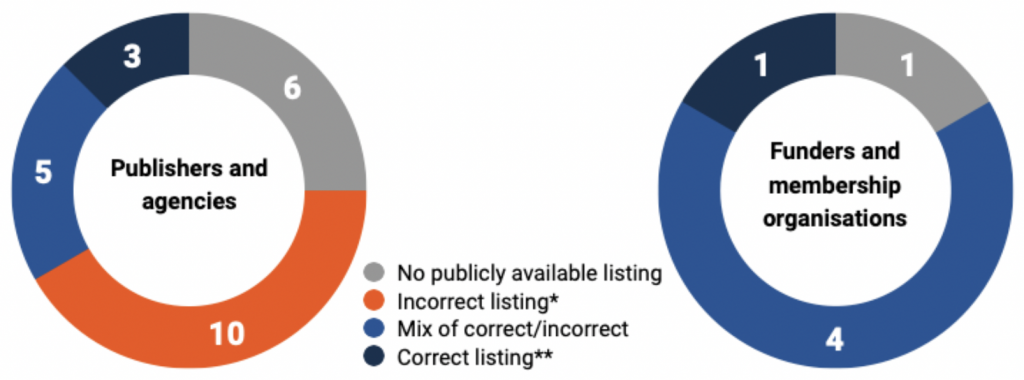
* lists gender/gender identity but not sex
** lists both sex and gender reassignment
In some cases, organisations refer to “gender” while probably meaning “sex”: some make separate reference to “gender” and “gender identity”. The problem with talking about gender rather than sex is that it can be interpreted in at least three different ways: as a synonym for sex, as the social roles associated with being male or female, or as gender identity. Lack of clarity in language risks staff charged with legal compliance failing to understand that they have legal duties to protect their staff from unlawful discrimination on the basis of sex and, separately, on the basis of gender reassignment. This undermines legal protections for everyone.
In other cases, organisations have an explicit focus on gender identity to the exclusion of sex. One publisher has described itself, for example, as “a place where anyone of any background, race, ethnicity, religion, sexuality, gender identity, age, physical ability, or socio-economic status can thrive, feel comfortable, and be heard and accepted”.20 This avoidance of sex as a category may occur more in employers that have prioritised gender-identity beliefs in their EDI initiatives. According to a publishing employee: “Gender ideology is packaged together with [EDI] efforts to change things in a way that’s been quite unhelpful.”
Some organisational policies omit consideration of the need to ensure protection from unlawful discrimination on the basis of protected philosophical belief. Gender-critical beliefs are recognised as a protected philosophical belief under the Equality Act 2010,21 meaning that employers risk unlawful discrimination if they treat gender-critical employees less favourably than other employees as a result of their beliefs. The relevant protected characteristic in the Equality Act is “religion or belief”. As figure 2 shows, however, fewer than half of publishers and agencies publicly list both religion and belief in their policies, and six incorrectly list only religion. If organisations cannot correctly name the category under which staff and others are protected from discrimination, it seems reasonable to assume that how to protect that group has not been properly considered.
Figure 2. Policies relating to equality or protection from unlawful discrimination: belief
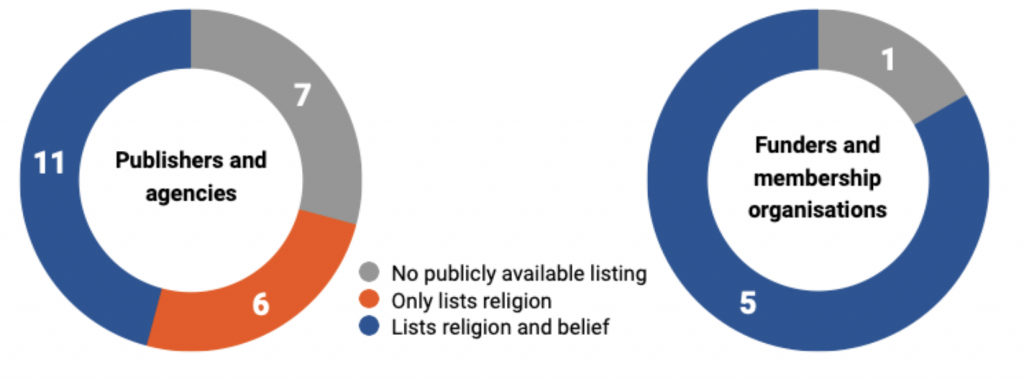
“I don’t think they have any [policies to protect people on the basis of gender-critical belief]. Because of the atmosphere, it would be very difficult to be the person who suggested that – because the orthodoxy is that if someone identifies [their gender] in a particular way, you have to respect that.” Publishing employee
There is, more broadly, a lack of regard to the Equality Act 2010 in published organisational policies and reports. Of the 30 organisations reviewed, half fail to mention the Equality Act in their policies. Nine refer to the act in relation to something other than equality policy (retrospective pay-gap reporting, for example), and only six refer to it in policies relating to equality or protection from unlawful discrimination.
Some organisations have prioritised trans-identified applicants for traineeships and volunteering positions over and above those less well represented in the industry. People identifying as trans make up around 1% of the publishing workforce,22 which is probably higher than the population as a whole23 – in other words, they are not under-represented. Implying the opposite, a publisher-sponsored proofreading course was advertised “for trainees from backgrounds traditionally under-represented in publishing – including, but not limited to, Black, Asian and ethnically diverse candidates, disabled people, neurodivergent people, and transgender and genderfluid people”.24 The Society of Young Publishers encourages “people of under-represented communities to apply”, to include “trans and non-binary people”.25
In the first example, there was no mention made of potential trainees from lower socio-economic backgrounds, who make up around four in ten of the general population but only two in ten of people working in publishing, nor of men, who make up only three in ten of the publishing workforce.26 Positive-action schemes are only reasonably necessary if they are targeted at genuinely under-represented groups.
Reports that purportedly demonstrate organisational “inclusion” sometimes focus on trans inclusion but overlook women. One publisher’s recent report into equality, diversity, inclusion and belonging, for example, highlights its support for trans and non-binary employees, research on transgender rights and its status as a Stonewall Global Diversity Champion. There is cursory mention of “women” linked to an online jobs platform in India and work on “gender equality”, but there is no mention of the words “female” or “sex”.27
Inclusion statements often focus on gender, not sex, which may signal to current or prospective gender-critical employees, authors and other relevant individuals that their views are not recognised. One international publisher’s inclusion statement states: “We know that creating and sustaining an inclusive work environment is critically important from the boardroom down regardless of race, gender, gender identity or reassignment, age, disability, religion or sexual orientation.”28 The two most relevant protected characteristics to gender-critical staff – sex and belief – are not mentioned. There is often a disconnect between publishers’ stated commitments to inclusion and belonging, and their failure to consider how the working environment might be hostile to gender-critical staff.
“People were insisting to me that their position on gender was one of neutrality. The HR director had pronouns in her email signature, then there was the trans-inclusion policy in itself and the fact that there wasn’t a women’s network because that would offend transwomen. The window of what was considered neutral had completely moved.” Ursula Doyle
Sometimes creative submissions suffer from the same limited identitarian lens. On its manuscript submissions page, for example, one publisher states: “We are committed to working with and supporting writers, illustrators, and other creative partners from all walks of life, regardless of race, sexual orientation, gender identity, disability status, nationality, religion or belief, age, social or economic circumstance.”29 This statement gives a veneer of inclusion for those who may not notice the omission of “sex”.
Relevant policies have not always been supplied to the people expected to adhere to them. Sibyl Ruth received an email from a desk editor for her then-client a month after she had sent the tweet that led to her dismissal (see chapter 6 on professional impact for a fuller discussion about this), stating that she was emailing “a reminder of our values and our policy on equality”. The email said: “As a freelancer… you are acting as an ambassador for our company and our values, so it’s important to always be aware of what these are.”30 Ruth said these values had never been shared with her. “They had made it up afterwards,” she said. Her contract was a technical document; it referred to information in an accompanying company handbook that was never supplied. “I don’t know if it ever existed,” she said. “It may have been a generic contract.”
At least six focus organisations (Creative Scotland and five publishers, including two of the “Big Five”) have policies or guidance on trans inclusion and transitioning at work.31 These are not in the public domain, but two of them have been shared with the author of this report. In a section on discrimination, bullying and harassment, one says, “Transphobic behaviour may include… persistently using incorrect pronouns or someone’s ‘deadname’ (former name), or otherwise refusing to acknowledge someone’s identity.” The other mandates the use of trans-identified colleagues’ pronouns, suggesting that mistakes are corrected and that repeated failure to use chosen pronouns may be “regarded as harassment” and dealt with accordingly. These policies may represent unlawful discrimination against employees who hold gender-critical beliefs and who do not feel comfortable manifesting the belief that a person can become a woman or man (or neither) through a process of self-identification.
Both policies state that staff can use facilities that align to their gender identity. This contravenes the Workplace (Health, Safety and Welfare) Regulations 1992, which state that employers must provide either single-sex facilities or unisex facilities (lockable cubicles with self-contained sinks).32 Allowing self-identification into purportedly single-sex facilities makes them mixed-sex.
“I raised concerns about some of the content. They didn’t respond. I wasn’t included in any more emails or given any more drafts of the policy. I was stonewalled.” Publishing employee
Some interviewees also critically discussed their employers’ trans-inclusion policies. Ursula Doyle viewed her former company’s trans-inclusion policy as driven only by the transactivist agenda. “It contained no mention of women’s rights or gender-critical points of view, and no acknowledgement that those arguments even exist. The company claims that inclusion and plurality are central to its mission, but that didn’t appear to be the case here.”
Another publishing employee was aware that concerns had been raised about her company’s trans-inclusion policy, which had been developed by a staff network, when it was still in draft form. The company later changed some of the language, including the phrase “sex assigned at birth” (sex is observed, not assigned), but retained its policy of self-identification into what should have been single-sex facilities and its prohibition of using sex-based pronouns for staff who wanted colleagues to use different pronouns when speaking about them.
“The culture is around promoting queer and trans issues. We have the Progress flag flying at work at the moment, as it’s been LGBT+ history month. You can have the flag in your email sign-off, but you can’t put in equivalent flags for other political or ideological issues.” Publishing employee
It is not just trans-inclusion policies that compel speech. Two interviewees said they had worked with male colleagues who identified as women. In both cases, they were expected to speak about them as women. “It’s not hurting me,” said one person, “but it feels like compelled speech having to call someone who is a man a woman.” Another said that she was asked to cast aside reality. “For everyone who had worked with him, suddenly they had to flick a switch and deny everything they knew.”
Staff at one company were told that they may need to use different pronouns depending on the day or week: a colleague might be he/him on a Monday and they/them on a Thursday. In another case, training on the organisation’s sexual-harassment policies included the warning that repeated misgendering represented grounds for dismissal. This demonstrates a striking internal contradiction: sexual harassment tends to be perpetrated by men, and yet its victims are required to refer to some men as women. In any event, misgendering is never sexual harassment.33
When individuals choose not to state their pronouns in email footers, biographies or meetings, it can be used as a signifier of wrongthink. An author who works in a university commented: “Not having pronouns in your bio is a clear act of defiance, as you have to go out of your way not to put them on. The refusal is the offence.” Her EDI team sends periodic messages encouraging pronouns to be stated for the purposes of equality and diversity.
“[Stated pronouns] are understood to be the orthodoxy without it being nailed down in official documents.” Publishing employee
These policies can appear cheap and easy to put in place. Mandating the addition of pronouns to email sign-offs, for example, is straightforward and has no immediate financial cost (companies may not factor in the medium-term costs of losing good will and increased staff attrition or legal cases).
Gender-identity beliefs have also migrated to policies that are meant to be about women. One publisher’s menopause policy is “inclusive of all gender identities including trans and non-binary employees”.34 Another offers support and guidance “to all colleagues experiencing menopausal symptoms, regardless of gender identity or gender expression”35 and one more targets everyone, “whether you’re a cis woman, a trans man, intersex or non-binary”.36 The first two fail to centre women and the third uses the term “cis”, which many women reject on the basis that it defines them as a sub-category. Policies relating to experiences that affect only women may land badly when they are presented on the basis of gender identity, not sex: women cannot identify their way out of sex-specific biological processes.
Consultation on internal policies is sometimes skewed. HR and EDI departments may check policies and language with transactivist organisations and internal LGBT groups, but fail to consult organisations that might provide legal authority or offer balance to ideological input. One publisher has consulted on self-reporting of gender with its Pride Network and Trans and Non-Binary Working Group but not, obviously, with any groups representing women.37 “You have to keep reminding them at every step that it’s not just about those groups,” said an interviewee from a different publisher. “EDI is also about women.”
Editorial and free-speech policies
Editorial documents such as style guides often take a gender-identity lens. One such guide for academic books states: “Individuals should be referred to by the gender they identify with and their chosen name and pronouns.”38 Another publisher’s guidance on gender equality states that it is “designed to be respectful of all genders: female, male and non-binary. We aim for a balanced reflection of gender identities, in proportion to their visibility in the societies in which we operate… [Publisher name] recognises that gender is a spectrum.”39 It does not say what happens if its staff do not recognise this.
A different academic publisher has developed an “inclusive language guide” that includes an array of gender-identity terms, including cisgender, agender, gender-queer and gender-affirming surgery, and an explanation of “ze/hir” pronouns. It says: “Avoid assuming someone’s gender based on their appearance or name, as some people may not identify as a man or a woman, but would instead prefer to choose their pronouns, commonly: he, she, they or ze… You should respect the way people wish to identify themselves. If you aren’t sure which pronouns to use, just ask them!”40
“I did try to say that we shouldn’t be enforcing one set of beliefs on authors. It’s valid if authors are gender-critical and believe in biological sex.” Publishing employee
Language that erases women is common. An interviewee gave the example of women being referred to according to whether they menstruate, not by the word “women”, in her company’s internal communications. “I have to remind myself to say ‘women’,” she said. “You end up training yourself not to do this.”
Organisations have made limited public commitments, so far, to freedom of speech or expression. As figure 3 shows, half of the 30 focus organisations have made a relevant public commitment; of these, two thirds have added a caveat,41 made a commitment only for some people (for example, talking about freedom of expression when it comes to authors but not making a similar commitment for staff) or committed to free speech in a way that implies they have done the opposite.42 Only five organisations have made a full, unqualified commitment to allowing or defending a plurality of perspectives.
Figure 3. Stated support for freedom of speech or expression
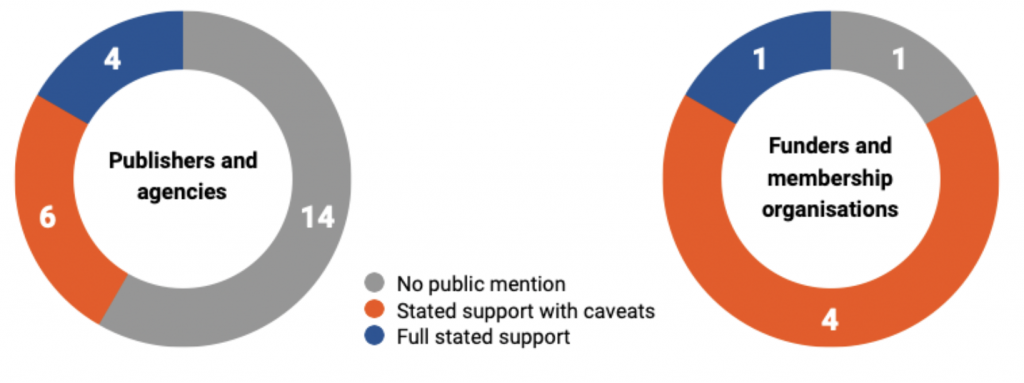
For those on precarious contracts, there is an inherent tension between client expectations that are arguably anti-free speech and the anticipated benefits of working independently. Sibyl Ruth, who – as mentioned earlier – was let go from a freelance contract on the basis of her gender-critical beliefs, said: “There is a paradox between apparent independence and the control an employer might seek in the way that you work… You were independent but at all times a brand ambassador for the company.”
There appears to be more positive movement, so far, on supporting free speech than there has been on other relevant internal policy areas. In 2021, an anonymous managing director of one of the largest publishers was quoted in The Guardian as saying that it is a “necessary inevitability” that books will be published containing viewpoints with which some of his staff actively disagree. “It is complicated,” he said, “but also, I think, quite stimulating.”43
Positive but isolated examples include a publisher’s statement, made in response to a staff threat to stop work on a book written by JK Rowling, saying: “Freedom of speech is the cornerstone of publishing. We fundamentally believe that everyone has the right to express their own thoughts and beliefs. That’s why we never comment on our authors’ personal views and we respect our employees’ right to hold a different view.”44 The chief executive has also told a House of Lords committee that new publishing employees must be told they will have to work on books written by people with whom they do not agree.45 (The same publisher has separately made public commitments to gender-identity beliefs.)
A concern was raised, though, that free speech in publishing may have become more restricted since the early part of the decade when these examples took place.
Facilities
Some organisations offer legally compliant toilet provision; others fail to comply. Provision is compliant when it is single-sex or unisex, offering individual lockable cubicles with an internal sink. It is non-compliant when people using unisex facilities have to share a sink, and when single-sex provision is effectively made mixed-sex by allowing people to select whether they use male or female toilets according to their identity. As highlighted in the section on HR and EDI policies, at least two publishers have a trans-inclusion policy that allows staff to use facilities that align with their gender identity, thereby allowing male people to use female single-sex facilities and vice versa. Only two trans-inclusion policies were reviewed, so the actual number may be far higher. This is unlawful, as is the provision of one author interviewee’s publisher that comprises gender-neutral toilets with open-plan sinks.46
Several publishers offer compliant unisex facilities.47 Women who would prefer the provision to be single-sex can find these uncomfortable. “You can hear the person in the loo next to you really clearly,” said one interviewee. An author, talking of visiting the unisex toilets in her publisher’s offices, said, “Men pee differently to women. [The toilets] were covered in urine and stank.”
“Everyone hates gender-neutral loos. It’s the maddest policy.” Author
Converting accessible toilets into gender-neutral provision has significant real-world consequences for staff with health conditions or other disabilities. The accessible signage on the doors of a toilet for disabled staff was removed at one publisher, opening its use up to all staff and restricting access for an interviewee with a relevant disability. “A trans colleague was using the same facility,” she said. “I assumed they didn’t want to use facilities with a disabled sign and the organisation was trying to accommodate their needs. That’s right and proper, but it should be additional, not taking away from accessible loos.”
The removal of this signage meant that more people used this toilet, restricting her access and meaning that she sometimes needed to use the general-access toilets. “Often that’s perfectly fine,” she said, “but sometimes it isn’t. I need washing facilities in the same space.” This is an example of a supposedly anti-discrimination policy directly causing discrimination.
The role of representative bodies
The industry is affected by template policies and reports put out by representative bodies. The Publishers Association has developed an Inclusivity Action Plan to which 21 founding organisations have signed up. While it has some positive elements, including a link to an ACAS template that accurately lists the Equality Act’s protected characteristics in reference to avoiding unlawful discrimination, the plan asks publishers to aim for their workforce to reflect national demographics by “gender”. There is no mention of sex.48
Information that is incorrect in law is sometimes put out by these organisations: the Publishers Association, for example, states in its Understanding Author Diversity Report that “gender” is one of the protected characteristics.49 “Gender” is not a protected characteristic in the Equality Act. The relevant protected characteristics are “sex” and “gender reassignment”, alongside age, disability, marriage and civil partnership, pregnancy and maternity, race, religion or belief, and sexual orientation.50
Organisations are sometimes correct in certain areas but undermine this accuracy in others. Publishing Scotland’s Equality, Diversity and Inclusion Policy makes a commitment to fair treatment and protection from discrimination51 on the basis of the nine (correctly cited) protected characteristics, but in the same document goes on to state that it has provided training on gender and gender identity “in accordance with the requirements of the law and good practice”.52 And while the Arts Council correctly outlines the protected characteristics in its Equality Objectives,53 its guidance to national portfolio organisations on producing equality action objectives and plans omits “sex” and “belief” from its definition of diversity (which covers most of the other characteristics) and states, wrongly, that “gender (sex)” is one of the protected characteristics.54
Creative Scotland points out that it is covered by the public-sector equality duty (PSED),55 which obliges public-sector organisations to “advance equality of opportunity between persons who share a relevant protected characteristic and persons who do not share it” and to “foster good relations between persons who share a relevant protected characteristic and persons who do not share it”.56 On the same webpage, Creative Scotland says that it is a corporate member of Stonewall and a Diversity Champion, of which more later. Membership of an organisation imbued with gender-identity beliefs does not obviously appear to support Creative Scotland’s adherence to the PSED.
Creative Scotland’s commitment to its statutory obligations is also undermined by other outputs. An equality impact assessment of a funding programme states that “consideration should be given to inclusion of organisations which programme art and cultural activity that represents and serves people who identify with [the] protected characteristic [of gender reassignment],” despite offering no evidence that those with this characteristic are under-represented in the funding they receive nor requiring similar commitments in relation to the protected characteristics of sex or belief.57
EDI policies are sometimes used to advance an agenda that prioritises ideas of social justice rather than centring the law. The Society of Young Publishers, for example, states: “Equality, diversity, and inclusion (EDI) policies, aiming to ensure fair treatment and equality of opportunity for all regardless of their background, are… an important way to build a more just publishing industry.”58 There is no mention of “sex” (other than the consensual kind) on its website, and no mention of “belief” in its coverage of EDI. It does, on the other hand, mention non-binary identities in its inclusion coverage. The Equality Act 2010 is mentioned once on its website in relation to making reasonable adjustments for people with a disability, but with no discussion of protection from unlawful discrimination at work.
Examples of good and lawful policies do exist. The Industry-Wide Commitment to Professional Behaviour in Bookselling and Publishing, which has the backing of the Booksellers Association, The Society of Authors, the Publishers Association and the Association of Authors’ Agents, states: “We celebrate and actively promote diversity and inclusion in all its forms, including and not limited to the nine protected characteristics cited in The Equality Act 2010,” which it goes on to cite correctly.59
Data collection and analysis
There is widespread confusion in data collection and analysis when it comes to sex and gender identity, resulting in category overlap and missing data. The recently published government-commissioned Independent Review of Data, Statistics and Research on Sex and Gender makes clear that sex and gender identity should not be combined in a single question, the word “gender” should be avoided due to its multiple meanings, and default questions should be about sex.60
There are lots of examples in publishing that do not align with this guidance. None were found that do. One of the Big Five publishers, for example, reports separately on “gender” and “trans identity”, which overlap. Its question on gender has the options: women, men, use own terms, non-binary or gender queer, questioning or prefer not to say. It does not report on sex.61 There are some situations in which publishers appear to collect only data on gender identity,62 leaving open the question of how people who do not believe in gender identity can answer a question about their gender identity.
One publisher defended its decision to collect data about only gender identity, not sex, by saying that the HR system already had data on the latter. “By allowing this you are not giving off any vibe that your company is a home for gender-critical people,” said an interviewee.
Some organisations employ fuzzy definitions when it comes to reporting on the pay gap between men and women. One company said in its 2023 Gender Pay Gap Report: “Some of our staff are non-binary, and so, due to the limitations of the government reporting rules, they are excluded from the gender pay gap data.”63 This is lawful – the Government Equalities Office states that employees who do not self-identify as either “gender” can be excluded from calculations64 – but it does not support accuracy of pay-gap reporting. A male who transitions late in life will do so having experienced the advantages of salary and promotions held by men up to that point. His salary will therefore artificially inflate the figures for women’s pay. A publishing employee commented: “The experience of pay discrimination often arises from things like taking time off to have children. That’s about sex.”
Three publishers have made caveats in their pay gap reporting like this one: “The regulatory requirements for gender pay gap reporting require us to include only employees who identify as men or women. We recognise that gender is wider than this and are committed to supporting and respecting all colleagues’ gender identity.”65
Poor industry practice on data collection and analysis has been informed by equally poor sector-wide guidance. The Publishers Association Inclusivity Action Plan refers publishers to its author data-collection toolkit, which the organisation suggests is used to collect supply-chain data on authors as well as researchers, peer reviewers, editors, suppliers and freelancers. There is no question on sex, while there are two questions on gender identity:66
- Which of the following best describes your gender? Male | Female | In another way | Prefer not to say | Non-binary
- Do you consider yourself to be a trans person? Yes | No | Prefer not to say
These make the resulting data meaningless. The inclusion of “male” and “female” in the first question means that some people will answer it on the basis of sex; the use of “gender” and the inclusion of options other than male/female means that others will answer it on the basis of gender identity, with no way of knowing on which basis individual responses that say male or female have been given. It is possible that sex could be reverse-engineered using the second question, but it seems (a) unlikely that publishers will take steps to do so without guidance and (b) likely that gender-critical staff will self-exclude from the first question, meaning a potentially sizeable chunk of missing data.
The document also states that the focus of linked research became “advice and guidance on best practice for gathering author data relating to protected characteristics”. It incorrectly gives two of these protected characteristics as “gender” and “gender identity”. Publishers may therefore believe they are following best practice in gathering linked data, when some of the concepts given a legal veneer by the document have no basis in law.
These data issues inform the operations of many publishers and, as a result, the environment that their staff, authors and other individuals must navigate. At the time of writing, 29 publishers were signatories to the Publishers Association Inclusivity Action Plan, including 14 of the 21 included in the online review for this piece of work: Bloomsbury Publishing, Bonnier Books, Cambridge University Press, Canongate, DK, Faber & Faber, Hachette, HarperCollins, Pan Macmillan, Pearson, Penguin Random House, Profile Books, Simon & Schuster and Taylor & Francis (Informa).67
Funders sometimes require organisations to collect and report data based on ill-defined or even meaningless categories. Creative Scotland requires the organisations it funds to report on the “gender” of its staff and volunteers, leading to some fairly extraordinary reporting in which it breaks down artistic directors across the arts sector into “male”, “female” and “other”.68
In addition to asking about gender identity of staff, Arts Council England asks some funded organisations to report on “intersex” as a category within “sex”, implying wrongly that people with disorders of sexual development represent a third sex in addition to male and female69 (such disorders are rare, and everyone who has one is still either male or female).70 A recent Arts Council survey for freelancers, conducted in partnership with the University of Essex, asks whether respondents are female, male, non-binary or prefer to use other language. It includes a separate question about whether respondents’ gender identity is the same as their sex registered at birth, but no question on actual sex.71
Both these surveys, flawed as they are, are improvements on an earlier workforce survey aimed at Arts Council-funded organisations, which specified that the term “male” includes “female to male trans men” (i.e. women) and that “female” includes “male to female trans women” (i.e. men).72
In one case, a consultation on data collection with staff networks led to inaccuracies. The original version of the staff survey had two questions: one on sex, with a binary male/female option, and one on gender identity. This made it, according to an interviewee, fully inclusive of everyone. A staff network consultation led to the first question then being changed to “gender recorded in official documents”, as well as the incorrect claim that posing the question in this way is a requirement of UK law (“gender” can currently be amended on some official documentation without a gender-recognition certificate, making it effectively doctor-accredited self-identification).
There are concerns that poorly designed questions may be used to identify dissenting staff and authors. “It is patently obvious that a vast number of authors are middle-aged women of my persuasion,” said one interviewee. “They were winkling out all of these things.”
“These were ludicrous, intrusive, turkey-voting-for-Christmas questions… used to whittle out people like me. I am a pieceworker, a freelancer. They have no right to this information.” Author
Organisations unaffiliated to the sector have influence on data collection practices. One publisher, for example, attained certified B Corp status in 202473 – defined as being a leader in “the global movement for an inclusive, equitable, and regenerative economy”.74 One of the B Corp standards relates to justice, equity, diversity and inclusion, a requirement for which is that “The company collects data on gender identity for people-related business processes and measurements. The company uses this for disaggregated data analysis and internal reporting.” There is no linked requirement to report on sex.75
The Publishers Association’s template author survey is based on guidance and wording provided by Stonewall,76 contributing to the dearth of meaningful industry data. While the original documentation used to inform the Publishers Association’s survey design is now missing from Stonewall’s main website, a document co-authored by Stonewall Scotland with the same title, Getting Equalities Monitoring Right, states:77
“Public authorities are obliged to monitor the gender of their staff to report back on the pay gap. It’s absolutely vital to ensure that this isn’t restricted to male and female, but is inclusive of non-binary identities.”
This is incorrect. Official pay gap data looks only at differences between men and women, and non-binary people are all either men or women.78
“UK law treats sex and gender as the same thing… When it comes to monitoring questions, it is better to use the term gender rather than the term sex. This will help to make it clear to people that you are asking them to tell you about their self-perception of their gender rather than about their biological sex.” Getting Equalities Monitoring Right
UK law does not treat sex and gender as the same thing. “Gender” is occasionally used as a synonym for “sex”,79 including in the “gender pay gap”, which does not help with clarity.80 The Equality Act is clear, however, that sex is a distinct characteristic when it comes to protection from unlawful discrimination. Organisations cannot monitor their treatment of women compared with men if they are collecting data on something else entirely.
“The technical term for someone’s self-perception of their gender is their gender identity… But it’s absolutely fine to use the term gender instead on forms, particularly for staff or service users, as this is more widely understood.” Getting Equalities Monitoring Right
This guidance advises organisations to ask about gender, not sex, and here says that the term gender represents gender identity – in other words, it advises organisations to ask only about identity, not biology. Gender identity is not a protected characteristic; organisations that follow this guidance, and that lack a lawful reason to collect data on gender identity, are likely to fall foul of the General Data Protection Regulation by requesting unnecessary personal information.
Training and consultancy
EDI training is sometimes delivered by organisations that lack a sufficiently comprehensive understanding of the law. Staff at Publishing Scotland have received training on equality, diversity and inclusion from a specialist organisation called Creative Access.81 A training course offered by Creative Access is called “The Equalities Act and Positive Action”, badged under the theme of “Inclusivity and the Law”.82 It is arguable that organisations should not be relying on legal training that misnames the key Act of Parliament upon which UK equality law is based, which is the Equality Act. (Creative Access, incidentally, also co-created the Publishers Association’s Inclusivity Action Plan.)83
“They couldn’t find anyone to deliver equality law training as the law was.” Interviewee
Poor training and absence of training mean that many organisations in publishing lack an understanding of the Equality Act 2010, linked case law and what these mean for the workplace. According to Sibyl Ruth: “People may be getting very misleading training. The Equality Act is about balancing competing rights, not about taking one protected group and prioritising their interests.”
“One of the things I couldn’t believe was the total lack of training on the Equality Act. There was no mention of it, and protected characteristics were constantly being misrepresented.” Ursula Doyle
Staff may be offered training in trans awareness or trans inclusion; no instances were found of training that might support the needs of gender-critical staff, such as how to avoid unlawfully discriminating against staff who hold a protected philosophical belief. One publisher’s training academy, for example, gives four examples of diversity and inclusion training: conscious inclusion, LGBTQ+ issues, disability inclusion and trans awareness.84 An interviewee said that freelancers contracted to her organisation were made to do and pay for this “ideologically driven” training, which cost £1,500, otherwise they would not get any more work. “I thought it was unethical and awful,” she said.
Staff training on trans inclusion or awareness across the sector has been run by All About Trans, Gendered Intelligence, Inclusive Minds, Stonewall, the Other Box, the Transgender Alliance (Scottish Trans) and We Create Space.85
“The [trainer] was saying we were really privileged, we cis people, as we are at ease with our gender and it matches our sex. I was really upset by that. I thought me and some of the other women in the audience probably had some of the worst experiences we ever had because we are female.” Publishing employee
Some of the content of trans-awareness and trans-inclusion training is incorrect. An interviewee described a session she had attended that said sex was a spectrum and assigned at birth, and that puberty blockers were reversible and totally safe. “It was full of misinformation and inaccuracies,” she said. “They were also saying some out-there stuff, like in Key Stage 1 [ages five to seven], all children should be having sex education that addressed the concept of transition so they could access cross-sex hormones at the earliest opportunity.” Other staff members who were parents felt unable to push back, despite feeling upset.
As well as taking up training time that has little to balance it, trans-focused training can undermine the provision of the limited training that is available on topics that are relevant to women. An organisation that delivered trans-awareness training also put on a session on the menopause, according to an interviewee; she did not attend the latter session because she did not want to attend training on female-specific issues run by “a company who thinks men can become women”.
Gender-identity focused topics generally receive more attention than topics focused on women, and language describing women is sculpted to fit the belief system in a way that language describing men is not. One interviewee attended inclusion training at which a status of red, amber or green was given to a variety of hypothetical workplace situations. Anything linking to sexism was coded green (acceptable) or amber (a moderate issue), while anything linking to trans issues was coded red (a severe issue). In other words, discrimination on the basis of sex was seen as less bad than discrimination on the basis of gender reassignment.
In other training, gender-identity beliefs have entirely replaced EDI training content that would once have focused on sexism in the workplace. Language that promotes this belief system is frequently used by trainers and other external consultants, with women often coming off worse. A publishing employee was asked by an external consultant whether she was connected in a professional network to “men” or just “people who menstruate”. “Men get to be men, and we get to be people who menstruate,” said the interviewee.
Culture and language
Internal culture
Staff sometimes face disciplinary actions for their views, and authors and freelancers face loss of work. Gillian Philip, Jenny Lindsay, Sibyl Ruth and Rachel Rooney have all lost work, and Ursula Doyle has reached a settlement in her case against Hachette. These are just some of the stories in the public domain. Many more people feel unable to speak out because of these examples, and because they see what happens internally. One interviewee, for example, has a colleague who was disciplined by her line manager for saying in a workshop that it was full of disinformation.
There is a cross-sector pattern of ignoring concerns raised by gender-critical members of staff or authors. These concerns relate to some of the issues already covered in this report, including use of language, training and issues with data capture. In-person conversations are usually polite but no action follows; concerns raised by email may never receive a response. In many cases, concerns are met with a firm closure of the conversation. No examples were given by interviewees of raising concerns that had led to nuanced discussions about how to balance competing rights, ensure diversity of thought and remain within the law.
Double standards are frequently at play, as are competing demands. Rachel Rooney was called to a meeting a few years ago with one of her publishers at which she was asked not to post on social media in support of organisations like LGB Alliance or Transgender Trend, and not to raise her concerns about drag-queen story hours. Rooney countered that one of the publisher’s staff members, also in the meeting, was posting about Mermaids, Stonewall and other organisations to which she objected. “’How can you do that when I can’t?’” she asked them. “They couldn’t really answer. They said I was representing the company more than he was, which I felt was untrue.”
“Despite being aware I protested Section 28 back in the 80s, I was told by [my publisher] over the years that some considered me transphobic and homophobic. I was sent screenshots of my posts as an example of wrongthink.” Rachel Rooney
The children’s author Gillian Philip, who was one of several people writing books under the pen name Erin Hunter, had a similar experience. Philip’s contract was terminated by HarperCollins and Working Partners after she used the hashtag #IStandWithJKRowling on social media. She was told that she had associated her political opinions with Erin Hunter, even though she was expressing them on her personal account and there was nothing in her contract to say that she was forbidden to do so. She checked the accounts of other Erin Hunter authors, some of which included highly political content: it appeared to be an issue only when it came to Philip and her gender-critical beliefs.
Staff are sometimes placed in impossible situations in their attempts to balance the competing demands of workplace requirements and not completely eschewing reality. Staff in one publishing company were told they could use the word “woman” but they had to qualify it. No details were given on the form this qualification should take. “No matter what I did, there was the potential for conflict,” said an interviewee.
There is a seeming inability to learn from what has gone wrong, and a tendency to blame individuals rather than look at broader systemic problems. In one organisation, a workshop was held at which a children’s book was used as an example of best practice. This book had been subjected to heavy public criticism and accusations that it was inappropriate for young children, which led to its removal from schools. Following internal complaints, the workshop organisers conceded that they had not fully considered organisational risk. “But nobody goes back to the team and says, ‘We shouldn’t have included this’,” said an interviewee. “Wrong information never gets corrected or addressed.”
Instead of considering that there may be issues in the broader environment that need fixing, blame is sometimes targeted at individuals who raise concerns about gender-identity beliefs in publishing. Rooney, for example, was blocked on social media by her publisher’s publicist because he did not like the views she was expressing. She was then accidentally copied into an email from her editor to the publicist, apologising to him that Rooney’s views could not be changed and that she had upset him. This culture may be facilitated by a reluctance of managers and leaders in publishing who themselves hold gender-critical beliefs to speak about them. An author said of her Big Five publisher: “Some extremely senior people there have told me privately that they agree with my views.”
“Every Scottish literature organisation… didn’t see it as their issue to sort. They were treating it as a ‘you’ problem rather than a systemic one.” Jenny Lindsay
The issue of sex and gender leads to extraordinary social and workplace behaviours. The manager of one interviewee found a public example of somebody criticising her position and offered to send it to her. “On another topic, would you go to a colleague and say ‘I have encountered someone who really hates you’?” she asked. “It made me really unsettled.” Later, when they no longer worked together, the same manager sent her an unsolicited text message describing her views as hateful and fascist. An author recounted a breakdown in her relationship with her editor following a number of conversations in which he sought out details of her views in order, she believes, to use these against her later. “He would ring me up and ask me for information,” she said. “What I thought was him being onside was him garnering information about me as being trouble… I told him everything, not realising how dangerous that was.”
A third of the focus organisations are publicly linked to transactivist organisations such as Stonewall, the Proud Trust, All About Trans, Gendered Intelligence and Mermaids. Much of the work of these organisations has been discredited. Stonewall, for example, advocates unlawful policies such as “trans employees can use male and female toilets where these align with their gender”,86 and trustees of Mermaids were found by the Charity Commission to have mismanaged the administration of the charity.87 Many partnerships between publishers and these activist organisations are nominally designed to create a more inclusive environment for staff, but they may have achieved the opposite. In some cases, these links have had a widespread negative effect on the sector, as was the case with the Stonewall-informed sector-wide survey guidance highlighted earlier in the section on data collection and analysis. Stonewall’s influence extends into the funding landscape.88 Stonewall even hosted an event for one publisher explicitly aimed at women.89
Another publisher invited the transactivist charity Mermaids to edit an educational article on the law and freedom of expression ahead of publication, requesting that it suggest changes to content it deemed to be offensive.90 The Employers Network for Equality & Inclusion has also been highlighted,91 which offers a quick guide to non-binary equality in the workplace and a video entitled “Gender Identity 101 – Creating Trans-Inclusive Workplaces”. As mentioned elsewhere, there is naturally no issue with trans inclusion per se. Workplaces should be designed to ensure all employees feel included, where practicable and reasonable. But “trans inclusion” has become a shorthand for gender-identity beliefs and, potentially, the exclusion of women and gender-critical employees through (for example) treating trans-identified staff as the opposite sex.
An institutional focus on gender-identity beliefs contrasts sharply with the fact that sexism in the workplace is still rife and has not yet been properly addressed. One publishing employee was interviewed for a promotion at which she was asked (by a man) if she was planning to get pregnant again. This was unlawful behaviour that she did not feel able to challenge. “Even in a female-dominated workplace you would be seen as a troublemaker,” she said.
There appears to be a widespread assumption across publishing that it is acceptable to abuse and harass people who have gender-critical beliefs in the workplace. One interviewee said that staff were reported for hate speech after they said that sex was binary and that freedom of speech is important. Another interviewee made a confidential complaint about a trans-inclusive policy that served to exclude women, which was then leaked. “People started talking about this dreadful TERF who put all these comments on the document,” she said, “and that wasn’t it awful we have this awful transphobe getting involved?”
“It’s so appalling that anybody should be bullied. I’m pretty tough… It’s for other people I’m really worried about who don’t have the experience and the resources and so on.” Author
Harassment sometimes takes place at a distance from the person at whom it is targeted, and sometimes it takes place by proxy. Rooney, for example, was called “bigoted” by the convenor of a creative-writing workshop for children’s writing, which she was told by somebody attending the event. This creates reputational damage without an opportunity for immediate challenge and repair. An employee at one publishing company said that she has heard and seen comments by colleagues denouncing JK Rowling for her gender-critical beliefs and activism.
“If you have a conversation with someone at a book event and someone says something negative about JK Rowling, I don’t go there. I nod and change the subject. I am not going to tear into JK Rowling to pacify the other person or send a signal. If I were to say, ‘What do you mean? Why is JK Rowling a cunt?’ – and I have heard that language – that is fraught with peril.” Author
Insubstantial material often informs in-person experiences of abuse and harassment. An author who works in academia signed a couple of public letters of support for other authors, which was enough to spark a student protest. “Such deviation from the norm is seen as a possible transphobic act,” she said.
Blacklists and blocklists have contributed to a hostile environment for people in the industry with gender-critical views. A group who called themselves the “Young Refuseniks” compiled a list of gender-critical people in publishing to avoid. They later retracted it, but there are fears that similar lists still operate privately, contributing to a reluctance from some people to speak out. “I would like to say things about men in women’s sports and women’s changing rooms,” said one author. “It is common sense, but somehow saying that online could lose you your job.” Another said that she had seen people in her own publicity team like and repost the blacklist before it was retracted.
“I know there is a list of TERF editors going around… It’s a social tool. It’s a tool to intimidate. Even to declare knowledge about the list as an insider is to intimidate. One person is on that list simply for following me [on social media].” Rachel Rooney
Pockets of good practice exist, even in publishers that have made questionable decisions in other parts of the business. One interviewee mentioned a brewing revolt at one of the publishers of Rowling’s books, saying that early and successful action was taken to end it (this refers to a publisher’s statement that free speech is the cornerstone of publishing, and it is covered earlier in this report). “That company did lay down the law and the world didn’t end,” he said.
Language
The language used by publishers about people who hold gender-critical beliefs is sometimes inaccurate and lacks balance. An academic publisher defined the term TERF as believing that “feminism should not include supporting the rights of transgender people,” giving the example: “She was labelled a TERF and accused of spreading hate about trans people.”92 The same organisation has published journal articles describing “extreme” gender-critical views pejoratively93 and dehumanising the female experience: “Trans women, cis women, alien women, and robot women are women: they are all (simply) adults gendered female.”94 Publishers have the right, of course, to publish these articles, and freedom of speech applies just as much here as it does to people with gender-critical beliefs. The issue, though, is that these articles are not part of an environment in which alternative perspectives are welcome or, often, even possible.
Another academic publisher published a roundtable discussion as a journal article entitled “Anti-gender movements and their implications for trans-specific healthcare for children in Europe”. The paper wraps gender-critical feminists into its definition of “anti-gender campaigners”, which it says “have been working consistently to influence public opinion and advocate for legislative and political action against the fundamental human rights of trans and gender diverse people”.95
As highlighted above, it is generally believed by people with gender-critical beliefs that human rights apply to everybody – it is the awarding of additional rights or privileges that may conflict with the rights of other people that is at issue. Affording additional “rights” to trans-identifying people may compromise the human rights of others, including women’s rights to single-sex spaces, the rights of lesbians and gay men to be same-sex attracted, and the right of children to grow up without unnecessary and irreversible medical treatment that has long-term negative side effects. Suggesting that people with gender-critical beliefs, including feminists, advocate against any group’s fundamental human rights is a significant misrepresentation of what they believe and how they act, and a further example of a hostile environment.
Inappropriate language and actions are sometimes led by the people who have oversight of and accountability for EDI or HR policies. The legal case of former diversity relationship manager Afreena Islam-Wright v Arts Council England revealed that she had compared gender-critical briefs to those of racists:96
“If I came to work one day, and attended a drop-in session where staff members were openly making racist statements, and asking [the Arts Council] what protection would be offered to them as race critical staff members – I would feel terrified. I can’t imagine what my trans and [non-binary] colleagues are feeling right now. I’m very concerned that gender critical staff members make funding decisions, and believe it is of the utmost importance that trans awareness training is delivered.”
The Employment Tribunal ruled in Islam-Wright’s favour, citing her lack of knowledge as part of the reason she had been constructively dismissed on the basis of these comments: she was “unclear about the nature and extent of protection for beliefs such as gender critical views under the Equality Act 2010”.
When the language of inclusion is designed to accommodate trans and non-binary identifying staff, it frequently achieves the exclusion of staff with gender-critical beliefs and women. The diversity and inclusion lead of an academic publisher has spoken of “cisgender” privilege,97 which may be news to those who feel excluded from dialogue, spaces and even language describing their sex.
Sometimes this tension between inclusion and exclusion is apparent in a single sentence. One publisher says, for example: “We value the positive impact the trans and non-binary community have towards enriching our culture and content and we are committed to creating an inclusive working environment where all our people feel safe, valued, and supported.”98 Where such a commitment translates – as it has done with this publisher – into mandated pronoun use and mixed-sex toilets that are meant to be single-sex, there are severe limits on some staff (those with protected gender-critical beliefs) feeling safe, valued and supported. The same publisher goes on to say: “We want you to feel fully accepted and comfortable in a workplace where you feel free to express yourself.” This does not appear to include the free expression of beliefs that counter the monocultural organisational commitment to gender identity.
Staff networks, groups and unions
There are more staff networks in publishing that cover trans issues than there are staff networks dedicated to women. Of the 30 focus organisations, ten make public reference to a Pride or LGBT+ network, while only seven refer to a women’s network. Of these seven, none are clearly defined on the basis of sex rather than gender identity. Some of these seven are explicitly not just for women – one is “for all who identify as women”99 and another is “for all genders”.100 This leaves women in publishing with limited company-level representation of their needs and rights. The same is true in academia. An academic author commented: “I could not set up a women’s group as transactivists, and specifically trans-identified males, would try to join.”
Lesbian, gay and bisexual members of staff who perceive a conflict between their own rights and what are presented as trans rights have no representation at all. Section 12 of the Equality Act 2010 defines sexual orientation on the basis of sex.101 Conflict arises when people who are same-sex attracted are told that a heterosexual man identifying as a woman is a lesbian, or that a heterosexual woman identifying as a man is gay. No staff networks were identified that focus exclusively on LGB issues. There are no staff groups representing same-sex attracted staff who do not wish to be represented by people advocating that people of the opposite sex can self-identify into their dating pool.
“People assume that those groups speak for everyone, but there are a lot of gender-critical lesbians who won’t be in that group, or will be silent if they hold those views.” Funder
Publishers’ LGBT staff networks have frequently shown support for gender-identity beliefs, further implying that LGB people who view this belief system as homophobic lack representation. Responding to the launch of SEEN in Publishing, for example, the Pride networks of three publishers released a joint statement saying:102
“We feel strongly that publishing should be a safe and inclusive space for all, including our trans and non-binary authors and colleagues. We stand in support of any LGBTQ+ colleagues that have been negatively impacted by this news and are here to assist those impacted by the announcement.”
Staff networks have often been a driving force in the mainstreaming of gender-identity beliefs within organisations. When Ursula Doyle was at Hachette, she criticised the actions of some of the networks. Changing the Story and Hachette Pride, for example, invited the transactivist organisation Gendered Intelligence to lead a workshop but failed to balance this with a gender-critical speaker. An employee at a different publisher lined up a speaker to discuss the importance of allowing heterodox opinions, but even this was shut down by other network chairs.
“Those of us who are gender critical or sex realist at work are very accepting of other people’s views. We don’t want to stop people for whom that is relevant having talks for them. We just want there to be space for other views and beliefs.” Publishing employee
Doyle was told that company leaders were unable to give the supposedly independent networks instructions. “They have a sponsor on the main board. Meetings are held on company premises in company time. [Network] chairs get an extra salary,” said Doyle. “It is disingenuous at best to claim that they are independent of management.”
“One of the times there was a controversy over JK Rowling speaking out, the Pride network issued a list of resources we could access if we felt threatened or unsafe. One was Mermaids, which I don’t feel company networks should be endorsing.” Publishing employee
Networks and unions have sometimes actively worked to silence people with gender-critical views. On one publisher’s internal communications platform, statements were made by both the Pride network and the union condemning the company’s publication of a gender-critical book. Some staff members posted in support of the book’s publication and freedom of speech, but their comments were deleted. After these individuals complained about the removal of their comments, a company representative said there was nothing they could do, as it would be seen as organisational interference if they were to act. It was felt, however, that in different circumstances, something would have been done. “If someone had posted something racist,” said an interviewee, “they would have taken it down instantly.”
Staff at Arts Council England previously felt unable to establish a group based on gender-critical beliefs due to fears of controversy. According to an independent review into EDI at the Arts Council, gender-critical staff had previously considered establishing a women’s network that aligned with beliefs around the material reality of sex, but the perceived controversy this would attract meant that they did not do so. This led Nous Group, the authors of the review, to comment: “It is not appropriate that a group, which shares a protected characteristic, feels unable to set up an employee network.”103
Since the review, a network has been established around the idea of sex as a protected characteristic. A women’s group still has not been established, according to the Arts Council interviewee, who said that potential network members had wanted to discuss childcare, menopause and other issues that affect women, but such a group would be seen as “verboten”.
Public statements and campaigns
Some publishers have signed up to contested political statements that have contributed to an inhospitable working environment for gender-critical staff, agents and authors. A 2020 open letter signed by people from across the industry – including publishers, editors-in-chief and publicity directors – said:104
“This is a message of love and solidarity for the trans and non-binary community. Culture is, and should always be, at the forefront of societal change, and as writers, editors, agents, journalists, and publishing professionals, we recognise the vital role our industry has in advancing and supporting the wellbeing and rights of trans and non-binary people. We stand with you, we hear you, we see you, we accept you, we love you. The world is better for having you in it. Non-binary lives are valid, trans women are women, trans men are men, trans rights are human rights.”
The slogan “trans rights are human rights” sounds positive on its face: of course people who identify as trans should have human rights, as should everyone. The problem arises through over-reach of the slogan. It has been used to argue, as above, that males can be women and females can be men. The statements “trans women are women” and “trans men are men” are core tenets of the gender-identity belief system. They imply that men who identify as women and women who identify as men must be treated as the opposite sex. These ideas have serious implications for women’s safety, privacy and dignity in spaces that are meant to be single-sex, as confirmed by the recent Supreme Court ruling, and for the safeguarding of children. And any employer that treats people as the sex with which they identify in all circumstances risks acting unlawfully.
While individuals clearly have the right to believe and advocate for these positions, employers should arguably be aiming for a more neutral position on something so contested and political. At an organisational level, two publishers signed up to a public statement in 2020 stating that trans rights are human rights105 (although both appear to have removed their names in the interim).106 The Group HR Director of a different publisher has said: “We believe trans and non-binary rights are human rights and diverse gender identities and expressions are accepted, visible and celebrated within our company.”107 The Society of Authors, despite its stated commitment to freedom of expression and its representation of members with diverse opinions, hosts a “Stop Funding Hate” guide on its website that includes the hashtag #TransRightsAreHumanRights.108 (For a more detailed discussion on the Society of Authors, see the following section.)
One publisher has implied that a gender-identity focus in children’s books is about acceptance, with no recognition that staff, authors, parents or other interested parties might have safeguarding concerns about a set of ideas that potentially sets children on a lifelong medical pathway. It has published a UK article about books being banned in the United States on the grounds of gender identity alongside (for those with gender-critical beliefs) more widely accepted concerns about censorship linked to race and sexual orientation. “This is a terrifying development,” said the article, “that removes access to these important works from anyone who can’t afford to purchase them, or anyone who struggles to find acceptance within their home and looks to books to find acceptance.”109
Industry commentators sometimes say that expressing gender-critical beliefs is harmful. An article in the Publishing Post on cancel culture, for example, says that “we need to differentiate mistakes from sustained harmful behaviour”. Discussing the removal of Baroness Nicholson’s position with the Booker Foundation as honorary vice-president and JK Rowling’s so-called “transphobic” tweets, the piece said: “The first openly apologised for any harm [she]’d caused and expressed a desire to learn, whereas the second has continued in her beliefs, despite many people telling her how harmful it is.”110 It was not recognised that there might be an alternative lens through which to view Rowling’s position – that, for example, harm can be caused by including men who identify as women in rape-crisis services or by medicalising vulnerable teenagers.
An anonymous open letter published in The Bookseller implies that gender-critical views should not be published and elides the statement of such views with previous victimisation of “homosexuals, Jews, disabled people, people of colour, Muslims, suffragettes, even left-handed people”. The letter says: “Publishers will excuse themselves from responsibility by saying: ‘It is right that we publish all views’.” (The later section on representation and published books makes clear how far many are from doing so.) After conflating concern about the erosion of single-sex spaces with transphobia, the letter goes on to say:111
“If you are a publisher or an organisation that is aware that you are providing a platform for these fearmongering, discriminatory views to be expressed, and for that bias against a minority in society to perpetuate, then please consider very carefully why you have allowed that to happen and not acted when the matter came to light. How will your actions appear in the clear light of history?”
Other parts of the industry
Literary competitions and other initiatives
Initiatives that might once have been targeted at women have been expanded to include non-binary writers (who can be male or female) and anyone who “self-identifies” as a woman (males and females). The agency WME, for example, has sponsored the Lucy Cavendish Fiction Prize for “unpublished and unagented women and non-binary writers based in the UK and Ireland”.112 According to the Cambridge college that runs the prize, it “is renowned for championing and launching the careers of exceptional women writers”.113 Since 2020, the Women’s Prize for Fiction has been open to men who identify as women. In a statement, the then Women’s Prize Chair of Trustees – who now runs one of the Big Five publishers – said:114
“As a Prize which celebrates the voices of women and the experience of being a woman in all its varied forms, we are proud to include as eligible for submission full-length novels written in English by all women. In our terms and conditions, the word ‘woman’ equates to a cis woman, a transgender woman or anyone who is legally defined as a woman or of the female sex.”
The final line of the statement said: “The Trustees of the Women’s Prize Trust would like to reassert that we are firmly opposed to any form of discrimination or prejudice on the basis of race, sexuality or gender identity.” Discrimination on the basis of sex – women no longer having a high-value prize that is open only to women – appears to have been of less concern to the trustees.
This issue is not restricted to prizes. The organisation ForthWrite, for example, was set up “to enable mothers of young children to write creatively”; it offers creative-writing workshops to “anyone who identifies as a woman”. Its funders include Arts Council England and the Heritage Fund.115
One publishing company made a transactivist statement, signed by its publisher and associate publisher, linked to the 2020 announcement that the Women’s Prize for Fiction would now include men who identify as women. The statement, still (at the time of writing) available on its website, calls for reform to gender-recognition laws and further revisions to the rules of the Women’s Prize, saying that writers of fluid identities are excluded from it. It also says: “The law… conflates all people born ‘of the female sex’ as women, erasing any person who was assigned female at birth and is not a woman.”116 Nobody’s sex is assigned at birth: it is observed. Men are not women.
Some authors appear to have been frozen out of literary competitions. Rachel Rooney, for example, won or was shortlisted for one prize for three consecutive collections of her poetry but, after she was publicly accused of transphobia on the basis of her gender-critical beliefs, the prize organisers did not engage with her subsequent collection. “My fourth collection didn’t get one like or retweet from them,” she said. Gender-critical authors have been ostracised from literary competitions for at least five years; the magazine Mslexia dropped the author Amanda Craig as a competition judge in 2020 after she signed a letter supporting Rowling.117
Competitions have frequently promoted children’s books and authors that advance gender-identity beliefs. The 2025 shortlist for the Carnegie Medal for illustration, for example, includes Homebody by Theo Parish.118 This is a children’s book with a female character who identifies as non-binary, wears a breast binder and searches online for answers to the question “Why don’t I feel like a girl?”. Lots of girls do not align with the stereotypes ascribed to their sex and might feel drawn to this question. They might want to identify out of their sex because they have experienced sexual abuse or because of societal homophobia, or they may simply reject the stereotypical view of what it means to be a girl. Most teenagers and young women who use breast binders experience back and chest pain alongside shortness of breath.119 Binding can also cause fractured ribs, muscle wastage and respiratory infections.120
While Homebody’s publisher states that it is for teenagers aged 14 and above, it is illustrated in a way that appeals to the younger reader and has been included in competition lists for younger age groups. The UK Literacy Association’s shortlist for information books for 3- to 14-year-olds, for example, includes Homebody.121 It is also inappropriate for teenagers, for the reasons stated above. Concerns about the book’s suitability were raised by SEEN in Publishing and communicated to the Carnegie Awards’ executives. In Carnegie’s response, some concerns were brushed aside and others, including teaching packs that refer teachers on to organisations such as Mermaids that have demonstrated serious safeguarding failures, were not addressed.122
The Society of Authors (SoA)
The SoA has, in the view of many gender-critical people working in publishing, promoted gender-identity beliefs in the sector and failed to stand up for the interests of authors who have been subjected to transactivist abuse. Its hosting of the slogan #TransRightsAreHumanRights has already been discussed. Its former management committee chair also signed the aforementioned 2020 public letter,123 which was separately backed by the Society of Young Publishers.124 As highlighted earlier, commitment to the rights of individual groups is fine, except when demands that are wrongly presented as rights harm other people’s rights.
Other actions of the SoA’s former management committee chair included reposting a call on social media to block “any [gender critical] that you see”.125 When an author on Bluesky called for SoA members to ensure a gender-critical candidate was not elected in upcoming elections (“She is a committed, obsessed, transphobic campaigner who will pitch the SoA against trans people”),126 the then-chair of the management committee did not call out this abuse. She agreed with a post discussing “horrible TERFs”, said how much nicer it was on Bluesky than Twitter, and then commented, “As Chair, I can’t direct anyone HOW to vote, but it’s important that as many people as possible DO vote, to ensure maximum representation of all our members.”127
“I’ve seen [the then-chair] say things online that are horrible… She has 10,000 people following her and because they agree, that’s what everyone thinks. It became distorted very quickly.” Author
This former committee chair made several statements saying that her personal views did not affect her work or the work of the SoA. On (what was then) Twitter, for example, she said: “My personal feelings about the gender-critical movement don’t affect my belief in free speech, or what I do for the @Soc_of_Authors.”128 However, the SoA (which is “there to support you no matter what type of author you are”)129 failed to defend authors such as Gillian Philip and Rachel Rooney when they were experiencing public abuse and attacks on the basis of their gender-critical views.
Threads attacking Rooney, for example, were liked and retweeted by several SoA committee members, yet the SoA responded to Rooney’s request for help by saying that it could not get involved in personal disputes between authors.130 Rooney eventually made a subject access request. This revealed that the SoA had decided to play down the fact that her trade was being affected. “They could exonerate themselves on the fact that none of this happened on SoA territory,” said Rooney. “It happened in the public domain.” There were, however, posts on the SoA’s Facebook page attacking her and even accusing her of terrorist propaganda.
“I wrote to ask them to cease and desist, yet they continued. They framed the smear campaign as author disputes, but it mainly happened behind a block, so I had no right to reply.” Rachel Rooney
The SoA eventually investigated itself and found itself to have acted with even-handedness and in line with its principles. In a statement, the SoA said that it “does not hold or express any view on gender criticism, although that seems to be the main basis of these complaints”.131 The SoA’s critics may have raised the odd eyebrow at the findings of its self-investigation, including the author who posted a screenshot of the SoA X account liking a post saying, “Don’t engage with [gender criticals], just block them”.132
Other parts of the industry
The Bookseller, which is the main industry journal for British publishing, has so far failed to cover the issues raised in this report in any great depth. “If you were a commentator on what goes on in any sector,” said a publishing leader, “I think it would be legitimate to comment on the tensions within that sector with different people who have different ideas.” Citing high-profile cases of victimisation in publishing, he suggested that it would have been legitimate for The Bookseller to commission pieces explaining both sides of the debate, and to ask questions about censorship and whether publishers are in an ideologically distinct position from the majority of their readers.
The toxicity of the environment may be affecting, in part, what The Bookseller’s editors decide to publish. When it printed a piece about the launch of SEEN in Publishing, the journalist who wrote it was attacked to such a degree on social media that her byline was removed.
“The Bookseller has largely done what most senior people in the industry have done – keep their heads down, don’t attract attention, don’t say the wrong thing and hope nobody comes for you.” Publishing leader
Other parts of the industry, including distribution, warehousing and bookselling, also seem to be part of the problem. With the exception of bookselling, they often sit in the background and are subject to little scrutiny. There is little publicly available information on distribution and warehousing company policies, although interviewees provided some examples of decisions these companies have taken that have affected the general environment when it comes to issues relating to sex and gender; these are touched on in the following section.
The chilling effect
Representation and published books
Representation of relevant issues
The publishing industry vastly over-represents books based on gender-identity beliefs compared with books about women. Analysis conducted for this research shows that almost as many non-fiction books based on gender-identity beliefs are published as non-fiction books about women. Within the focus publishers and imprints, 432 titles were found for the former and 617 for the latter. Women and girls make up half the population, and gender identity represents a niche belief system.
This relative imbalance would matter less if it reflected what the market wants – but as the following section shows, books based on gender-identity beliefs sell, on average, only 14% as many copies as books about women do. Moreover, they sell, on average, only 11% of the copies that gender-critical books do. These figures suggest that gender-identity beliefs have taken root in publishing to such an extent that they have distorted day-to-day operations, and that commissioning is driven by ideology, not markets. The ideological drive contributes to the hostile environment for gender-critical staff and authors in publishing. It is also bad for business.
Book sales
The average book based on gender-identity beliefs sells around 10,000 fewer physical copies than the average gender-critical book in the UK, and around 8,000 fewer copies than books about women, according to the analysis done for this report. Data on book sales were gathered133 for all mapped non-fiction trade books based on gender-identity beliefs and published by the 21 focus publishers. These were compared with a random sample of 80 of the mapped books about women, as well as all non-fiction gender-critical trade books (this latter category was for all publishers, rather than the focus 21, as there are so few published books in this area). Books published since January 2025 were excluded as sales figures will not yet be significant. Some books will inevitably have been missed; this was an indicative analysis rather than a full bibliometric study. Other caveats are outlined in the appendix to this report.
Figure 4 shows, however, such a striking general pattern that any missed books would be unlikely to change the results significantly. As highlighted elsewhere, the issue is not that books based on a belief in gender identity are being published: a plural, diverse, healthy industry publishes books from a range of perspectives. The issue is that they are so overrepresented when the market does not support this, contributing to an environment in which gender-critical perspectives and voices are denigrated. Figure 4 also demonstrates a healthy appetite for gender-critical books, perhaps reflecting how mainstream this perspective is (as the YouGov polling referred to earlier demonstrates).
Figure 4. Average number of books sold by focus area
Figure 5 shows the distribution of book sales by focus area (gender-critical books are shown using absolute numbers as there are too few of them to use percentages). This makes clear that even removing high-selling outliers would show a similar trend.
Figure 5. Breakdown of units sold by focus area
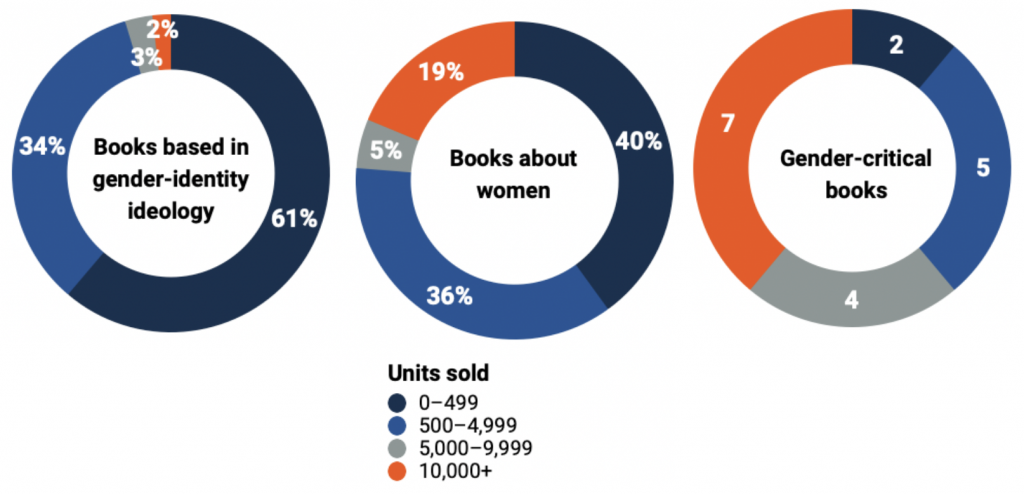
Commissioning decisions
“It’s by no means a blanket broad cancellation, but you can feel the chill.” Matthew Hamilton
The commissioning environment underpins this contradiction between book sales and the type of books that get published. A publishing employee put some of this down to a commitment to focus on EDI. “Lots of this is well-intentioned and beneficial,” she said, “but it trickles down into commissioning.”
“There was a meeting about a book on a controversial topic, not about sex and gender, and at that meeting, there were slurs about TERFs and colleagues saying we shouldn’t publish TERFs.” Publishing employee
The market for gender-critical books has been under-rated by publishers to an alarming degree. Material Girls by Kathleen Stock and Trans: When Ideology Meets Reality by Helen Joyce were both bestsellers, with combined UK sales of 45,000 (and international sales of 173,000).134 When their book proposals were originally sent out, however, ten editors turned them down because they felt that the market for them would be too small. “This is an incredibly important issue that will garner plenty of coverage and intense debate,” ran a sample comment, “but the sales numbers will be on the smaller side.”135 An interviewee from one publisher said that little thought is given to the market in commissioning decisions made by her company. “We are meant to make market-driven decisions,” she said, but they do not.
“While some people really don’t like criticism of gender ideology in books, a significant chunk of potential readers do. No book is aimed at everybody, whether it’s controversial or entertainment or information. There is a healthy appetite for this kind of thing.” Publishing employee
Another reason to turn down these ultimately very successful books included a stated dislike of their content. In written feedback on Stock’s book proposal, an editor commented: “As an ally to the trans community I find Stock’s view deeply problematic and dangerous.” Another said “[Publisher name] prides itself on putting work into the world that has positive effects and consequences, so this project is definitely not for us.” Someone else remarked, this time in reference to Joyce: “I’m familiar with Helen Joyce’s journalism and feel that often what she writes is dehumanising towards trans people as well as being based on flawed science and scaremongering.” Others mentioned personal anxiety about the topic.
Five publishers would not even read Stock’s proposal. Hypocrisy is sometimes a factor in commissioning decisions, believes Matthew Hamilton: “Publishers are ready to set aside their progressive ideals when there is a best-selling writer like Douglas Murray.” As shown by the sales figures above, both Stock and Joyce went on to become bestsellers, so perhaps this point relates more to authors who have not yet got the weight of a successful book behind them.
“I hope [this strong market] will give publishers, in a climate where it’s incredibly competitive trying to sell books and make money, reassurance that there are great opportunities to publish gender-critical work precisely because there has been a degree of censorship or bullying not to publish such work, so readers are starved of it.” Publishing employee
In other cases, editors felt that they would not successfully be able to progress the books internally. “While I thought this was good,” wrote one editor of Joyce’s proposal, “and should get a lot of attention as well, I think it would generate a lot of ire from certain quarters in-house.” Another editor turned it down because she worked with trans-identifying authors. Hamilton has heard of editors that have not progressed gender-critical books because they do not want to have a fight with their publicity directors or other colleagues.
Susanna Rustin’s book Sexed: A History of British Feminism was also turned down by one editor due to a belief that it would be resisted by colleagues: “I just don’t feel completely convinced I could get it through.” Despite her proposal being described by editors as “fascinating”, “illuminating” and “articulate and impassioned”, it was turned down by more than 20 publishers – including the editor who had originally suggested she write it. Another editor commented: “This space feels so loud and opinionated.”136
“I didn’t manage to place [a gender-critical non-fiction project] despite the enthusiasm of editors who were overruled. They wanted to publish and were told that they couldn’t… They were overruled by a shareholder who had vetoed it because of its subject.” Publishing leader
Editors have to choose whether the downsides of publishing a gender-critical book are worth it. One publishing employee gave the example of a gender-critical author who had contacted her about a potential book. She spoke to a colleague in a different department, who said: “I don’t think we would want to take this on because we have been told to avoid controversy.”
A book may not even make it to the submissions stage given the current climate. One author, who has not made his views on sex and gender public, put a sympathetic gender-critical character into the sub-plot of a novel he was writing. He ensured balance through a similarly sympathetic trans-identifying character. The author wanted readers to be able to explore the issues through the characters’ debate. His agent told him that nobody would publish a book containing this, even though it was a minor plot line and a zeitgeist issue. She gave two reasons: publishers’ fear of backlash and the fact that the gender-critical character was sympathetic. “It’s her job to be honest with me about the climate,” said the author. “But it did shock me. That’s when I realised how stifling and threatening publishing had become.”
Some editors have told Hamilton that they privately agree with gender-critical perspectives being put forward in book proposals, making comments like: “Off the record, I am completely behind you and support you, but I don’t want to have the fight and to be labelled a transphobe or for it to be used in any way politically – that I have become a difficult employee, or that I am not respecting vulnerable people within the corporate workforce.” Hamilton believes this issue extends beyond sex and gender. “For any writer who writes for The Spectator or UnHerd or goes on a podcast that challenges the progressive orthodoxy, that will apply,” he said. “The trans thing feels particularly charged.”
There is also an occasional fear of lawfare in publishing houses. A publishing employee mentioned a book proposal on a similar topic to another book that had previously been legally challenged. “The decision-maker in question was… extremely worried about the commercial impact on the company,” he said. “He was not motivated by a partisan, political stance – it was a perfectly human reaction to being in a tough situation.”
Internal publisher wranglings led to Julie Bindel’s proposed book being dropped after verbal agreements on a deal. The book was about feminism, not trans-related issues, but members of staff threatened to leave because of Bindel herself on two recent occasions. “You become the enemy, a toxic person,” said Bindel. “Even if I am talking about countering child sexual abuse, domestic violence and femicide, and nothing at all to do with the arguments about gender ideology, they will stop you from being published.”
A few years previously, Bindel had a book agreement with a small feminist publisher. After a positive acquisitions meeting, Bindel, her agent and the editor met in a pub. The editor showed great enthusiasm, saying that she couldn’t believe Bindel would consider being published by her organisation. Bindel warned her about push-back; having already experienced post-acquisitions cancellations, she told the editor that she could not go through this again. “We are feminists,” said the representative. “You have a huge reputation, don’t worry.”
However, after this meeting, Bindel was met with silence. The editor eventually informed her agent that the book proposal was being sent out to an academic who would review its suitability before the publisher made a final decision on whether to commission it, a process that does not tend to happen outside academic publishing. This took place after she had been told that getting internal sign-off would be just a formality. According to Bindel, the academic reviewer “did this patronising take-down of my views on [sex and gender identity] and said that I shouldn’t be allowed to say that there is antagonism between the aims and objectives of anti-male violence feminism and transwomen”. Bindel pulled out of the deal.137
There are decisions made about gender-critical books where we can be less certain about the underlying reasons. Professor Alex Byrne had a contract to write a book on sex and gender identity with Oxford University Press. After he submitted his manuscript, he was told that he had not dealt with the subject in “a sufficiently serious or respectful way” and that the book would not be published. A spokesperson for Oxford University Press, which has published two books by the gender-critical Australian academic Professor Holly Lawford-Smith, said that “OUP does not advocate through its publications for any particular views or beliefs”. Byrne disagreed, saying: “There is clearly a faction in OUP somewhere which disapproves greatly of publishing books that are on the gender critical side.” His book was eventually published by Polity.138
“I was still on the books with [my publisher]. The editor there was really excited about my new book and gave it a good review, then out of the blue said, ‘Unfortunately we are not going to publish [author’s name] any more. She’s not making us any money and the publishing world has changed.’ …I don’t know for sure if it had any roots in gender ideology, but it was a coincidence that around the same time, I was being accused of transphobia [at my place of employment].” Author
There is a soft censorship that emerges from the commissioning environment too. According to one interviewee, people can say in acquisitions meetings that they like a proposal but it is not for them, and then those types of books stop being put forward. “It’s a very subtle chilling effect, and then writers don’t write those books and a whole ecology disappears,” the interviewee said. “But it’s nebulous. It’s hard to pin down. Everybody feels it to be true. Nobody will be able to prove it.”
“I also know of authors whose books weren’t specifically about gender identity, but who touched on [a gender-critical understanding of it] in various ways, who then had those parts edited out… This would seem to me to prove a widespread understanding that it was generally thought to be a forbidden topic, or why would editors want to edit it out?” Publishing leader
Some books that are presumably commissioned for readers interested in women and feminism weave in threads of gender-identity beliefs – for example, defining women to include men who identify as women. In Eve: How The Female Body Drove 200 Million Years of Human Evolution, for example, author Cat Bohannon discusses “trans men and non-binary folk who have ovaries” and says that “trans women are just women whose bodies are atypical”.139 These statements imply that men can be women and vice versa, undermining both the scientific and the feminist credentials of the book.
There is a need to recognise strengths, as well: there are patches of positive, plural commissioning in some parts of the industry. “Books that challenge this [belief system] do appear,” said Hamilton. “It’s not true that there is no voice.” The bravery of Polity and Swift was mentioned by some interviewees. And despite a generally closed environment, publishers have occasionally approached authors directly to write books that are critical of gender-identity beliefs. This was the case for at least four books, including Karen Ingala Smith’s Defending Women’s Spaces140 and Jenny Lindsay’s Hounded (both published by Polity).
Book publicity and marketing
“I don’t think they publicised my books sufficiently. I can’t prove that.” Rachel Rooney
Several authors believe that their books were not given sufficient publicity and marketing support because of their beliefs, but this is almost impossible to evidence. One author’s previous book had attracted lots of coverage, but her most recent received nothing. The head of publicity at her publisher did not reply to her emails for months. “There were people reading it, nice reviews on Amazon and not a single review in print,” she said. “I do not know if [people] were ever sent a copy.” She thinks that the lack of publicity may relate to the importance of biological reality to the experience of women in her most recent book or to the fact that she has signed gender-critical open letters. Part of the difficulty lies in the unknowing: “Writers are introspective. We beat ourselves up. Does she not like me? Does she not like the book? But readers are liking the book.”
As well as being hard to evidence, it is difficult to ask proper questions about perceived under-promotion of books. One author wonders if it would be useful to ask her publisher if they have a problem with her or her book, but she does not know how to go about this without creating further difficulties. “I’d feel happier if I could prove what they think,” she said. “At least I would know what I am dealing with. I am in this grey space full of paranoia and ghosts.”
“I had a book out and it was feted. It was taken up by librarians’ associations. I was asked to give lots of talks. The next one came out and there was nothing… I offered free copies and did not even have a reply. You can’t help thinking that one of the factors must be that these organisations that talk about inclusivity are excluding you because you are not singing from the right hymn sheet. If you looked at my [social media] profile, you could work it out from who I follow. That kind of thing gives you a bit of a pause. I know there are blacklists.” Author
Some of this possible chilling effect may come from media outlets. “My book was reviewed in The Scotsman,” said Jenny Lindsay, “but the usual reviewers apparently refused to touch it.” One successful author believes her openly gender-critical views meant that her latest novel received less publicity than previous ones. She was asked by her publisher’s marketing department to desist from talking about the issue in the months before and after publication, which she did. She then received a mixture of five-star reviews from some media outlets and no communication from others. “I have never, in 30 years, written a novel for which I wasn’t interviewed on Radio 4, on Woman’s Hour, Start the Week, Front Row or other books programmes,” she said. “That’s very serious. Woman’s Hour has three million listeners, so it really does affect who knows that you have a book out.”
Helen Joyce has never been interviewed on Woman’s Hour about her book, despite the issues within it being so salient to women. Kathleen Stock was interviewed about the abuse and harassment she experienced at the University of Sussex, but not about her book. Grace Lavery, on the other hand, was interviewed about Please Miss – A Heartbreaking Work of Staggering Penis, a memoir outlining his experiences of identifying as a woman.141 While Joyce and Stock sold tens of thousands of copies of their books in the UK, Lavery sold just 1,723.142 The transactivist Juno Dawson was also interviewed on Woman’s Hour.143 Dawson has depicted womanhood as a submissive sexual identity: “I knew I wanted to be ‘the woman’ when it came to sex… It was a conscious urge to get fucked, be penetrated as a woman would be,” he wrote.144 It is surprising that somebody with such a perspective, which arguably undermines the position of women in society, has been platformed on a programme about women instead of authors who argue for women’s rights. (Bergdorf, incidentally, was given a six-figure advance for his book Transitional,145 which sold 2,915 physical copies in the UK.146 Joyce’s advance was no more than a fifth of this, at £20,000, yet her book sold more than 23,000 physical copies in the UK.)147
In some cases, evidence of a chilling effect is clearer. Publishing employees indicated that internal decisions sometimes contribute to muted publicity for gender-critical authors and books. An interviewee worked on a non-fiction book written by an author who had, around the same time, made some publicly gender-critical statements. “Someone in marketing took exception,” she said, which she thinks affected how the book was promoted. Other employees refused to work on it. The chilling effect can sometimes come from outside. Helen Joyce said: “My lovely, supportive publisher wanted to push my book further after news events made it more relevant, but didn’t want to spend ad money on it because of a potential backlash from other authors.”
Rachel Rooney was untagged from her publisher’s publicity following a sequence of events in which her publicist had said it was “out of order” for her to repost an article that referred to the author and transactivist Munroe Bergdorf as male, and her editor agreed; Rooney was wrongly accused by another senior member of staff of causing a pile-on on Juno Dawson; and the same staff member said incorrectly that she had “misgendered” Dawson by referring to an unnamed “neurotypical male author” in a separate post, which Rooney had left up for an hour before deleting.
Once her publisher said it would consequently no longer tag her into the publicity of her books, Rooney lost coverage. One of her books, for example, was read out on a children’s television programme, after which the publisher put out a thread about the books of theirs that had been included. “One was mine,” said Rooney. “Unlike other people, they didn’t tag or even name me. The image was unusually blurry, so that the author and illustrator names couldn’t be deciphered.”
“Gillian Anderson read [my book] The Problem With Problems as part of a money-raising campaign for Save the Children. It was a coup. [A transactivist social media account] contacted Save the Children and said I was all these awful things, as a result of which they removed the video.” Rachel Rooney
A couple of interviewees cited issues with their agents. One agent, for example, held an emergency meeting with other authors with whom she worked to discuss an interviewee’s supposedly “transphobic” views. “I was completely taken aback that anyone would care or my own agent would behave like that,” the author said. “In the meeting, she didn’t say one thing in support of me and complained about the position it put her in… I was reeling.”
Some interviewees perceive a converse over-promotion of books based on gender-identity beliefs. “They over-promote novels by trans people and non-fiction in general,” said one author. “People don’t want to read [them]. It’s mad. The publishers thought they were riding a wave.” As the previous section demonstrates, if such a wave ever existed, it was only a ripple: these books have, in general, had limited sales.
The chilling effect is not limited to publishers and media; it extends through into distribution and sales channels. One publisher lost its European distributor because it published a gender-critical book. “They were quite apologetic about it,” said an interviewee. “They didn’t say, ‘You are publishing a shocking book that I hate’, but they did say, ‘You are publishing a book that other clients bigger than you may find shocking, so we cannot afford to continue working with you’.” Helen Joyce had to record her audio book herself, at home, as no company in the UK was willing to record it.
This is an example of a more general pattern of second-guessing the views and reactions of other key players within the industry. “There is a basic non-political commercial judgement based on a perception of the dominant thinking of what you can and can’t say,” according to one person. These assumptions extend through the hidden parts of publishing that are not immediately apparent to people not intimately familiar with them – warehousing, distributors, wholesalers and the trade press.
Levels of stocks and positioning of books in shops clearly affect sales, and there are multiple reports of books by authors sceptical of gender-identity beliefs being moved or not stocked for ideological reasons. A well-publicised example is that of a former Waterstones employee and TikToker who lost her job after saying she would “tear up and bin” the work of one novelist.148 Individual authors have also been told that their books have been treated differently in some bookshops. A manager in one bookshop left a computer note instructing staff not to display Susanna Rustin’s book in her section.149 Rooney was told by her publisher that they had been contacted by some booksellers saying that they would not place her work.
A publicly funded literary network told Scottish bookshops last year not to stock the books of gender-critical authors nor to give them a platform. According to a report by The Times, a briefing by Literature Alliance Scotland used the derogatory term “TERFs”, whom they said were joining forces with fascists. People from key representative bodies sat on Literature Alliance Scotland’s board at the time, including the chief executive of the Scottish Book Trust, the business development manager of Publishing Scotland and the executive director of Edinburgh International Book Festival.150 Board members later said the guidance was posted without their approval and several resignations ensued.151 A few months later, in another incident, it was reported that a Creative Scotland literature officer (working, apparently, in a personal capacity) advised an Edinburgh bookshop not to stock Jenny Lindsay’s book Hounded.152
“An Edinburgh bookshop, Lighthouse Books, took up a very clear anti-gender-critical feminist position. This was a bookshop where I’d had a successful book launch in 2017, where I’d previously, as a left-wing writer, felt welcome, and now they were tweeting, ‘No TERFs, no Tories’. More troubling is that it is where Scottish PEN [an organisation that campaigns for freedom of expression in literature] regularly held book events. I wrote to Scottish PEN in April 2024 and a year later, despite following up, I have received no reply.” Magi Gibson
One publishing leader suggested that the situation in retail may be more positive than the picture painted by individual stories. He referred to a gender-critical book his company had sold that was their biggest ever seller. His worry that it would not be stocked in Waterstones was not realised: it was not prominently displayed, but it was stocked. “It’s not an ideal situation or one we ought to accept,” he said, “but it was not as bad as we had convinced ourselves it would be.”
Even in 2025, however, there remain bookshop employees comfortable saying that they will bin gender-critical books. Susan Dalgety announced the publication of the paperback version of The Women Who Wouldn’t Wheesht in early March, to which one person responded on X: “I work in a bookshop and I put any copies I find in the bin, where they belong.” When challenged, he said: “My boss is the one who started me on it, it’s a chain bookshop, we mark it as not received on the system.” An author on the thread challenged him to name the bookshop, to which he replied, “Oh you’re an author? Whee! More books to add to my bin list.” It is unclear if the post was genuine, but even if it was not, it is representative of the environment in which gender-critical authors must operate.153
Librarians (or, perhaps, library visitors) have sometimes behaved similarly. In one case, Magi Gibson was speaking at an event at the Scottish Poetry Library at which her books were meant to be laid out on a display table. They were not. “It was hard to walk in there knowing there might be antagonism towards me, then the books weren’t there,” she said. “[The staff] went looking. The books weren’t on the shelf…. They’d been distributed to different parts of the library and hidden on different shelves.” She was not sure who was responsible.
In another case, a librarian involved in the Carnegie Awards said that she considered Rooney’s A Kid In My Class to be ableist and that she had removed it from her shelves. (It was not even arguably ableist, so this behaviour may very well relate to Rooney’s gender-critical beliefs.) These actions often have knock-on effects: as a consequence of the “ableism” allegation, Rooney’s agent received a call from her illustrator’s PR to say that he would have to distance himself from her work. “This was on the basis of one comment that wasn’t even true,” said Rooney.
Funding
Organisations may believe they must publicly subscribe to gender-identity beliefs, or at least not challenge them, in order to access funding. Publishers, festival organisers and other recipients of funding may perceive that they are putting themselves at financial risk by entering what they perceive to be a controversial area (this report makes clear, however, that controversies mainly sit on the other side of the debate). Arts Council England has told funded organisations that they are monitored for the level of risk they represent in being able to deliver a given funding agreement. It says: “The type of action or activity that may constitute or influence an increase in reputational risk can include… issues with artistic and creative output that might be deemed controversial.”154 This environment also appears to be leading to self-censorship.
“Maybe it’s that people aren’t even bothering to apply to us. I haven’t seen funding going to writers or artists who are explicitly gender critical. They may not have applied as they think they have no chance.” Funder
As in publishing more generally, the environment within funding bodies can lead to individual persecution and loss of work, contributing to the broader chilling effect. Denise Fahmy is a former Arts Council employee who challenged the Deputy Director’s assertion that LGB Alliance was anti-trans, following which she was subjected to harassment on the basis of her gender-critical beliefs. “People started calling her transphobic, a petition went round and they called her a ‘cancer’ that should be cut out of the organisation,” said the Arts Council interviewee. “Her working life was untenable and she left.” Fahmy later won a legal case against her former employer, at which the employment tribunal found that she had been subjected to harassment for her gender-critical beliefs.155
There has been a homogenising effect on language, too, that often departs from observable categories. Applicants hoping to be awarded funding to run projects about women are usually explicit that they include men who identify as women, according to the Arts Council interviewee, or that they are aimed at “women and non-binary people”. This employee believes that this carries a coded assumption that non-binary people are women; it is hard to imagine an application for funding aimed at “men and non-binary people”. Funding applicants commonly market their queerness and neurodiversity, which the interviewee thinks is to ensure that heterosexual white applicants have a minority label that protects them from losing out in funding decisions. Now so many applicants are presenting themselves in this way, there is little to differentiate them from each other.
Where clear links are made between funding received and viewpoints that are arguably prejudiced towards people that hold gender-critical views, there may be an assumption that such positions are endorsed, or at least accepted, by the funders in question. An article by the trans-identifying male author Juno Dawson in 2018 was posted on Edinburgh International Book Festival’s website. It misrepresented concerns about gender-identity beliefs – saying, for example, that people “advocate the restriction of my actual movements”, which is assumed to refer to a view that men should not enter women-only spaces. The article concluded: “I am absolutely free to say that I think you’re transphobic.” Underneath this, it said: “Supported by the Scottish Government’s Edinburgh Festivals Expo Fund through Creative Scotland.”156
Deplatforming and other forms of removal
“Literary festivals are not booking gender-critical authors even though they are popular.” Jenny Lindsay
Gender-critical authors and other speakers have been deplatformed from events linked to the publishing industry. One interviewee was invited to chair a literary event. The invitation was later rescinded. A later subject access request informed her that a publicist from her own publisher had contacted the event organisers to demand her removal due to her supposedly “anti-trans” views. The author discovered through this process that her agent had known about it too. “It was betrayal on a monumental scale,” she said. After a festival director had platformed a gender-critical author, a group of local politicians contacted the director to tell her that she was a bigot. “They said they wanted to report me,” she said. “I don’t know who to. It’s a very limited idea of what we are allowed to say and who is allowed to say it.”
During live events, contributions from the audience have been closed down by the chair. Magi Gibson gave an example from the late 2010s when she was a keynote speaker for a co-hosted Scottish PEN and University of Edinburgh event for International Women’s Day. The late gender-critical campaigner Magdalen Berns spoke from the audience about her experiences of being a young lesbian in an environment in which men were self-identifying as lesbians. The chair of the event, who had previously written a piece saying that transwomen are women, attempted to close the discussion down and to stop Burns from speaking further.
Event cancellation, threatened cancellation and disruption are further issues. The Society of Friends, for example, cancelled the launch of a book written about trans-identifying children by Heather Brunskell-Evans and Michele Moore in 2018, citing staff safety and possible external protests.157 The ticketing website Eventbrite removed references to the launch of Karen Ingala Smith’s book Defending Women’s Spaces, which is about the importance of survivors of male violence having access to single-sex services and other support. Eventbrite refunded pre-purchased tickets shortly before the event was due to take place, saying that it violated the company’s policies on “hateful, dangerous, or violent content”.158 In 2023, protestors at the Edinburgh launch of Sex and Gender: A Contemporary Reader physically attempted to prevent people entering the venue and shouted “Shame on you!” at those who did so.159 Events sometimes go ahead but are affected by complaints raised against authors. In one case, this led to the question-and-answer part of a talk being cancelled.160
Venues sometimes turn down requests to host events that feature gender-critical authors. A festival director tried to book a celebrity author with gender-critical views to speak at an event she was organising, but the venue turned her down on the basis that the author was a “TERF”. A venue representative told the director later that they should not have used this term, but that people with this author’s views were not welcome in their venue. It was a choice between the local trans community and the author, and the venue was selecting the trans community, they said. The director tried two other venues. The first one gave similar reasons to the initial venue; the second said that the date did not work. The event did not go ahead.
“Venues… became an opportunity to silence people. You saw that in Edinburgh with Joanna Cherry.161 Jenny Lindsay had an enormous problem with venues. People would just withdraw. You can say they are not silencing people and they can go somewhere else, but if no-one else will have you… Publishing needs to decide if it will support all its authors and make sure all have an opportunity to talk about their books.” Festival director
In 2024, Conway Hall in central London turned down a request to host a book-focused panel discussion on the history of the women’s movement, claiming that this was due to a hypothetical “adverse reaction”. This central London venue had, a few months earlier, put on an event about cancel culture.162 The event about the women’s movement was being organised by the feminist organisation FiLiA and would have featured the authors of two recently published books: Susanna Rustin, author of Sexed, and some of the authors and editors of The Women Who Wouldn’t Wheesht. A representative of the venue emailed Lisa-Marie Taylor of FiLiA to say: “We have considered your request, and as a charity with a small team, we would be unable to handle any adverse reaction that might come as a result of Conway Hall hosting this event.” The representative went on to discuss their legal duty to protect staff and the potential impact of having protests outside.
“It’s a classic example of a hypothetical heckler’s veto,”163 commented Rustin. Taylor, FiLiA’s chief executive, said: “There was further back-and-forth as we pushed them a little more, suggesting that this is (in effect) a ban on FiLiA … which started as ‘Feminism in London’ in Conway Hall!”164
There is a type of pre-emptive action of which the presumed intended end-point is the deplatforming of authors with gender-critical views. Gibson, Lindsay and physiotherapist-comedian Elaine Miller, for example, were targeted when they came together to put on an event called Woman Word in Glasgow. Activists attempted to get the venue to cancel and, when this failed, they moved to personal harassment and accusations of transphobia. “They threatened us,” said Gibson. “They said they were going to stop us getting into the venue, and would harass and harangue us… It was a terrible storm with terrible bullying, and no support from anyone in the Scottish literary world.”
Sometimes this pre-emptive action is led by other speakers. Several authors withdrew from the 2025 Oxford Literary Festival after an announcement165 that Helen Joyce would be discussing her book Trans: When Ideology Meets Reality with fellow gender-critical author Julie Bindel. It was the first invitation Joyce had received to such an event to talk about her bestselling book – which, by this point, had sold over 100,000 copies internationally – four years after it was published.
The festival organisers had tried to find an author with opposing views to share a platform with Joyce, but they were unable to do so.166 A panellist in another session decided to step down because of the festival’s “platforming of anti-trans campaigners”, saying that a choice had been made to “prioritize hate speech over the safety of LGBTQ+ speakers and attendees”.167 Both Joyce and Bindel have previously received threats of violence against them for articulating views they share with the large majority of the British public.168 As they have not made any such threats themselves, it is not immediately apparent what these safety concerns linked to their participation might have been. (Joyce required special security to speak at this event.) Another author who stepped back from the festival called Joyce “an absolutely chilling character”.169
Joyce’s event was the only session at the festival to sell out, and it did so within 24 hours. The philosopher and author Constantine Sandis, who did a separate event at the festival after saying he would not share a stage with Joyce, reportedly sold fewer than 100 tickets to his session.170
Oxford Literary Festival organisers have been targeted as a result of their decision to platform Joyce. One author said: “As far as I’m concerned all members of the team behind the Oxford Literary Festival are transphobes until proven otherwise.”171 Another commented: “The total exclusion of trans speakers from the festival and the prominent billing of writers who have done irreparable damage to a vulnerable minority leaves me in little doubt of the festival’s organisational priorities and I refuse to profit from the tacit endorsement of transphobia.”172
Content warnings and public distancing are another form of more subtle deplatforming. Organisers of Cheltenham Literature Festival emailed panel hosts last year to ensure that the festival was distanced from a range of possible views expressed during sessions by panellists, including gender-critical ones. The email said, “If, during any of your events, a speaker shares an opinion that could be deemed controversial, please reinforce that everyone is entitled to express an opinion, however Cheltenham Festivals does not endorse the views shared on stage. By controversial we mean those views that may be harmful to an individual or group of people, particularly those who have been historically marginalised or oppressed.” The first example given was gender-critical views.173
Authors and other freelancers have found themselves quietly removed from company websites. The former editor Sibyl Ruth discovered by chance that this had happened to her. “I wanted to check all my skills and experience were shown so clients would want to work with me, and that’s when I noticed I had been disappeared,” she said. Gillian Philip’s agent did the same to her. Following the extreme social media pile-on she experienced (see the following section), she asked her agent if she would still be interested in being sent Philip’s next book; the agent said she would not. “Someone said later that they had seen my name scrubbed from the agency website,” said Philip. “It was the first I knew of it.”
Other instances of removal are side-noted with calculation. A literary agent amended the graphic of the Phoenix Book Award’s 2022 shortlist, which included Onjali Raúf’s The Boy at the Back of the Class, to remove reference to Raúf or her book. This graphic was sent from the agent’s company’s X account, while on her personal X account she posted: “Am I petty enough and procrastinating enough to amend a shortlisting image to take out the shortlisted terf. Probably.” She then posted a reply saying: “Turns out I am.”174
There have also been calls not to use writers and other creatives because of who they follow on social media. One author remembers a fellow writer posting that she would be unfollowing anyone who followed JK Rowling on Twitter, which included him. “What astonished me was the speed with which people jumped into saying they must be horrible transphobes,” he said. “I found this terrifying. I couldn’t see what the link was. I could see people saying, ‘You mustn’t use these people because they are transphobic’.” Another author mentioned seeing the same post about unfollowing people, which she found “incredibly intimidating”.
Abuse and harassment
“It is horrible to think that your colleagues hate you, that they think you are an awful person and a dreadful bigot. A couple of times it has happened quite publicly. At other times, it’s been under the radar.” Publishing employee
Public abuse and harassment
Staff from key organisations, including funders and publishers, have participated in targeted harassment against people in the industry who hold gender-critical beliefs. Rachel Rooney’s book publicist, for example, publicly supported another author in a thread stating that Rooney’s income should be curtailed and that she should be prevented from going into schools. Jenny Lindsay discovered that staff from Creative Scotland and the Scottish Book Trust were liking tweets that harassed her and called her a TERF. “These were people who used to hire me and praise my work,” she said. “I thought, ‘They are never hiring me again.’”
“Social media is a bit like rats. If you see one tweet saying you are a hateful bigoted bully, you can guarantee there will be hundreds of others.” Ursula Doyle
Some authors have been subjected to particularly concentrated, extreme abuse that has included death and rape threats. Gillian Philip, for example, was the target of a horrendous 24-hour online pile-on. “When I blocked one, two would pop up,” she said, “It was like a hydra. They would get more abusive. They were emailing me now through my website, so I was getting abusive emails. The Twitter feed was saying it couldn’t show me notifications as there were too many… I didn’t sleep until 5am.”
“You have all these people you don’t know pouring out hate, trying to get you fired and saying that they hope you die in this horrible way…It’s extremely intense and there is no escape from it. There were people trying to support me, but I was hardly seeing any of that as it was so torrential.” Gillian Philip
While Philip’s abuse appeared to be driven by fan sites linked to the Erin Hunter series, some interviewees named a small group of individuals across publishing who drive some of the vitriol. One person said that this clique had linked her books to the murder of a trans-identified teenager. She commented: “I didn’t respond, but the ludicrous accusations they make about publishers and writers who don’t toe the line – there is an impunity to it.” There is a difficulty, too, when people recognise their abusers: Lindsay said, “I preferred the anonymous people being horrible when I could see my peers being horrible as well.”
Rooney experienced a co-ordinated smear campaign involving more than 50 authors and librarians. “They were tweeting and retweeting bad things about me,” she said. “They wanted my income curtailed, slurs and calls for others of my books to be removed from the shelves.” A friend of Magi Gibson’s attended a poetry event in Edinburgh at which a trans-identifying poet dedicated a poem, which was a nasty parody of Gibson’s work, to “Scotland’s biggest transphobe”. The event organiser did nothing. “Even when I am reading normal poetry, not about this contentious issue,” said Gibson, “I worry there is going to be a complaint about me, but a transwoman could get up at an event and read a poem that was a direct attack on me, and no-one said anything.”
“I began to feel a bit vulnerable. People were starting to point a finger at me. I had a Twitter friend get in touch saying she”d just seen some people in publishing saying they’d just found out [someone in my job role] was a bigot… There were public conversations on social media saying that I was a Nazi.” Interviewee
Another interviewee was targeted by a publishing industry hopeful whose abusive thread was reposted and liked thousands of times. This happened during the pandemic so everybody was online, contributing to a feeling of visibility that would be less present today. Social-media dynamics are constantly shifting and playing into patterns of abuse. According to Matthew Hamilton: “On Bluesky, we are seeing similar behaviours and censorship… that we used to see on Twitter.”
There are sexual undertones to some of the abuse from men. “There’s envy and misogyny,” added Hamilton. “Anyone with eyes can see the attitudes at work there. It is very aggressive.”
Sometimes harassment takes the form of vexatious complaints. Trans-activist pressure made Gibson feel compelled to stand down from a new appointment to the board of one literary organisation rather than spark more attacks. A former student also made an unwarranted complaint of transphobia about her and her husband that led to their investigation by the Federation of Writers Scotland. There was no evidence to support it. “It was very much ‘The process is the punishment’,” said Gibson. “It was the fault of the climate, particularly in Scotland. If someone made an accusation of transphobia, everyone had to jump.”
“At least one person phoned in ahead of [a Scottish Poetry Library] event to say my presence would make people unsafe. I have severe osteoporosis and risk fracture if I get jostled. I have done nothing to deserve or justify that kind of treatment.” Magi Gibson
There is a phenomenon that does not stretch as far as representing clear abuse or harassment, but where being closely watched and policed for language or behaviour contributes to a hostile environment. “We are living in an era of political persecution and suppression of writers and artists, comparable to historical events of the 20th century, such as the Cultural Revolution in China, McCarthyism in the USA, and the reign of the Stasi in East Germany,” said an author. Behaviour sometimes escalates gradually. A festival director was targeted by a transactivist author because the director followed LGB Alliance on her personal X account. The author complained to the festival trustees, who took no further action. By the following year, according to the director, this author “was making demands that I showed my commitment to transgender ideology”. After the festival director sent a conciliatory note, the author “came back with ferocity to say I clearly hadn’t learned and that I was platforming gender-critical authors… She wanted nothing more to do with it.”
Antagonism sometimes runs two ways. “I don’t always think that everybody is very strategic about this,” said one author. “I love all the women that I’ve met through this, but a lot of people in the literary arts, who’ve been treated like absolute shit, tip over into being a bit troll-y online.”
Social media may give a skewed impression of general sentiments in the sector, but it can cause enormous damage. A publishing leader said that small numbers of angry people can wield enormous power and influence, and may imply that more people are angry than there really are. This can damage titles as well as individuals (see chapter 6 on impact for a fuller discussion of this).
“Witnessing the Jenny Lindsay affair was a real shock. I am ashamed to say I did not speak out or help her publicly. I have a deep sense of shame about that, as she was destroyed. Because she was so effectively destroyed, I thought that it would happen to me.” Author
Examples
Examples of apparent social-media harassment perpetrated by people in the industry are given below. There are many more, and worse, instances of abuse coming from outside publishing. It was noted by one interviewee that it is sometimes hard to capture the range of industry-sanctioned abuse as the targets are often not named, but it is clear from the context around the social-media posts who they are.
Perpetrators’ names have been redacted, as have publisher names except where their identity is relevant to the context: while some of the examples that follow are egregious, the purpose of including them is to evidence the general climate in publishing rather than criticising individuals. Two examples have been given for each area, although many more exist for many of them. Posts are given verbatim, so some contain errors.
Conflating gender-critical beliefs with transphobia and bigotry
- “Being transphobic is not equivalent to being gay, Jewish or Black. It is equivalent to being racist or homophobic. Being a bigot is not a protected characteristic I’m afraid!” Hachette employee in relation to Ursula Doyle’s case, July 2024
- (Quote tweeting a post about “transphobes and racists”) “They are across publishing too and of course they keep getting book deals and @hachetteuk has a whole imprint for TERFS it seems.” Former marketing director at a Big Five publishing company, September 2021
Implying radicalisation
- “Still mind-blown by how obsessive these authors are. Must be horrible for their family and friends to have watched them become radicalised like this.” Publishing marketer, July 2023
- “Most [gender-critical] women have been conned into a moral panic that mostly benefits the misogynist Far Right.” Author, May 2023
Stating that gender-critical views represent hate
- “Just for ref there are many people in UK publishing who are still intricately entwined with the ‘’gender critical’ movement (a proven hate campaign against trans individuals). my DMs are open if you’d like to know more.” Literary agent, April 2022
- “All those TERFs who’ve let their principles and hearts decay from cult like hatred now twisting themselves in knots justifying how much their position is identical to Trump’s.” Author, February 2025
Linking gender-critical beliefs to sexual fantasy and a desire for people who identify as trans to die
- “Julie Bindel has called for Mika [a male who identifies as a woman] to be arrested for breast-feeding her child, and a lot of [gender criticals] are joining in… The irony is that they are the ones having weird sexual fantasies and [scapegoating] trans people for what is going on in their heads.” Author, July 2023
- “Don’t assume that dead trans teenagers are, for all [gender criticals], a negative outcome. Why target trans adolescents and puberty blockers as a priority? Because they want more of us visible and vulnerable.” Author, December 2024
Equating gender-critical beliefs (termed transphobia here, which they are not) with a threat to safety
- “This is not a neutral issue. You don’t get to both sides this one. Every time a publishing organisation chooses to platform a transphobe they are signalling very clearly that they do not care about the safety of the trans community.” Author, May 2022
- “The language about trans positive doctors used by [gender criticals] and their [fascist] allies is increasingly related both to antivax conspiracy theorists and the rhetoric used to demonize and then kill abortion doctors. Sooner or later the BMA etc. are going to have to take a stand.” Author, March 2024
Foretelling tradwifery, Nazism and genocide
- “To define sex as reproductive biology and nothing else is a political choice and in my view a deeply dangerous, reactionary and misogynist one that will lead inexorably to tradwifery and being the women’s auxiliary of Nazis.” Author, May 2023
- “I have asked [Helen Joyce] repeatedly to clarify what she intends. Saying that she does not intend mass incarceration of trans people is simply not good enough. No genocide starts with that… Demanding the social segregation of trans people and the removal of existing rights, protections and identities is an obvious first step towards genocide especially when coupled with demeaning rhetoric and demanding our removal from society.” Author, June 2022
Targeting reputations and professions
- “There is a UK literary agent who I consider to be horrifically harmful to trans people.” Literary agent, February 2021
- “@LittleBrownUK and @FleetReads I am going to dissect every word of this toxic TERF-y trash fire and call out the sheer irresponsible cruelty of platforming a notorious bigot with a release like this. [Kathleen Stock] is an infamous Transphobic bully of the highest order.” Digital-content lead, February 2021
Making other threats
- “New PSA, book industry folks. I don’t care who you are, how I know you or how ‘powerful’ you might be, if I notice you following ‘G.C’ people aka Transphobic bigots, I will contact you to call it out and unfollow you if you don’t support ‘ALL’ of the LGBTQ+ community.” Digital-content lead, May 2023175
- “There is a book publishing soon (from a prominent transphobe) purporting to be about the ‘demonisation of middle-aged women’ (which to me sounds like a dog whistle for the (rightful) ‘demonisation of TERFs’, lol).” Literary agent, November 2022
Using slurs and insults
- “Their heart is so much bigger and purer than the shriveled black organs of those sad little TERFs could ever hope to be.” Librarian who used to work on CILIP children’s writing and illustration awards, February 2022
- “This shit-for-brains had me blocked a long time ago, but I’ve now read her bilge.” Author assumed to be talking about Rachel Rooney, February 2022
Scorning anonymity and implicitly supporting unlawful behaviour
- “Unlike what certain whimpering anonymous blogs going around would have you believe, the children’s book community (like actually most communities) support trans rights by vast, clear majority.” Author, June 2023, responding to an anonymous blog that included the following:
“Why is there no significant corpus of children’s authors asking questions? The answer is, we’re too scared. And understandably so. Children’s authors who have asked questions or expressed concern with the direction, nature and pace of the culture shift have been ostracised and verbally abused; they have lost representation, publishing deals, and publicity and marketing opportunities; they have been ‘cancelled’ or ‘ghosted’, characterised as transphobic and bigoted, and received serious threats to their livelihood and, in some cases, their lives.”176 - [In a thread discussing discrimination against gender-critical feminists] “Cultural values have strategic import in publishing, and many people have very strong feelings about it. Yes, maybe it is illegal; no, they really don’t care. [To be honest,] I don’t much either – as I said, I suspect we won’t see many prosecutions.” Managing editor of a publishing company, June 2024
Silence
“Writers look at Rachel Rooney, Gillian Philip and me, and instead of seeing what they should do, which is be brave and principled and speak out, they see cautionary tales.” Jenny Lindsay
One outcome of the widespread adoption of gender-identity beliefs in publishing has been required adherence to a contested monoculture, with penalties in place for those who deviate from it. A publishing employee compared it to academia, where threats of disciplinary action against people with gender-critical beliefs are customary. “The thing it has in common is this chilling effect,” she said. “Most problematic is the idea that you can’t have different views. If you don’t think about something in one particular way, you are beyond the pale.”
Several interviewees said they had deliberately not discussed their views in public due to the anticipated backlash. “I daren’t talk to people,” said one person. “I feel that if I spoke up, I would be vilified and maybe in trouble with HR. I would have a black mark because I am not going along with the company ethos.” Another commented: “I leave my belief in two sexes at the door.”
“I have seen what’s happened to some women and some men who have spoken out, and I can’t risk that.” Publishing employee
This point is reinforced by the fact that most people interviewed for this report chose to remain anonymous.
Several interviewees said they had colleagues who felt similarly to them but would not say anything in the workplace or publicly, potentially due to fear of the consequences. “People who agree with me would never publicly say so,” said Ursula Doyle. “When I wrote to management querying some aspects of the trans-inclusion policy, my letter began, ‘I am writing on behalf of a few of us’. Quite understandably, nobody wanted to put their name to it for fear of the consequences, which I think indicated that there was a problem here.”
“It has a real chilling effect on the culture. People are terrified. Nobody wants to be called out for being a bigot if you critique any of this.” Publishing employee
Publishing employees worry about the potential impact on their careers, as do authors. “It’s having a terrible effect on the literary world,” according to Jenny Lindsay. “It’s making some writers too scared to speak out, and it’s making other writers say things that I’m fairly sure they don’t believe.” Agents who hold gender-critical beliefs fear soft cancellation and losing clients. Some people have compound reasons not to speak out. “My wife doesn’t agree with my position,” said one author. “If I went public… it would affect not only my career, but also my marriage.”
“When I was growing up, there was a sense that everyone had an opinion and it was valid if it was based on facts. There is only one right opinion now… [Then,] you could sit as Conservative, Labour or Liberal Democrat and have a conversation. I don’t remember my parents’ generation having this entrenched sense of difference.” Author
When problems with training material or internal policies are raised by those who feel secure enough in their positions to do so, their challenges have often been shut down or ignored. It can also be difficult to find supportive colleagues in such an environment. Some interviewees discussed holding coded conversations as a means to identify others who have similar views. “It’s very easy for people who believe in gender-identity theory to find each other, as it’s very easy to talk about it at work,” said one publishing employee. “It’s not easy to talk about sex or biology.”
People who have been burned after speaking out about this issue often find that the usual systems of social and professional support are not available to them. When Gillian Philip experienced the online pile-on, she expected some level of support from her publishers and her agent. She had previously shown loyalty to them at great personal cost. She continued, for example, with unpaid overseas tours when her husband was admitted to hospital and when her mother, recently diagnosed with Alzheimer’s disease, had absconded. “I should have been at home, but I didn’t want to let the publishers and everyone else down,” she said. “I thought that loyalty would be reciprocated.” It was not. Of her agent, she said: “She was taking the word of the accusers and the mob over mine.” This links to a wider point made elsewhere: complaints and accusations are often taken at face value, and unquestioningly assumed to represent the truth, when the people accused are gender-critical.
“No one got in touch with me during that period to ask what was happening or ‘Are you OK?’. By the morning of the 26th, they were taking everything as gospel that the mob were saying. They were believing all these anonymous accounts.” Gillian Philip
Proffered support has sometimes been removed when supporters themselves have been attacked. A writer friend of Philip’s put a lukewarm post on Facebook that said while she did not agree with Philip’s views, the way she had been treated was terrible. People replied calling the friend a let-down and Philip a transphobe, and asking how she dared to defend Philip. The friend removed her post, telling Philip that she could not afford to have it on her Facebook page and that she was just trying to show her support. “Most people cut me dead and ignored me,” said Philip.
The silencing of non-aligned perspectives can give employers a false impression that everyone believes in gender identity. “They don’t realise that most people probably don’t agree with giving Key Stage 1 kids [aged five to seven] access to information about puberty blockers and cross-sex hormones,” said an interviewee.
Specialist areas and functions of publishing
Children’s and young adult publishing
“I’m most concerned about children’s books. It’s where the harm is being done by the unquestioning promotion of this idea.” Agent
The promotion of gender-identity beliefs in children’s publishing is widespread. As Figure 6 shows, more than a fifth (111 books) of the 21 publishers’ mapped books based on gender-identity beliefs are aimed at children. These include young-adult books, which are often marketed at younger teenagers. Titles include Are You a Boy or Are You a Girl?, Being a Super Trans Ally!, Beyond the Gender Binary, He’s My Mom!, Hooray for She, He Ze, and They!, Me and My Dysphoria Monster, The Pronoun Book, Trans Teen Survival Guide and Transmogrify! 14 Fantastical Tales of Trans Magic.
Figure 6. Books informed by gender-identity beliefs: breakdown
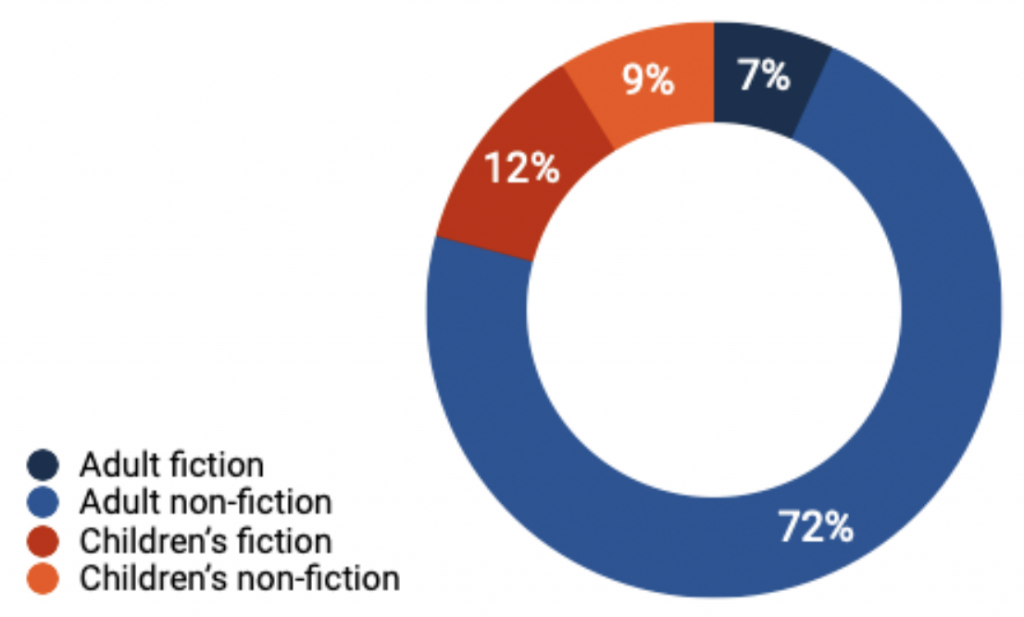
Children’s books paint a shiny, sparkly world of trans identities that fix deep-seated underlying vulnerabilities, resolve bodily hatred and create enduring joy in the form of “trans euphoria”. They are steeped in stereotypes. The blurb for the book I Am Jazz, for example, reads:177
“From the time she was two years old, Jazz knew that she had a girl’s brain in a boy’s body. She loved pink and dressing up as a mermaid and didn’t feel like herself in boy’s clothing. This confused her family, until they took her to a doctor who said that Jazz was transgender and that she was born that way.”
Jazz Jennings is now an adult who has had several transition-related surgeries and experienced post-surgical complications, as well as other health issues.
This ideological marketing to children risks causing extensive harm. It is beyond the scope of this report to detail the risks to children of gender-identity beliefs. In summary, though, these publications are teaching children from the earliest ages – many of these books are aimed at toddlers – that a trans identity can cure any bodily discomfort or anxiety that they may be feeling, and that the physical reality of biology is unimportant or can be superseded by medical interventions.
There is little recognition in the development and promotion of these titles that children who suffer from gender-related distress are more likely than other children to have underlying vulnerabilities such as poor mental health, a history of abuse or having grown up in care. They are several times more likely to be autistic or to grow up to be lesbian, gay or bisexual.178 Children who are given the label of a new identity find it hard to shake off, meaning their dysphoria can become fixed. Stereotypes also become entrenched through the idea that if girls like clothes and toys that are more typically aimed at boys, they may really be a boy in a girl’s body, and vice versa. Alarmist campaigns from activists highlighting suicide risks if children are not affirmed have been exaggerated179 and reporting of this issue has been irresponsible.
“While [children’s publishers] might say, ‘We care about disabled kids,’ they need to look at how they are doing those children a disservice – the most vulnerable children. If they are that right-on, why are they not taking note of the Cass Report180 and [how many] of those kids are autistic?” Rachel Rooney
A culture that supports these ideas has seen an enormous increase in children suffering from gender-related distress and resulting referrals to healthcare professionals. Children who are socially transitioned may be more likely to enter a medical pathway,181 resulting in long-term harms that include adult sexual dysfunction,182 an inability to have children,183 negative impacts on heart184 and bone health,185 and lifelong medicalisation.186 The mixed-sex spaces that this belief system implies – it teaches that boys and men can self-identify into the changing rooms and sports teams of girls and women, for example – carry significant safeguarding risks, including physical injury through mixed-sex contact sports and sexual assault through mixed-sex changing rooms. Such spaces and sports are also, in many cases, unlawful.187 The messages of hope these ideas convey are false: most of their promises cannot be realised.
While individual publishers’ names have not been cited outside the footnotes except in cases of legal challenge in the rest of this report (its purpose being to depict the general environment rather than naming individual or corporate instances of poor practice), this section cites publishers’ names. Children’s publishing is a small world, and the ramifications of decisions made are far-reaching: a teenage girl who hates her developing breasts reading a book that suggests she might really be a boy, and that her discomfort can be cured by a double mastectomy, is a very different prospect to an adult choosing to read a biography of a trans-identifying author.
“I am appalled by what has been published and that nobody is asking questions about whether it is suitable for children. You do have a responsibility to ask if it is suitable for an 8-year-old.” SEEN in Publishing representative
An industry-wide charter appears to have contributed to this gender-identity focus in children’s publishing. The Everybody In Charter focuses on inclusion and diversity for organisations and individuals that work with children’s books, including publishers, booksellers, authors and libraries. Both the Publishers Association and the Booksellers Association were involved in its development. The charter’s understanding of diversity includes “gender and gender identity”, but not sex (although gender might be understood as a synonym for sex here).188 Signatories include Usborne Publishing, Penguin Random House, Faber & Faber, Jessica Kingsley Publishers, The Reading Agency and BookTrust.189
The charter includes a requirement to ensure that all children are represented in books which, coupled with its definition of diversity, implies that different gender identities should be included. Usborne has reflected this in its own diversity policies, saying: “All children – including children of every ethnicity, age and gender – must be able to see themselves in our books.”190 While, on the face of it, this appears to be a reasonable aim, “every… gender” implies more than two, and there is no mention of “both sexes”.
Exam boards’ curricula and academic publishing in the form of textbooks have contributed too. Gender-identity beliefs are now threaded through some A-level specifications, teaching materials, textbooks and directives on language. Many of these have not been fully thought through, according to one interviewee: those charged with curriculum development and assessment attend a course and then update the materials. As part of its sponsorship of Pride in Education, Pearson commissioned a transactivist poem that includes the lines:191
“Education can give us confidence
to be who we are, without fear.
To value our contribution to society,
As Non-binary, Trans or Queer.”
It is, of course, brilliant if education can empower children to be confident and unafraid to be themselves. Teaching them to do this through the lens of non-binary or trans identities, however, risks entrenching discomfort with their developing bodies and a belief – when it comes to physical reality, and unlike the poem – that they cannot be who they are.
A supportive ecosystem further embeds this belief system. “You have the authors who are posting online about no dead trans kids,” said one author (as already discussed, data suggest that suicide narratives have been misreported and weaponised, and there is no evidence that transition improves things for those who feel this way). “Then you have the publishers. They are organising tours in bookshops, going out with the Pride and trans flags and the buttons.”
“Librarians have been very active at pushing trans books in schools.” Author
These connect to efforts made in this area by libraries, the School Library Association and CILIP: “They all link together and see each other doing these things in the name of inclusion and diversity, but it’s having the opposite effect.” Gender-identity beliefs imply one “correct” worldview, which happens to be anti-science: it is the antithesis of diversity, and it excludes anyone who does not conform to it.
This ecosystem is facilitated by the broader constrained atmosphere in which people in the children’s book world feel unable to challenge what is happening. “I became fearful that I would be blacklisted,” said one writer. “I am a moderately successful children’s author. I have a career to defend. If you are seen to be joining a camp, you are blacklisted by the other camp. It includes agents, publishers and the people putting pronouns in their bios.”
The wider children’s book world also contributes to the ecosystem that embeds gender-identity beliefs – the prizes, magazine covers, book tours, sensitivity readers, and social and traditional media. A trans-identified editor with Jessica Kingsley Publishers has written in The Guardian, for example: “I walk into work every day and commission books for young people that might help keep queer and trans children alive.”192 As highlighted earlier in this section, there is no evidence to back up this statement. Its implication that there is a single cause of actual or potential suicides in trans-identified children also contravenes suicide-reporting guidance as it increases the risk of contagion.193
“One of the things that disturbs me most about the whole subject is the indoctrination aspect…. It’s very strange to me that gender ideology should make itself most felt in the area that young children are reading it, on sex changes and body modification.” Matthew Hamilton
Academic and scientific publishing
The belief system may be even more tightly bound to academia than it is to publishing, which affects authors employed in universities and staff working for academic publishing companies. Gender-identity beliefs first arose in academia, so they have had more time to imbue its culture.
“Publishing and academia are little corners where people have been particularly susceptible to this, and people… might see their view as being superior and their role to shape the masses into believing this stuff.” Publishing employee
These beliefs have evolved into something more negative, according to an academic author who studied Foucault’s ideas about post-structuralism as a student (these ideas later informed Judith Butler’s notions about gender as identity and performance). Post-structuralist theory was used in the academic author’s undergraduate days to make students aware of their preconceptions and sense of identity in order to avoid projecting them onto what was being studied. It is now being used to validate their sense of who they are. “Increasingly, people are becoming activists and… creating a political agenda rather than encountering sources on their own terms,” she said. “It is destabilising and undermining.”
“The people who are very vulnerable are academics and the people who have to live in that interface between very serious careers and teaching the young.” Author
The introduction of student fees in 1998 may have contributed to the proliferation of gender-identity beliefs within academia. “Students pay so you really have to listen to them,” said one author. “I have seen how much more student-led the curriculum is… We’ve had censorship and trigger warnings that are all student-driven.”
“I feel depressed about teaching these students at the moment, as they are very closed-minded. Their mantra is about kindness, like they have been fed this kind of language. They won’t confront difficulties in themselves.” Author
In many disciplines, ideology has replaced scientific reason and empirical evidence. One interviewee said she knew people working in maths and science who were making clownfish arguments about sex in humans: this is the idea that because clownfish can change sex, human sex must be on a spectrum. (Clownfish are highly unusual in their ability to change sex. It is a talent that humans lack.194) Another gave the example of a well-known anatomist who heavily criticises those who say that sex exists. The “no debate” culture is more of an issue here than the sex denialism, according to this interviewee.
“In a lot of cases, you can’t demonstrate that something is absolutely true or false. It’s about honesty and not falsifying things. To say that something as fundamental as the existence of sex is a Western construct, and that we need to decolonise the curriculum and remove the idea of sex, is profoundly threatening.” Author
As with other areas of publishing, policies and training tend to promote gender-identity perspectives and potentially contravene equality law. “We are supposed to be a scientific organisation,” said an interviewee who works for a scientific publisher with a bullying and harassment policy that counts misgendering and deadnaming as infractions.
Changing rooms are a particular issue for universities, and therefore for the academic authors working within them. These are governed by the Workplace (Health, Safety and Welfare) Regulations 1992. “One woman meets this man every morning in the changing rooms,” said a university-based author. “The university is doing nothing about it. It needs to enforce the idea there are single-sex spaces.”
The culture is unfriendly to those who reject gender-identity beliefs. A few years ago, one academic author who was new to the arguments asked on an academic network why two prominent feminists were being subjected to criticism. “Literally thousands of women came down on me,” she said. “They told me to educate myself and check my ‘cis’ privilege.” She was later contacted by an American friend who told her that she was beginning to sound like a bigot because of her social-media posts. “It ended with her saying that I was Nazi adjacent. She then blocked me.”
“These academic women were saying ‘trans women are women’ and ‘no debate’. I had no idea if transwomen are women but ‘no debate’? We are academics! Debate is written into the DNA. That’s when I started asking questions.” Author
Bullying is widespread. Sometimes it is perpetrated by students and facilitated by internal university systems. In one case, student complaints were levelled against an author for supposedly transphobic social-media posts for which no evidence was given, and colleagues suggested to her that she should not speak about her beliefs on sex and gender identity. Students who felt “unsafe” were moved out of her classes; she told her head of department that this was inappropriate, but no action was taken. Her office noticeboard was graffitied and she was informed about a student protest against her, but was offered no protection.
There are serious problems with academic publishing and peer review. In small academic fields, no peer review process is genuinely anonymous: academics know each other’s writing style and fields of interest. “There is scope for animosity and favouritism,” said an interviewee. “I know people who have struggled to get something published as they have said, ‘Sex is real and I am talking about the biological sort.’… The peer review comes back saying the article is outdated and old-fashioned, and they recommend it is rejected.”
“With the move to open access, there is a move to fund your own publications. If you don’t have a grant, your ideas will not get published. The idea that academic publishing is any kind of neutral platform where the battle of ideas is conducted is nonsense. A huge amount is being submitted based on a belief in gender-identity ideology.” Author
Author submission guidelines in hundreds of scientific journals incorrectly state that sex is on a spectrum. Elsevier’s Science Direct is the publishing platform for more than 5,000 journals,195 of which up to 750 require authors to set aside their scientific knowledge and sign up to definitions based on a contested ideology.196
Elsevier’s guide for authors across multiple journals uses the contested term “sex assigned at birth”. Sex is observed, apart from in a tiny number of cases in which babies are born with disorders of sex development and their sex is unclear. However, the nature of these conditions and their diagnosis is such that this group of babies is definable and quantifiable, and each of them has a reproductive system that is structured around the creation of large gametes (female) or small gametes (male). Sex is binary and immutable, even taking these cases into account.197
The author guide also states:198
“Sex and gender are often incorrectly portrayed as binary (female/male or woman/man) and unchanging whereas these constructs actually exist along a spectrum and include additional sex categorizations and gender identities such as people who are intersex/have differences of sex development (DSD) or identify as non-binary.”
Medical journal The Lancet, also owned by Elsevier but published on a separate site, uses almost exactly the same phrasing in its information for authors with some minor tweaks (for example, “Sex and gender are often incorrectly portrayed as binary… concordant, and static.”)199
The implications of these guidelines for scientific knowledge and research are unclear. It is possible that (a) authors aware of the salience of sex to scientific knowledge choose not to submit papers to these journals; (b) authors change their language to match the specified language of the journals in question; and (c) authors shape their findings to fit with gender-identity beliefs rather than the material reality of sex.
“The most ominous thing is there is a silence around what is happening in publishing and academia…. The most depressing thing about this movement is how silencing it is. The more people who speak, the better, but there is a lot at stake.” Author
Journals may be rejecting important research papers because of the opinions of their authors. Dr John Armstrong of King’s College London had a paper he co-authored with Professor Alice Sullivan rejected after he was accused by staff of the British Medical Journal of being “argumentative and opinionated” on Twitter (now X). Staff on the journal separately said that Dr Michael Biggs of Oxford University was “known for being transphobic” based on a 2018 student article about him. Biggs’ paper was also rejected.200 Both papers would have contributed to the body of academic knowledge: the first in showing where an earlier statistical analysis had gone awry, and the second by showing problems with the Office for National Statistics’ census questions on sex and gender identity (concerns that were later validated by the Office for Statistics Regulation, which found that these questions did not meet the quality standards of the Code of Practice for Statistics).201
Scottish publishing
“Gender-critical writers in Scotland have been cancelled in all sorts of ghost ways for years. We have had our careers derailed. We’ve been made worse than persona non grata. We have been made whipping boys for having perfectly reasonable and legal views that we have a right to hold.” Magi Gibson
Several of the more egregious examples in this report of discrimination and harassment against people with gender-critical beliefs took place in Scotland. This may be due to the policy and cultural environment in Scotland, which has been deeply informed by gender-identity beliefs. Other sectors show how far this belief system has permeated within Scottish institutions. Scotland was at the centre of the Adam Graham/Isla Bryson scandal, for example, in which a male rapist was initially placed in a women’s prison after his guilty verdict because he identified as a woman.202 Edinburgh Rape Crisis Centre constructively dismissed Roz Adams on the basis of her beliefs that sex is binary and that survivors should be able to choose the sex of their support workers.203 The case of nurse Sandie Peggie versus NHS Fife and Dr Beth Upton is ongoing. Peggie was suspended by her employer after she complained that Upton, a male doctor who identifies as a woman, was using the female changing rooms.204
From a political perspective, the minority government passed the Gender Recognition Reform (Scotland) Bill in 2022.205 The bill would have changed the process by which people can access a gender-recognition certificate, effectively turning it into a self-identification process. The bill will not receive royal assent due to an intervention by the UK Government based on an objection that the proposed regime would have UK-wide effects, and that it was therefore outside the Scottish Government’s devolutionary competence.206 In April 2025, the Supreme Court ruled on For Women Scotland’s challenge of the Scottish Ministers’ definition of the word “woman” as it relates to the Equality Act 2010, which they held included men who hold gender-recognition certificates. The Court found against the Scottish Ministers: the word “woman” refers only to biology, not certification.207
This institutional landscape has been shaped by transactivism. Magi Gibson used to have a note on her X profile that she was a former Reader in Residence at Glasgow Women’s Library, for example; transactivists contacted the library to complain, and the library then contacted Gibson to ask her to remove this reference. Gibson noted the irony of such a request being made by an organisation tasked with conserving women’s history and writing.
“I was just walking in May, and someone at their gate shouted ‘Murderer!’ at me. I said, ‘Pardon?’ They shouted again… That person sat on the board of one of Scotland’s trans organisations and was working for another LGBT organisation at that point…. I reported it to the police, but under Scots law there is nothing they can do unless I get attacked.” Magi Gibson
Transactivism in Scottish institutions plays forward into the funding environment for authors and the arts more broadly. The Scottish Government funnels funding into quangos, literary organisations and charities, and sets an agenda that is firmly embedded in gender-identity beliefs.
“If the Government in control of the funding is telling you that this is a priority, you are going to make it a priority to get more funding and to continue with the funding you’ve got.” Magi Gibson
Creative Scotland – which, as we have already seen in chapter 6, is a Stonewall Diversity Champion, appears not to have given proper consideration to its public-sector equality duty and requires funded organisations to report meaningless data that conflates sex and gender identity – funds Literature Alliance Scotland (LAS). LAS put out trans guidance for bookshops and festivals, the content of which, according to Gibson, was “shocking”. She wrote an online article about it that led to an apology from LAS and the removal of the guidance. Gibson had previously outlined her concerns about a new code of practice for authors working with Scottish Book Trust, which she felt restricted free speech and would leave gender-critical authors open to attack for stating biological facts. She believes that her engagement with the code of practice led to the chief executive of Scottish Book Trust misrepresenting the facts of her correspondence with him on social media. She wrote another online piece, supported by evidence, to correct the record.
“All of them sound like such small things, but it’s the layering effect. Because Scotland is so small, too, no-one is ever going to hire you and give you opportunities.” Jenny Lindsay
Jenny Lindsay’s hounding in Scotland was sparked by her objection to a writer calling for “violent action” against lesbians with gender-critical beliefs. She was accused of transphobia and swarmed on social media. Other writers said that they would not share a stage with her. She was told of private groups in which she was being discussed and disparaged. Lindsay received warnings that her safety might be at risk: she had to leave her home city and lost friends. She got dropped by organisations that should have supported her. A board member of Scottish PEN, an organisation that campaigns for freedom of expression, signed an open letter accusing the Scottish Poetry Library of institutional transphobia when it came to her defence; so did the then project manager of Scottish PEN.208 The letter said:209
“It seems clear to us that there is a serious lack of understanding of trans rights, women’s rights (which are trans women’s rights), transphobia and misogyny (which affects trans women) at the Scottish Poetry Library.”
Women’s rights are not “trans women’s” rights, as clarified by the Supreme Court’s recent ruling. By the same token, misogyny does not – and cannot – affect men who identify as trans.
“Jenny Lindsay was a canary in the mine in arts in Scotland. I thought what was done to her was shocking by people who were her friends. They made such a thorough example of her that ‘None of you will dare to challenge us’, and it worked. I know lots of people didn’t speak up for that very reason.” Author
SEEN in Publishing
SEEN in Publishing, a sex equality and equity network,210 was set up in the wake of clear-cut cases of bullying, online pile-ons and other cases of harassment of gender-critical authors, publishers and others across the industry. It was launched in June 2024 as “a network of publishing professionals, authors and creatives, who recognise the material reality of sex, and support freedom of expression”.211 Its membership cuts across the political spectrum. The cases of Gillian Philip, Rachel Rooney, Onjali Raúf and Amanda Craig, as well as the broader culture, informed the decision to set it up. Its inception was driven, according to the SEEN in Publishing (SP) interviewee, by “a feeling that there is a whole area you can’t talk about and, if you do, everything is at risk”. It represents many individuals who are unable to speak publicly about this issue.
“A lot of what we do is provide a place for people not to feel so alone.” Publishing employee who is also part of SP
The backlash to the announcement that SEEN in Publishing had been established was instant and intense. “Within hours, we had all these people from the main publishing houses – Hachette, HarperCollins, Penguin and all sorts of smaller places, agencies and media companies – saying we were bigots, transphobes and racists,” said the SP representative. “We said, ‘We are not doing any of the things you say we are doing. We just need to have a conversation.’” Comments levelled at SP, its members and supporters included:212
- “I’ve seen the statement from that vile TERF publishing group and let me make something very clear: what they are calling ‘industry-sanctioned blacklisting’ is all of us rising up to call them hateful cowards and showing support for the trans community.” Commissioning editor and author
- “This is disgusting dogwhistle rhetoric that is capitalising on anti-trans governmental legislation. Solidarity to my trans colleagues. Anyone who joins this hate group can get fucked🖕” Senior marketing manager
- “I am actually really proud of all but one of my followers who have not seen fit to follow this nasty, anonymous, hate-filled little network. If you do follow it, it’s a block because this is reprehensible.” Editor
- “Get fucked.” Publisher (in response to a follow-up letter from SP about employee abuse).
“With the SEEN in Publishing announcement, the Pride networks at the big companies were quick to denounce it in a co-ordinated way. These are the people about whom the editors will be thinking, ‘Do I want to have a row with this lot?’” Matthew Hamilton
Representatives of 37 companies made negative comments on social media; polite follow-up letters were written to each of these, to which only three responded (not including the “Get fucked” response highlighted above). One replied to say that the company had no issue with staff who used their work accounts to denigrate SP.213
One of the criticisms of SP was that its organisers chose to remain anonymous, but these examples show why it has been necessary for them to do so. “I was really scared,” said the SP interviewee of her decision not to reveal her identity. She pointed out that most of the abuse directed online at SP had been sent from social-media accounts that were linked to their employers in the publishing industry. It is striking that calling people disgusting, nasty bigots can be done in full daylight, while joining a network that believes in the material reality of sex requires secrecy to protect those joining it from the perpetrators of this open abuse.
The backlash against SP further demonstrated that, within publishing, discrimination and harassment of people with gender-critical views are live, tangible issues. “I thought things were getting better,” said an agent. “Then I saw the response to SEEN in Publishing… I was really gobsmacked.” An interviewee was on a discussion group with representatives of other sex equality and equity networks after the launch, and asked them if any of them had a similar response in their own sectors. They had not. “Nobody else’s sector responded in such a deranged manner as publishing,” she said.
SP organisers would like to reach the stage at which people in the industry can speak freely about their beliefs, whether these relate to sex and gender or other issues, and at which point it can cease to exist. The SP representative said she would like people in publishing to acknowledge there is a problem and some of the harm that has been done; to support young staff without centring their belief systems; and to make it more possible for staff members to speak without fear. An author said that she wanted people in the industry to undo some of the harms outlined in this report. “If we are still here in 10 years, that would be depressing,” said another interviewee who is part of SP. “We want to disband SEEN in Publishing as soon as we can.”
“I would like to leave publishing in a better place. It’s been a good career to me, and I’ve been so horrified by what I’ve seen in the last five years. It’s not the industry I joined or the one I want to leave behind.” SEEN in Publishing representative
The impact
Impact on authors, agents and staff
“There are lots of women walking around who’ve done so much work, and behaved so decently, and we are walking around with all these wounds.” Magi Gibson
Personal impact
The identities of interviewees have been obscured in the section that follows, even when they have been named in other parts of the report, due to the very personal nature of some of the effects. Exceptions have been made where quotes are more general than personal.
“I feel as if I am the Ancient Mariner. It’s robbed me of my sense of who I am, my identity, my peace of mind, my reputation – it’s all gone.”
The personal impact on the people who have been harmed by the pervasiveness of gender-identity beliefs in publishing has been immeasurable. The biggest effect has been on stress and poor mental health, which was mentioned by almost half the interviewees. “I’m so anxious, paranoid and tearful all the time,” said one person whose livelihood has been affected. “Mental health-wise, one of the things that is really difficult is that dreadful knowledge that there is no way out of it,” said another. “I was never getting my old life back.” Someone else commented: “I suffer from anxiety anyway and my levels went through the roof.”
“It’s in my head all the time. I dream about it almost every night.”
One person was affected so badly she felt suicidal. Her doctor referred her to a psychologist. “A month later, I’d come through the crisis but, my goodness, I was in pieces,” she said. The pressure on her led her to soul-search, to question herself about whether she was cruel or behaving badly. She concluded that she needed to be able to state the facts as she saw them. “It is a truth and I need to state it,” she said; “and I have every right to do so, even if it’s different from someone else’s truth.”
Mental-health impacts also contribute to the broader chilling effect. “When other people see you under this kind of strain,” said an interviewee, “it makes it more difficult for them to speak up. People feel outraged and upset on my behalf, and they don’t feel able to challenge it themselves.”
“I struggle to express the whole distress of it all. I have never cried. It is too huge.”
Another key impact has been in fears about personal safety, as well as the safety of family members.
Physical ill-health has been a further substantive impact of the hostile environment outlined earlier in this report. Interviewees described a variety of physical-health impacts of their experiences, including migraines in one person that were so severe she had to lie on the floor at work, vomiting into a bucket; weight loss and weight gain, panic attacks, poor sleep and high blood pressure. One interviewee developed a health condition that saw her hospitalised at the end of a stressful work period involving conflict over the pervasiveness of gender-identity beliefs in her workplace. “I attribute it directly to the issues that were going on around that,” she said. “I am on lifelong medication now.”
“I don’t know a single woman who has been in the public eye and hounded who hasn’t had digestive issues and cancer scares and all those things that are part of living in flight and flight for so long.” Jenny Lindsay
Cancellations, deplatforming and loss of work have financial consequences, as well as effects on family life. One person may lose her home. “Financially, it’s destroyed me,” said another. “It buggered up my relationship with my daughter, who is a supporter of gender-identity ideology,” said one interviewee. “There is a pain in that.”
“A lot of it was compounded by the financial situation that I was in. I couldn’t think beyond, ‘I’ve made the bills for this month. How will I make them for next month?’”
Anger, loss and disappointment were common themes. People are angry at their treatment and, sometimes, at the lack of support they have received. An interviewee commented: “I feel almost more contempt for people who are my level and peer group who say privately ‘I agree with you, but I can’t say so publicly’.” A sense of loss was pervasive. One person commented: “To have that dedication, loyalty and good work not reciprocated at all felt like a huge betrayal. It was quite devastating.”
“The personal impact? A profound disappointment and sadness at the loss of relationships – what you thought they were, they were not – and how self-serving and cowardly people I really admired and were close to me have shown themselves to be. I’ve had to recalibrate everything… It’s been very difficult to lose those relationships, but in a way, I didn’t have them anyway. I only had them when I wasn’t saying anything.”
There is sometimes a fear of being uncovered as someone who has beliefs that do not align to the mainstream belief system. “You get all these anxieties and paranoias about what people are thinking about you and that they secretly think you are a massive bigot,” said one person, “or that they will expose you.”
In some cases, people’s personal experiences have strengthened their belief that gender identity is an inappropriate belief system around which to build workplace structures. “It hardened my viewpoint, that’s for sure,” said one author. “I thought: ‘Look what you have done to literature.’ Suddenly there is a climate of censorship that didn’t exist before.” Another said: “People had lost their minds… A man is a man, and is still a man even if he wants to be a woman. I still occasionally wake up and wonder if I am going mad. People don’t seem to be able to see what’s real.”
Professional impact
“Some people do think I am a Nazi bigot and think I want to murder trans children or whatever it is they believe that middle-aged women think…. It’s been a pretty poisonous thing. I don’t know what it has to do with books and reading and that lovely experience of sharing in other people’s thoughts and ideas.” Festival director
Loss of work has been the biggest professional impact. Several of the named interviewees in this research have lost book and employment contracts, speaking engagements and other means of generating income. Rachel Rooney stopped writing after two and a half years of cross-industry bullying, much of which took place online. Jenny Lindsay lost clients, speaking engagements and other works after her hounding. Ursula Doyle brought a legal claim of discrimination against her former employer, Hachette, which has since been settled.
“It was really unjust. It was nothing to do with how good I was as a poet and an events organiser.” Jenny Lindsay
Gillian Philip was fired after she was swarmed on social media; she was told her publishers were sorry, as she was a great writer, but this did not pay the bills. She said: “Professionally I was persona non grata with publishers and agents.” She now drives trucks for a living.
Sibyl Ruth’s contract as an editor was effectively terminated after she posted on social media about her lawfully held beliefs. She brought a legal case against her former company, which settled before it went to court. Financial compensation did not fix her loss of work, however. “I was assured at an early stage that I had a strong case,” she said. “I thought there would come a point where it was established that the organisation had acted wrongly. At that point, I thought people would say: ‘I’m sorry. Welcome back. Let us shower you with projects.’ It’s not what happens.”
These losses are cumulative, as people who are seen as industry disruptors or troublemakers are less likely to get work in the future. “There is a lot of risk-averse behaviour going on. Even if someone heard you might be involved, you are not wanted,” said Ruth. “There are scores of graduates who might passionately believe in these ideologies – if they look right, sound right and don’t make trouble, they get the work, even if they are not as good.”
Other interviewees have lost work too, including clients and the ability to put on events, or have witnessed other people losing work on the basis of their beliefs. An editor employed by an educational publisher, for example, noticed that her company stopped working with an author who had challenged a general focus on social justice at the expense of basic language skills. “I feel that we put fashionable box-ticking before loyalty to authors,” she said.
“If you are looking for the approval of these people, a lot of the time nothing happens, but your clients may be quietly not given life…. Anyone who is really interested in prestigious and powerful positions in the industry won’t have a long history of heterodox authors. You see what the game is and play it.” Matthew Hamilton
A less immediately cataclysmic but related effect has been the erosion of professional networks that give people career security. People have been excluded from meetings and professional networks due to their beliefs. Doyle started to be excluded from conversations that she would previously have been invited to join and said that colleagues would no longer discuss anything meaningful with her. Lindsay described losing layers of people at each stage of the process: in 2019 when she was first hounded, then with the open letter, then with an essay she wrote about her experiences and later with her book, Hounded. “Nothing has changed about my views whatsoever,” she said, “but at each stage I get more attention, lose more clients and more people cut me off.” Her CV now “looks like squirrels have nested in it. It is hard to get work.”
“They are very subtle. It’s not as if they are coming out and saying that they don’t like my stance. They are distancing themselves. In a university environment, it is almost imperceptible, but I understand that there is a world I am not allowed to join now. Sometimes it”s social events, sometimes it’s team meetings, and I don’t seem to get the memo.” Academic author
An author said that his network had been affected too. “If you are online and not following the right people and the right things, then offline, it is the same,” he said. “Previously I was on nodding terms with the main actors and now they wouldn’t look at me. There’s almost a religious schism.”
Some people have lost the ability or will to be creative. Philip said: “I had a very good relationship with my publisher and my agent, and to have that disappear in minutes and hours rendered me unable to write.” Lindsay lost her love for poetry through this process, saying that there is no way to have that life without continued upset. “I don’t write even now,” said Rooney. “It’s like a post-traumatic response.” Another interviewee mentioned a loss of joy in putting on events.
“I think I have useful and important things to say. I would expect the publishers to support me. It has made me feel as if I am going mad as, for whatever reason, they are not promoting the book. I feel betrayed, abandoned and very angry. People keep asking me what I am going to write about next. Why would I do that and put in years of dripping blood onto the page when they are going to treat me like this?” Author
Other effects include the time wasted in having to engage with this belief system, professional hypervigilance and worries about unforeseen consequences. An interviewee mentioned her worries about tainting people by association when she sits with them on panels. People in publishing sometimes second-guess their decisions. One person said that she included a non-binary celebrity in a book she was editing. “We wouldn’t have any trans people without me,” she said. “Am I covering my back?”
The personal impact may be compounded due to being unable to share difficult experiences fully with friends and colleagues. After Ruth was sacked by her former company, she increased the hours that she spent in her alternative library-based career. She chose not to speak about what had happened to her with people she did not know and trust fully. “How do you tell new colleagues that you are involved in an employment dispute?” she asked. She was concerned that people would think her a troublemaker or worry she would harm them in some way: “So I said nothing.”
Many interviewees have made compromises in the course of their work. These include not stating their beliefs or stating them in a more muted fashion than they would otherwise choose, and using the language of gender-identity beliefs, including chosen pronouns and LGBTQIA in place of LGB. “As I’d never compromise on my beliefs,” said Jenny Lindsay, “I’ve had to compromise on no longer following my passion for working in the arts.”
Professional impacts on individual authors, agents and publishing staff have knock-on effects on the industry and wider culture. Jenny Lindsay used to be a bridge between institutions and grassroots writers, part of which involved scouting for new talent. “Nobody else is really doing that now in Scotland,” she said. “It’s a real loss.”
Another interviewee, who has been running literary events in a rural area for a number of years, has decided to stop. This is due, in part, to her local arts venue’s treatment of her and its ultimate refusal to host any gender-critical authors she might want to invite. “So much in the arts is being told ‘no’,” she said. “You need to have enough ‘yes’ moments for you to keep going.” As a result, her town will lose visitors and income, and local residents – who live some distance from the nearest city – will lose an invaluable cultural touchstone. “There is real poverty and cultural poverty here,” according to this interviewee. “It’s dreary if you don’t sprinkle in the fairy dust of lovely arts stuff. There’s little for kids to do. It’s a loss.”
“If there had been a climate of open discussion without censure or fear, it would have led to a much healthier, intellectual artistic climate.” Author
Gender-critical people working in publishing have not always experienced a negative impact as a result of their beliefs, and some who have spoken out do not regret having done so. One publishing employee said: “I work with the authors that I want to on the books that I want to… I haven’t felt that I have had to compromise what I publish.” An interviewee whose views are known in the industry makes an effort to speak to people she knows do not agree with her, and tries to attend a variety of meetings and events. “If I get invited to parties, I go, I talk to people and I don’t worry about whether people hate me,” she said. An author was glad she had spoken about this issue: “I have a more authentic life, but I am sad and sorry that I have lost all the people from before.”
“I wouldn’t want to repeat the last 5 years, but I’m glad I spoke out about this. I can’t think that there is anything more embarrassing than not speaking out, because it is insanity. It is going to stop and I will hold my head up in time.” Jenny Lindsay
Legal, financial and reputational damage and risk
“The protected characteristics are a shield to protect everyone, not a sword to advance the causes of certain groups.” Funder
Organisations in publishing are putting themselves in a position of legal and reputational risk through a range of unlawful policies and activities; in some cases, this risk has converted to active damage. Several concluded legal cases and settled claims inform the environment in which publishers, agencies and organisations allied to publishing operate. Some of these have been touched on during this report, including Ruth v Cornerstones Publishing (Cornerstones settled and paid a sum in lieu of damages). Gillian Philip’s case against HarperCollins and Working Partners was not allowed to proceed on the basis that Philip was found to be neither an “employee” nor a “worker”,214 though a different contractual relationship (or a different legal interpretation of her contractual relationship) might well have seen her case succeed. Denise Fahmy was found by Leeds Employment Tribunal to have been subjected to harassment for her gender-critical beliefs through her employment with Arts Council England.215
The environment for gender-critical academic authors may improve in the wake of the University of Sussex being fined £585,000 for breaches of free speech and governance issues in March 2025. The university was investigated after the harassment and linked departure of Professor Kathleen Stock in 2021.216 The record fine seems likely to give vice-chancellors an incentive to reflect on what may be happening on their own campuses.
There are several relevant cases from outside publishing too, the case law and precedent from which inform the environment in publishing. Forstater v CGD Europe established that people who hold gender-critical beliefs are protected from unlawful discrimination by the Equality Act 2010.217 Since then, many cases have established protections for gender-critical employees and workers, including Meade v Westminster City Council and Social Work England, Phoenix v The Open University, Pitt v Cambridgeshire County Council and Bailey v Stonewall, Garden Court Chambers & Others.
Professor Jo Phoenix, who was a successful claimant against the Open University, has partnered with researcher Ruth Birchall to analyse these cases and others, from which they have drawn six areas of organisational failure. The content of this report suggests that these are all areas of significant legal risk for organisations in the publishing industry:218
- They prioritise the expression of gender affirmative belief over the expression of gender critical belief
- They fail to take rigorous and active steps to protect those who hold GC beliefs from unlawful discrimination and harassment
- They fail to equally protect people who hold gender affirmative beliefs, no belief and gender critical beliefs
- They fail to educate staff that GC belief holders are protected from unlawful discrimination and harassment; and that the expression of them is not inherently harmful, degrading or contrary to the Equality Act 2010
- They fail to challenge the culture of raising complaints against GC staff for expressing lawful GC beliefs
- They fail to stop a dominant or “extreme” gender affirmative culture taking hold within their organisation.
As chapter 6 – covering the environment in publishing – demonstrates, employers sometimes describe gender-critical beliefs as transphobic; it is likely that this represents unlawful harassment of staff who hold these beliefs. The discrimination-law expert Dr Michael Foran has pointed out that various employment tribunals “have all held that employers/duty-bearers describing mere statements of gender critical/sex realist views as transphobic constitutes unlawful harassment”.219 The equality law specialist and solicitor Audrey Ludwig also believes that calling manifestations of gender-critical belief “transphobic”, and equating them to racism or homophobia, are potentially themselves “unlawful harassment on grounds of belief”.220 (This was in response to a post from a Hachette employee who targeted Ursula Doyle.)
Organisations are frequently failing to balance the needs and rights of employees and workers who have the protected characteristic of gender reassignment with the needs and rights of employees and workers who have different protected characteristics. These include women through the protected characteristic of sex, who may need female-only changing rooms and toilets (some people, both women and men, also require single-sex spaces under the protected characteristic of religion); LGB staff through the protected characteristic of sexual orientation, who may need company-level representation that does not assume that trans-identifying people of the opposite sex should be in their dating pool; and disabled staff, who may need accessible toilets that have not been designated as third spaces.
Employers may be leaving themselves open to indirect discrimination claims when they impose policies and rules that consider the needs and rights of only one group. They are also failing to pay attention to the risk that vexatious complaints can be made against those in publishing who hold gender-critical beliefs by those who disagree with them.
Employers are ignoring unlawful and abusive statements made by their own staff. By doing so, they may be putting themselves at legal risk. Several employees who state their company links in their social-media profiles said that they would not work with anyone involved in SEEN in Publishing; this is potentially unlawful discrimination on the grounds of gender-critical belief. If workers or employees lose work as a result of staff actions, there might even be a claim against the employer using section 109 of the Equality Act 2010, through which staff are conducting themselves in a way for which the employer may be liable. A similar claim might be made against employers under the same section of the act when their staff are abusing or harassing other staff members, as was the case with some Hachette employees towards Ursula Doyle (see the section on abuse and harassment in chapter 6).
Public-sector organisations allied to publishing, such as funders, are bound by the public-sector equality duty and put themselves at risk of unlawful behaviour if they fail to uphold it. According to the Equality and Human Rights Commission, this duty requires public bodies to “put an end to unlawful behaviour that is banned by the Equality Act 2010, including discrimination, harassment and victimisation; advance equal opportunities between people who have a protected characteristic and those who do not; [and] foster good relations between people who have a protected characteristic and those who do not.”221 The Arts Council England’s inclusion review cited earlier found that it had not yet met its obligation to foster good relations between staff, and in particular between those who are gender-critical and those who hold “pro trans” views. The review said:222
“The Arts Council’s leaders need to set clear expectations on how groups and individuals interact with each other when they hold directly competing philosophical views. When this standard is not met the consequences need to be demonstrably equitable for people on each side of a debate.
“Individuals need to recognise the legal right of the other group to their belief, and that they do not have the right to discriminate against an individual for holding that belief. Staff colleagues must also recognise that the privilege of working for the state comes with compromises and requires high standards and interpersonal relations. This is true both for staff colleagues and for the Arts Council itself. The Arts Council is part of the UK state and does not have full freedom of action in how it engages with philosophical debates. Staff colleagues (including some more senior staff colleagues) do not fully appreciate the nature of these limitations.”
The Arts Council’s response to this review recognised that there was work to do in this area, saying: “Colleagues across a range of protected characteristics have not experienced the care and respect we all owe each other.” It promised a review of progress at 12 and 18 months.223 No record of these could be found at the time of writing, although a delivery plan published in November 2024 set an intention to implement the review’s recommendations.224
Creative Scotland has also exhibited some dubious practice when it comes to the public-sector equality duty. Its equalities monitoring form, for example, fails to ask about sex: instead, it asks about gender, giving the options of “male”, “female” and “other”. The form fails to ask, too, about gender reassignment or the “belief” element of religion and belief.225 It is hard to see how an organisation can be fulfilling its statutory obligation to advance equal opportunities between people who have a protected characteristic and those who do not if it collects no data on said characteristics.
Employers are potentially contravening the law by collecting data about “gender” in a way that conflates sex and gender identity, rendering the data meaningless. The General Data Protection Regulation requires organisations to have a lawful basis for processing data, many bases of which require the processing to be “necessary”. This, according to the Information Commissioner’s Office, means that the processing “must be more than just useful, and more than just standard practice. It must be a targeted and proportionate way of achieving a specific purpose.”226 When the answers to a question include, for example, male, female and non-binary, the question represents category mash-up for which it is difficult to see any necessary purpose.
Literary venues and representative bodies sometimes appear to be acting unlawfully too. Some examples were given earlier in this report. One interviewee also mentioned a local venue that refused to host events with authors that had gender-critical views. “They maintained that they weren’t discriminating against anyone on the basis of a protected characteristic,” she said. “They did. They said it specifically and with witnesses.”
The backlash in publishing against the Supreme Court’s ruling on the definition of the words “women” and “sex” in the Equality Act may imply a lack of desire in some quarters to act within the law. Two days after the ruling, the Bluesky account of one publishing company put out a post saying:227
“If you had any doubt about where transphobia leads, you only have to look to America, where it is already being used as a tool of fascism, as an early wedge in dehumanising larger and larger swathes of people.
“Trans rights are human rights. Attacks on trans rights are attacks on human rights.🏳️⚧️🏳️⚧️🏳️⚧️”
The same day, a children’s publishing company put out a post on Instagram with an illustration of a child alongside the words: “You see, I may have been born a boy, but I don’t always feel like the boys. Sometimes I feel more like the girls. Sometimes I feel somewhere in between.” The accompanying caption said: “Solidarity to our trans and non-binary friends! 🏳️⚧️.”228
An email to SEEN in Publishing from a representative of The Bookseller explaining why the publication had chosen not to cover the ruling said: “It doesn’t feel that immediately relevant to publishers.” The content of this report, however, suggests it is all too salient.
Litigation is costly for all parties; it would be better for everyone if organisations ensured they were acting within the law. Barriers to claimants include the fragility of contractual relationships in publishing, as Philip found. Costs are also prohibitive and can run into hundreds of thousands for both claimant and respondent. An employment tribunal is generally a cost-neutral forum in that litigants rarely have to pay the other side’s legal bills, but they do not recoup their own costs. Even when a settlement is made, it is not a financial fix-all for a successful claimant. Ruth pointed out that a settlement functions more as a cushion or a compensation for a lost future than it does recompense for lost income. Being able to continue working within the sector would mean she had a resource available if she needed to continue working in retirement or faced an unexpected bill. This is no longer available to her.
Staff at all levels in publishing appear to lack a detailed understanding of the Equality Act, which would help them to minimise these substantial legal, financial and reputational risks.
Ripple effects
The endemic problems in publishing caused by gender-identity beliefs have ripple effects elsewhere:
Language and ideas: if concepts and categories are changed to represent identity rather than underlying reality, it changes what people understand of the words on a page, and has all sorts of consequences for what we think and believe.
“The language you use is so bound up in the argument you make. It’s been a fight about language, and it’s not trivial what language you use.” Publishing employee
Other groups of people: the children’s book world has contributed to an environment in which it is normal for children to believe their bodies must be wrong if they do not fit the stereotypes of their sex, with potential lifelong medical harms for some of them. Publishing has also contributed to a wider culture in which women’s sports, services and other spaces have been eroded.
“If males can identify as females, the word ‘female’ becomes meaningless.” Publishing employee
Scientific knowledge and progress: academic publishing – and, particularly, the journals that require submissions to be based around the fallacy that sex is on a spectrum – is contributing to the erosion of scientific norms and the integrity of scientific knowledge.
The future of publishing
“In an optimistic way, I hope that sanity will prevail and we will come to see this as a period of madness. I hope that it will become more possible for me and authors who are gender-critical or biological realists to express these beliefs.” Publishing employee
There are early signs that the culture is improving. “I feel like the atmosphere is slightly less fevered than it was,” said a publishing employee. “Things like the Cass Report have had a huge impact on that.” The multiple court cases demonstrating the personal, financial and legal costs of unlawful discrimination against people with legally held beliefs has also made the situation easier for gender-critical people in publishing. One interviewee was recently awarded funding after having been fully gender-critical in her application. People in workplaces are quietly dropping stated pronouns, according to someone else. Another said that most people now believe that we need single-sex changing rooms and women-only sports teams. “It’s been a decade or so of cultural madness,” she said.
“At work, I haven’t heard about this stuff for three months… so I am hoping… that it has become desperately unfashionable. And it is a fashion that has such appalling effects on people’s lives.” Publishing employee
The backlash against the Supreme Court ruling, however, puts this more positive trajectory in doubt.
Positive change may take time. A publishing leader pointed to anecdotal evidence that teenagers may be growing tired of gender-identity beliefs, saying: “It is entirely possible that this stuff will go out of fashion, but the people now in junior roles in publishing who are most exercised about it will move up the chain and ladder. Does that then mean you have a management cohort who are more passionately in favour, or will it all become unfashionable? It’s not obvious. Anyone who predicts with confidence is not to be relied on.”
“The last place in society that will drop this is the arts and academia. That is where it gestated and spilled from there into wider society. As wider society rejects this, arts will still style itself as the resistance until such time as there has been such a mood change in society that people who have quietly gone along with it no longer feel they have to do so.” Author
Change may be difficult without the support of organisations like the Society of Authors. “It’s such a weird employment environment where the people who do most of the [creation] are the ones with the least rights,” said Gillian Philip. “I don’t think that is going to change any time soon.” In another perspective, change may come from authors themselves, with or without the support of the SoA. Jenny Lindsay believes that some authors are starting to recognise what has been lost, and that they should not have stepped back, especially those who have limited experience of social media. “A lot of older writers didn’t need to use these platforms when they were making a career, so they hadn’t really paid attention to how awful things had got,” she said. “Now they are paying attention.”
Another interviewee struggled to see how the people who have perpetrated the worst of the abuse against people who do not align with gender-identity beliefs will ever change course. There may be more change among the people that followed them, however. “Lots of people went along with it because they wanted to be seen as progressive and, once they don’t have to be seen that way or think it’s no longer a progressive movement, it will isolate them in the way that we were isolated,” said an author.
“A change in the culture is what could do it. It has to come from within, and it will be very slow in the publishing industry because it is so heavily captured.” Gillian Philip
It is possible that more court cases will need to play out to effect real change. The ramifications of the Supreme Court ruling for the industry are significant. As this report demonstrates, employers in publishing have put in place many unlawful policies. Many publishing companies, for example, are still operating on the basis of self-identification in their policies and guidelines. “What you need is more tribunals and cases,” said a publishing employee. “People who will say: ‘I will take my employer to court because you are indirectly discriminating against me – I can’t go to the gym because you are not offering single-sex changing rooms’.”
“As more people are winning settlement fees from employers that have behaved badly [even though] they thought they were [acting lawfully], institutions will take better advice.” Publishing leader
Another interviewee said that the outcome of Ursula Doyle’s legal case would be key. She believes that the many people in publishing who only read The Guardian or get their news from the BBC, which tend to cover these issues less than other outlets and to be partisan towards gender-identity beliefs, will have no idea about the many employment-tribunal outcomes that demonstrate the consequences of unlawful discrimination against those who hold gender-critical beliefs.
“When organisations realise the financial and legal risk, they will stop doing it.” Publishing employee
This point about The Guardian and the BBC links to a broader one about mainstream media which, until recently, had not been giving these issues a great deal of attention. “Sunlight is the best disinfectant,” said a publishing employee. “Once people start to know about it, they start having to answer questions and to justify this stuff, and then it dies away, but if it’s all happening in secret, it continues.”
Change is also likely to be driven by the market. Commercial imperatives, informed by better information, are likely to take over. “Eventually people will realise these books are crap and not selling,” said Gillian Philip. “It will be a long, slow grind of changing culture and attitudes.”
“Reality is biting. People are seeing what puberty blockers are doing to children and starting to wonder why girls want to cut their breasts off. There is a lot of confusion about what it means to be [transgender], and when people start to look into it, they realise the enormous implications. And if you then get a book saying you can [change to] be a boy or a girl, parents will recoil from that.” Author
It is also feasible that change will be driven by more people with gender-critical beliefs gaining confidence to speak up following clarification of the meaning of the word “sex” in law.
Conclusions and recommendations
Conclusions
- The views of people who believe in the material reality of sex are protected in law, are based on evidence and reflect the views of the majority of the British public. Sex differences between men and women matter in certain contexts, including sports, changing rooms and prisons. Men are physically different to women, and evidence shows that they are more likely to perpetrate sexual violence, regardless of how they identify. Children who identify as trans are more likely than those who do not to have poor underlying mental health, to have been abused, to have autism and to grow up to be same-sex attracted, all suggesting that their identity is not based on a permanent state of being. Gender-identity beliefs reduce men, women, girls and boys to stereotypes based on personality and appearance, and restrict women’s ability to articulate and discuss their shared experiences.
- Freedom of expression and lawful treatment of employees, authors and other freelancers is good for publishing, the creative industries more broadly and wider culture. Publishing is at the heart of the creative industries. Theatre, television and film start with words on a page. Ensuring that readers are able to access different perspectives is key to rich culture and debate, and supports the financial viability of bookshops, libraries and festivals. Treasury tax receipts benefit, too. Exclusion in the name of inclusion undermines these possibilities.
- There have been serious failures in law, policy, safeguarding, training and data collection. HR and EDI policies commonly focus on gender identity rather than sex-based or belief-based protections, and they often ignore – and sometimes contravene – the Equality Act 2010. Editorial policies are often infused with gender-identity beliefs, while free-speech policies are frequently lacking. Staff networks focused on gender identity mean that women’s rights and needs in the workplace are overlooked, and representation is lacking for those lesbian, gay and bisexual staff who perceive conflicts between trans rights and their own. Data collection and analysis on sex and gender identity is poor, with category overlaps leading to meaningless data. EDI training is inadequate: it is sometimes delivered by organisations that do not understand the law, and it often fails to balance the needs and rights of different groups.
- Culture and language in publishing have contributed to an environment in which people who believe in the material reality of sex have been cancelled, harassed and abused with impunity. Language often inaccurately represents gender-critical beliefs and can be discriminatory. Without recognition of nuance or open discussion of different perspectives, attempts to be inclusive of one group lead to the exclusion of others. Individuals have faced disciplinary action and lost work due to their views, and concerns raised by gender-critical members of staff have often been ignored. Concerns, when they are addressed, are frequently treated individually instead of as part of a broader systemic issue. There is a widespread assumption that it is acceptable to harass and even abuse people with non-aligned views. There has been widespread industry participation in targeted harassment, abuse and threats, including accusations of transphobia, hate and genocide. Some of those targeted have been threatened with violence.
- These failures have created tangible, significant personal and professional detriments, as well as a wider culture of fear. People have lost work, reputations, networks and their future careers, with consequences for financial security and family life. Many have experienced mental and physical ill-health as a result of their experiences. Some individuals have lost the will and even the ability to write. Being unable to share these difficult experiences with friends and colleagues has compounded, for many, the personal impact. Some people feel unable to speak out about the damage caused by this belief system due to fears that they will experience the damage to careers, finances and health that they have witnessed in others.
- Organisations have also created legal, financial and reputational risks and harms by acting unlawfully. The multiple areas in which organisations appear to be acting outside the law include policies that allow men to self-identify into female toilets, failures to balance the needs and rights of different protected groups, and ignoring harassment and abuse perpetrated by members of staff. Mislabelling gender-critical beliefs as transphobic is likely to constitute unlawful harassment, and publishers may be violating data-protection laws by collecting meaningless data that conflates sex and gender identity, and that lacks a necessary purpose. These legal risks are leading to actual and potential claims that have significant financial consequences, and that risk serious reputational damage to organisations found to have contravened the law.
- Funders, unions and other industry bodies have often exacerbated these harms instead of fixing them. The Society of Authors has failed to stand up for the rights of members who have been harmed by this belief system. Guidelines written by the Publishers Association have contributed to inaccurate statistics and the lack of meaningful industry data. Public bodies, including funders in publishing, risk breaching the public-sector equality duty through their actions. Various of these organisations have established links to transactivist groups instead of ensuring impartiality in conduct, advice and allocation of funding.
- The situation in children’s publishing is particularly concerning. Books should not teach children that there is something permanently wrong with their bodies if they are going through temporary struggles with identity or physical development. Children’s books based on gender-identity beliefs often entrench stereotypes, present an idealised vision of trans identities as a solution to distress and ignore underlying vulnerabilities. An industry-wide charter reinforces some of these issues, and they are supported by a broader ecosystem that includes booksellers, exam boards, libraries and literary prizes. Children’s publishing is arguably indoctrinating children into this belief system and may be contributing to the high number experiencing gender-related distress.
- A sustainable industry is based on markets, not ideology. Analysis of published books and linked sales figures shows that the overrepresentation of books based on gender-identity beliefs is based on ideology, not the market.
- Clear leadership is required to course-correct. The culture in publishing has been driven by vocal activists and staff who believe themselves to be progressive and their views to be the only correct ones. Decisive leadership would ensure that policies are lawful; that the needs of all staff are considered in the development of internal policies and processes, including trans-identifying staff, gender-critical staff, LGB staff and women; that training is delivered by competent organisations that understand the Equality Act; and that their staff understand what a plural, diverse sector looks like, and why this matters for the financial security of the industry as well as everyone who works within it.
“In terms of the culture, senior leadership has to wake up. They can be saying the right things, but they have to be paying attention to what is going on below them. They can’t just be sitting in an ivory tower saying: ‘We publish for everyone.’ If staff are acting in a way that is contrary to that, you have to act.” Publishing employee
Recommendations
Sector-wide recommendations
- Ensure that internal policies, processes and training are compliant with the Equality Act 2010. This means ensuring that the needs and rights of groups that have different protected characteristics are balanced; that there is explicit reference made in policies to protections from unlawful discrimination on the basis of belief, sex (not gender), gender reassignment and sexual orientation alongside the other protected characteristics; and ensuring that leaders, managers and anyone with a role in HR or EDI has received specialist equality-law training from an organisation that understands it. Where other training or external consultancy is sought, it should be delivered by organisations that are ideologically neutral and that know how to ensure employers are legally compliant.
Data should be collected on the basis of sex (male and female). It may sometimes be necessary to collect data on gender reassignment for monitoring purposes relating to the Equality Act. If organisations collect data on gender identity without having a clear, lawful purpose for processing it, they may be contravening the General Data Protection Regulation.
Organisations should also check who is advising them. If previous advice on policies, processes and training turns out to be incorrect, new advisors should be sought. - Make a clear commitment to freedom of speech both internally and in commissioned work. Companies should ensure that everyone in the workforce understands the importance of freedom of belief and speech, that there is a difference between hurt and harm, and that gender-critical beliefs are lawful, representative of the general beliefs of the country, and do not in themselves cause harm; and that staff and new joiners are aware that they may sometimes need to work on books containing ideas with which they do not agree. New joiners could be asked to commit to working on books that cover a range of ideas and perspectives as part of their employment contracts.
“Publishers should be interrogating their staff, especially the younger ones when they come in, saying: ‘This is not a place of activism. You will have to work on books you don’t necessarily agree with.’ If they can’t cope with that, you shouldn’t employ them.” Matthew Hamilton
- Aim for institutional neutrality. Companies should ensure they avoid signing up to political statements that may alienate parts of the workforce and that they keep tenets of belief systems, such as the Progress flag and preferred pronouns, out of official materials. It may be worth running internal checks to ensure that publicity is allocated to books on the basis of their content and market potential, not on whether publicists agree with the ideas contained within them. More junior members of the workforce may need more mentoring both for career-development purposes and to ensure they understand how to apply the principle of neutrality. There is a linked need to encourage ideas of autonomy and accountability among staff, and to move away from ideas of identities centred around victimhood.
- Stand up to abuse and other forms of harassment perpetrated by staff. This means being clear that abuse on social media will not be tolerated if perpetrators are doing it from an account that shows they are an employee of the organisation in question; and challenging individuals and staff networks that use slurs like “TERF”, or that groundlessly accuse other staff or authors of transphobia. Individuals who continue to harass others within the industry on the basis of their protected beliefs should face appropriate disciplinary procedures.
- Review diversity policies and pay. The industry is not diverse on several measures, including socio-economic status, political beliefs, sex and geography. This has contributed to a monoculture in which alternative perspectives are not tolerated. Reviewing policies to make roles more appealing to people from working-class backgrounds and to men would be a first step, as would be giving greater consideration to diversity of thought when recruiting for new positions. It may not be feasible for all organisations to review pay, but it would be useful to do this where possible – both to appeal to a more diverse range of potential employees and to prevent the trade-off whereby people expect their belief systems to be implemented in return for lower pay than in other sectors.
Organisation-specific recommendations
Publishers and agencies: commission interesting, challenging books that reflect a plurality of ideas and perspectives, and that reflect what people want to buy and read. This may require courage from leadership. It is likely to require a different emphasis on the books that are being sought – rather than books by writers that identify as non-binary, for example, agents and editors might choose to make clear that they are seeking intelligent, well-written books that are likely to sell well. It would be helpful to put robust policies in place to ensure the abuse of people with gender-critical beliefs, as well as those with other protected characteristics, is not tolerated. Publishers should also consider conducting reviews of their own titles based on gender-identity beliefs, looking at sales figures, publicity levels and other investments in order to establish the profitability (or otherwise) of related commissioning decisions.
“I want to see a movement towards a more holistic, inclusive publishing world – the republic of letters where all ideas exist and everyone can exchange ideas.” Author
Scientific publishers: centre evidence and knowledge, and remove all policies stipulating that papers must be based on gender-identity beliefs to be considered for publication. This means removing guidelines that require authors to sign up to a definition of sex that says it is on a spectrum and can be changed. It would also be valuable to review the peer-review process to ensure that papers are not rejected on the basis of authors’ belief that sex is real and important.
Public funders: specify that an institutional commitment to free speech is a condition of funding, and uphold the Nolan Principles. This means that venues that receive public money platform people with legally protected beliefs; that literary funding goes to organisations that have committed not to shut down debate; and that financial agreements are rescinded when organisations break their commitments. Public bodies, including funders, should also themselves commit to upholding the Nolan Principles on standards in public life.
Industry bodies: ensure that sector guidance is accurate and lawful, and commit to fair treatment of different groups that have lawfully held beliefs. The Publishers Association should ensure it is putting out guidance that aligns with the Equality Act and ensures accurate data collection. The Society of Authors must protect the interests of gender-critical authors to the same extent that it does the interests of other authors. It would also be beneficial if an industry body were to take responsibility for advocating for the rights and protections of industry freelancers who are on precarious contracts, who have little on which to fall back if they find themselves at the sharp end of discrimination.
SEEN in Publishing: engage with the Publishers Association, CIPD or other relevant bodies to encourage them to develop a suite of template policies on EDI, HR and freedom of speech that are Equality Act-compliant, specific to publishing and that can easily be adapted by individual organisations. If they are willing to do so, it will also be worth working behind the scenes with funders, unions and other industry organisations to ensure that sector-wide guidance is lawful and supports a thriving, plural industry. Possible areas of future enquiry are the three specialist areas and functions of publishing in which there have been particularly damaging impacts of gender-identity beliefs: children’s and young-adult publishing, academic and scientific publishing, and Scottish publishing.
Annex: Method
Liaison with SEEN in Publishing
A virtual inception meeting was held with members of SEEN in Publishing to agree and further refine the research approach. Ideas were shared regularly via a dedicated Discord channel. SEEN in Publishing steering group members provided invaluable support to this research, including sourcing supplementary information as part of the informal evidence review, and sourcing and sharing social-media snippets.
Interviews
Due to the sensitive nature of the research and the potential for activists to attempt to sabotage it, a decision was taken not to publicise it widely. Initial interviews were sourced using SEEN in Publishing’s networks and recommendations. Interviewees were either people who had experienced negative impacts of gender-identity beliefs in publishing or those who worked in publishing leadership and had a sense of its broader effects. Minimum interviewee numbers were set in different categories before recruitment began, including five authors, three senior and two junior staff within different publishing houses.
Interviews were supplemented using a snowball sampling approach through which interviewees recommended other contacts. We ensured that interviewees came from a broad range of different organisations and job roles, for people employed in the industry; and, for authors, from a range of creative backgrounds and specialisms.
Twenty-five interviews were delivered online in January and February 2025 using a semi-structured discussion guide. For people who had been directly affected by gender-identity beliefs, questions covered their experiences of it at work, through professional networks and via social media; and the impact it had on their work, prospects and wellbeing. Those in senior roles who have not been directly affected were asked about the development of the belief system in their organisations and how (where applicable) the environment was shaped, as well as their observations about its impact on colleagues. Some interviewees were asked questions about workplace codes and cultures of conduct. All interviewees were asked for their thoughts on how the culture in publishing can be improved for gender-identity sceptics.
Research participants were offered full anonymity and, for those who chose to keep their experiences anonymous, their stories have been written up to obscure identifying details.
Online and social-media reviews, and informal evidence call
Using a combination of searches for key terms, annual reports, EDI/HR policies available on websites, targeted Google searches and social-media platforms, the information sourced for each organisation included, where available:
- The presence of Pride/LGBT(Q+) and women’s networks, and whether the women’s networks are organised by sex or gender identity.
- Whether each organisation’s website mentions training, indices or other resources offered by Stonewall, Mermaids, GIRES, Gendered Intelligence, Trans in the City or similar organisations; and whether senior leaders from the publisher in question have spoken at events organised by these organisations.
- Which training organisations state they have provided training for the publisher in question, along with an assessment of whether the training is likely to be compliant with the Equality Act.
- Whether organisations give due regard to the protected characteristics of sex, gender reassignment and belief.
- How annual reports and EDI/HR policies approach issues of sex and gender, including whether there is recognition of the material reality of sex, and the balance of reporting in terms of the needs of female employees (protected characteristic: sex) and the needs of trans employees (protected characteristic: gender reassignment).
- What the organisation’s website says about the Equality Act, protected characteristics and balancing of rights.
The publishers analysed for this information were Atlantic Books, Bloomsbury, Bonnier Books, Cambridge University Press, Canongate Books, CGP Books, DK, Faber & Faber, Hachette, HarperCollins, Informa, Oxford University Press, Pan Macmillan, Pearson, Penguin Random House, Profile Books, Scholastic, Simon and Schuster, Usborne Books, Verso Books and Walker Books. These represented a mixture of the big trade, academic, children’s and educational publishers. A selection of imprints were checked alongside these brands when their content was not held on the main websites; this was not comprehensive due to the numbers involved.
Three agencies were also reviewed: Curtis Brown, United Agents and WME. The focus funders, unions and membership bodies comprised Arts Council England, Creative Scotland, Publishers Association, Publishing Scotland, the Society of Authors and the Society of Young Publishers.
Online review information was supplemented by a search of relevant press coverage and other online reports, and by links submitted by SEEN in Publishing’s steering-group members and their contacts. It was initially believed that there would be comprehensive gaps in information that would need to be filled through an informal call for evidence, but there were minimal gaps – lack of input data was not one of the challenges of this piece of research. There was, however, no publicly available information on the provision or otherwise of single-sex facilities and compliant unisex facilities, so this was sought informally using SEEN in Publishing’s networks.
Some individuals in the industry, and particularly people who had been targeted online, were asked to provide screenshots and links of social-media posts that were abusive or constituted harassment in other ways. A light-touch analysis was run on these posts, supplemented by targeted searches run on X and Bluesky.
Published books and sales review
Published books were sourced using within-website searches. For books based on gender-identity beliefs, searches included terms such as trans, transgender, non-binary, gender identity, gender diverse and gender diversity. Individual book pages were then checked to ensure they had some basis in gender-identity beliefs. Fiction books were included when one of the main characters identifies as trans. Some well-known books were added that did not come up using the main search terms, including Pageboy and Being Jazz.
Books were excluded that focused on more general LGBT issues (to avoid the possibility of mistakenly including books that represent the interests of LGB people). An exception was made for LGBT children’s books, as any book with “T” in the title is likely to teach children at least some elements of gender-identity beliefs. Children’s books with Progress flags on the front cover were included when they were seen, although these clearly did not come up on the main searches.
For books about women, titles were included that had one of the words woman, women, female, feminist or feminism in the title, and that excluded the word “gender” from their blurbs. Books were also excluded that had the given search terms but that were equally about men, as were books about women that were clearly (generally) aimed at men (for example, How to Chat Up Women), and a few books that were not obviously aimed at women, despite their titles, including some books about faith.
Across the three categories, the following books were excluded: those that appeared to be on a part of the website that sells books to a non-UK market, those that were in multiple volumes (the first book in a volume was selected to represent the rest), and those that were obviously out of print. On some websites with several thousand hits, further exclusions were made to search terms to narrow down the results (for example, including the word “book” and excluding “journal” and “blog”). Non-UK books were included only if they had a UK publisher.
As with the online review, some major imprints were checked where they were not on the main websites, but not all of them. Most publishers appear to include the books of all their imprints on their main websites (or they do not have imprints), including Atlantic Books, Bonnier Books, Cambridge University Press, Canongate, CGP Books, DK, Faber & Faber, Oxford University Press, Pan Macmillan, Penguin Random House (via its UK Penguin site), Profile Books, Simon and Schuster, Usborne, Verso and Walker Books. HarperCollins Children’s Books was checked separately, as was Bloomsbury Professional and Osprey Publishing (Bloomsbury); Headline Books, Jessica Kingsley Publishing, Little, Brown and Hachette Children’s (Hachette); and Chicken House Books (Scholastic). For Informa, Routledge and Psychology Press were included, but Taylor & Francis appears to include all imprints with no straightforward way of filtering out journal articles, and was too large to include in the available time. The Cambridge University Press Bookshop site was reviewed for the book search in place of its main website, as there were no blurbs provided on the main site (to allow books about women that have “gender” in their blurb to be excluded).
For the analysis of book sales, the focus was trade non-fiction books; academic books were thought to be too specialist for meaningful comparison. Books published by Cambridge University Press, Informa and Oxford University Press were therefore excluded, as were academic titles from publishers such as Bloomsbury. Sales are UK-only and exclude e-books. Gender-critical trade non-fiction books from across the industry were included for comparison, with the exception of self-published books: there are few enough of these to include all publishers (apart from academic titles and those published by academic presses like Polity), although it is likely – because it was not based on within-site searches – that some were missed. 80 books about women were randomly selected from the larger file using a randomising function. Wollstonecraft’s A Vindication of the Rights of Women was one of the books that came up; only the Penguin version was included (there were more than 100) as it would have skewed the results to include all of them.
ISBN numbers were sourced for each title using Amazon: some had several ISBNs covering different hardback and paperback editions, each one of which was run through Nielsen BookScan so that the sales figures could be collated. Sales figures for the books analysis provided earlier were correct on 8th–9th March 2025.
Analysis and write-up
Interview text was generally taken from detailed notes made during the interviews rather than word-for-word from audio files. Quotes were occasionally lightly edited to remove hesitations. Interview analysis was thematic, as were the qualitative elements of the online review. The social-media review was less in-depth but also based on thematic analysis. Individual quantitative elements (for example, the proportion of organisations that correctly cite the protected characteristic of sex) were coded, then calculated and presented visually where possible. The various research elements were triangulated and then used to develop the report.
Some caution was taken in the write-up of interviews to ensure that experiences were retold at a sufficiently high level that individuals could not be identified by those who know them. For the same reason, care has been taken over the use of language: “EDI” has been used in place of other potential acronyms (for example, DEI or D&I) even in direct quotes from interviewees to ensure their places of work cannot be reverse-engineered; “Pride network” and “women’s network” have been used in place of any alternatives for the same reason, except in cases in which interviewees waived anonymity. And for ease of reading, punctuation has occasionally been added to social media quotes: capital letters where a quote starts mid-sentence, and full stops where they are missing.
In a handful of cases, members of SEEN in Publishing added new points when reviewing the draft report. Where these have been included, they are presented according to their role in the industry (“An author said…”).
Legal checks
There was a great deal of legal content in the draft report, and we wanted readers to have confidence in the linked legal analysis. It was therefore read by solicitor and equality-law specialist Peter Daly, who confirmed points and made revisions where necessary.
Limitations
This research was commissioned to investigate widespread but anecdotal reports that publishing has become a hostile environment for people who hold gender-critical beliefs. Conducting this research was limited by, and therefore to some degree is further evidence of, this hostile environment.
Snowball sampling (existing study participants suggesting future participants) was used, so the views included in this report may not be wholly representative of people in publishing who have been affected by the gender-identity belief system. The inputs to this report have also been limited by the fact that we were unable to publicise the research; it is likely that we would have had a deeper and broader range of examples had we been able to do so.
There are various potential and actual limitations linked to the website, book and sales searches. The intention was not to produce an in-depth bibliometric study or comprehensive website content analysis; it was to investigate reports that publishing has become a hostile environment for some people working within it. Website searches were relied upon for the assessment of current policies and approaches that affect gender-critical staff, authors and other freelancers, as direct engagement with the organisations in question – which might have produced more complete data – risked undermining the research or increasing pressures on gender-critical staff.
Books do not always come up in standard online searches, so some are likely to be missing. Shortlisted books may not always have a transactivist agenda; sometimes this has been inferred from the title. Some books about women may have been wrongly excluded in cases where the publisher used gender as a synonym for sex. The volume of different ISBN numbers linked to individual titles leaves a possibility of data-entry errors.
Low sales figures for books based on gender-identity beliefs may partly reflect the inclusion of Jessica Kingsley Publishers, which is highly specialised; but there are books by the same publisher on the comparison list, such as those on women and autism. Specialist titles by small publishers such as Swift Press have also been included in the gender-critical comparisons.
There is, as in all research projects, a limit on the time available for the research, the data collection element of which took place over eight weeks. The searches run will not have picked up everything and errors will have been made: these, where they exist, are the author’s. The findings, though, demonstrate important general patterns and linked lessons for the industry.
- One person’s transcript was not used following a change in circumstances.[↩]
- Section 27 of the Equality Act 2010 provides interviewees with protection against victimisation, that is, suffering a detriment from their employers because they have made a protected act. Contributing to this research meets the definition of a protected act: s.27(2)(c) “doing any other thing for the purposes of or in connection with this Act” and (d) making an allegation (whether or not express) that A or another person has contravened this Act.[↩]
- The seven principles of public life are selflessness, integrity, objectivity, accountability, openness, honesty and transparency. Source: Committee on Standards in Public Life (1995). Guidance: The Seven Principles of Public Life.[↩]
- For Women Scotland v The Scottish Ministers (2025). UKSC 16.[↩]
- Fair Play for Women (2024). How ‘Inclusion’ in Sport is Harming Women and Girls.[↩]
- 151 out of 245. See UK Parliament (2024). Written Question – Prisoners: Transgender People. UIN 20298, tabled on 16th December 2024.[↩]
- 14,469 men were convicted of a sexual offence out of 65,427 total convictions. Source: Ministry of Justice & HM Prison and Probation Service (2025). Prison population: 31 December 2024. Table 1.Q.5. Time series: prison population under an immediate custodial sentence by sex, age group, and offence group, England and Wales.[↩]
- Becerra-Culqui, T. A. et al. (2018). Mental health of transgender and gender nonconforming youth compared with their peers. Pediatrics, 141(5).[↩]
- Calculated from Kaltiala-Heino, R. et al. (2018). Gender dysphoria in adolescence: current perspectives. Adolescent Health, Medicine and Therapeutics, 31–41.[↩]
- They make up 4.9% of service referrals but only 0.6% of children in England. Matthews, T. et al. (2019). Gender Dysphoria in looked-after and adopted young people in a gender identity development service. Clinical Child Psychology and Psychiatry, 24(1), 112-128.[↩]
- Thoma, B. C. et al. (2021). Disparities in childhood abuse between transgender and cisgender adolescents. Pediatrics, 148(2).[↩]
- There were 1,933 referrals made for girls, 853 referrals made for boys and 799 referrals made for children whose sex was unknown. Source: GIDS (2023). Number of referrals to GIDS. (Downloaded on 7th December 2023; data tables have since been removed.)[↩]
- Calculated from (a) Holt, V., Skagerberg, E., & Dunsford, M. (2016). Young people with features of gender dysphoria: Demographics and associated difficulties. Clinical Child Psychology and Psychiatry, 21(1), 108-118 and (b) Office for National Statistics data on the national proportion of young people who are exclusively same-sex attracted or bisexual.[↩]
- Streed Jr, C. G. et al. (2017). Cardiovascular disease among transgender adults receiving hormone therapy: a narrative review. Annals of Internal Medicine, 167(4), 256-267.[↩]
- Schagen, S. E. et al. S. E. (2020). Bone development in transgender adolescents treated with GnRH analogues and subsequent gender-affirming hormones. The Journal of Clinical Endocrinology & Metabolism, 105(12), e4252-e4263.[↩]
- van Trotsenburg, M. A. (2009). Gynecological aspects of transgender healthcare. International Journal of Transgenderism, 11(4), 238-246.[↩]
- Cass, H. (2024). Independent Review of Gender Identity Services for Children and Young People.[↩]
- YouGov (2025). Where does the British public stand on transgender rights in 2024/25?[↩]
- Trans-exclusionary radical feminists – a slur often directed at gender-critical women.[↩]
- pBloomsbury Publishing (2022). Diversity, Equity and Inclusion Annual Report.[↩]
- Employment Appeal Tribunal (2021). Maya Forstater v CGD Europe, Center for Global Development and Masood Ahmed. Judgment. Appeal No. UKEAT/0105/20/JOJ.[↩]
- Publishers Association (2024). UK Publishing Workforce: Diversity, Inclusion and Belonging in 2024.[↩]
- 262,000 people said in the most recent census that the gender with which they identify is not the same as their sex registered at birth, while it was the same for 45.4 million. This means that 0.57% of those answering the linked question said they had a different gender identity to their sex (please note, however, that there were quality issues with this question). Source: Office for National Statistics (2023). Gender identity, England and Wales: Census 2021.[↩]
- Pan Macmillan (no date). Diversity, Equity and Inclusion (accessed 3rd March 2025).[↩]
- The Society of Young Publishers (2025). Volunteer (accessed 21st February 2025).[↩]
- Publishers Association (2024). UK Publishing Workforce: Diversity, Inclusion and Belonging in 2024.[↩]
- Cambridge University Press & Assessment (2024). Building a Place Where Everyone Belongs: Equality, Diversity, Inclusion and Belonging Report 2022–24.[↩]
- Pearson (2015). Diversity & Inclusion.[↩]
- Simon & Schuster (no date). Manuscript Submissions (accessed 25th February 2025).[↩]
- Email from Cornerstones to Sibyl Ruth, 7th June 2022 (shared by email, January 2025).[↩]
- Creative Scotland (2024). Equalities, Diversity and Inclusion Mainstreaming Report 2022–2024. | Hachette (2021). Changing the Story: Our People and Publishing Transparency Report. | Informa (2024). UK Colleagues and Pay: 2023 Report. | Penguin Random House UK (2021). Our 2021 Pay Gap Report. | Interviews[↩]
- Regulation 20 (2) (c), Workplace (Health, Safety and Welfare) Regulations, 1992.[↩]
- Sexual harassment is defined at s.26(2) of the Equality Act 2010. It proscribes conduct of “a sexual nature”. Misgendering, though relevant to sex, is not “sexual”.[↩]
- Bonnier Books (2022). Bonnier Books UK introduces menopause policy to break down stigma (accessed 25th February 2025).[↩]
- Penguin Random House UK (2020). 2020 Gender Pay Gap Report.[↩]
- Hachette (no date). Diversity and inclusion (accessed 25th February 2025).[↩]
- Hachette (2023). Gender Pay Gap Report 2023.[↩]
- Cambridge University Press & Assessment (2023). Editorial Services Style Guide for Academic Books, Version 5.0.[↩]
- Pearson (2020). Pearson WILL UK Gender Equality Guidelines.[↩]
- Informa (2023). Inclusive Language Guide.[↩]
- For example, “We recognise there are some limits to freedom of speech.” Source: Bonnier Books (no date). Our values (accessed 19th March 2025).[↩]
- One publisher’s UK investor relations site, for example, highlights its donation to the American Civil Liberties Union (ACLU) as part of its defence of free speech (source: Bloomsbury Investor Relations (no date). Our Communities. Accessed 19th March 2025). The ACLU is a vigorous defender of gender-identity ideology, calling opposition to it “cruel and discriminatory”. See, for example, ACLU (2025). Defend Trans Freedom.[↩]
- The Guardian (2021). ‘If publishers become afraid, we’re in trouble’: publishing’s cancel culture debate boils over.[↩]
- The Independent (2020). JK Rowling: Hachette UK book staff told they are not allowed to boycott author over trans row.[↩]
- The Bookseller (2021). Publishing faces ‘watershed moment’ on free expression, Alexander and Shelley say.[↩]
- Regulation 20 (2) (c), Workplace (Health, Safety and Welfare) Regulations, 1992.[↩]
- Regulation 20 (2) (c), Workplace (Health, Safety and Welfare) Regulations, 1992.[↩]
- The Publishers Association (2023). The Publishers Association Inclusivity Action Plan.[↩]
- The Publishers Association (2021). Understanding Author Diversity Report.[↩]
- Equality Act 2010, s.4.[↩]
- This should, more accurately, be protection from unlawful discrimination: in some cases, it is lawful to discriminate on the basis of a protected characteristic as in, for example, the provision of single-sex toilets.[↩]
- Publishing Scotland (2016). Equality, Diversity and Inclusion Policy.[↩]
- Arts Council England (no date). Equality Objectives (accessed 28th February 2025).[↩]
- Arts Council England (no date). Guide to Producing Equality Action Objectives and Plans for NPOs: Introductory Section.[↩]
- Creative Scotland (no date). Equalities in Creative Scotland (accessed 28 February 2025).[↩]
- Equality Act 2010, s.149.[↩]
- Creative Scotland (no date). Equality Impact Assessment – Development of the Multi-Year Funding Programme for Organisations as Part of Creative Scotland’s Future Funding Framework (accessed 28 February 2025).[↩]
- Society of Young Publishers (2023). Equality, Diversity and Inclusion in Publishing Hiring.[↩]
- The Booksellers Association, The Society of Authors, The Publishers Association & The Association of Authors” Agents (2023). An Industry-Wide Commitment to Professional Behaviour in Bookselling and Publishing.[↩]
- Sullivan, A. (2025). Independent Review of Data, Statistics and Research on Sex and Gender. Department for Science, Innovation and Technology, Social Research Institute and UCL.[↩]
- Penguin Random House UK (no date). Environmental, Social and Governance Data Report 2023.[↩]
- For example, Informa’s voluntary census, “which provided a valuable baseline of data on colleagues’ backgrounds including gender identity, race and ethnicity and caring responsibilities”. Source: Informa (2022). UK Colleagues and Pay: 2021 Report.[↩]
- Hachette (2023). Gender Pay Gap Report 2023.[↩]
- Government Equalities Office and Women and Equalities Unit (2024). Statutory guidance: Preparing your data (accessed 25th February 2025).[↩]
- Government Equalities Office and Women and Equalities Unit (2024). Statutory guidance: Preparing your data (accessed 25th February 2025).[↩]
- The Publishers Association (2021). Understanding Author Diversity Report.[↩]
- The Publishers Association (no date). Diversity, Equity & Inclusion (accessed 20th February 2025).[↩]
- Creative Scotland (2024). Equalities, Diversity and Inclusion Mainstreaming Report 2022–2024.[↩]
- Arts Council England (no date). NPO Survey Template 23+.[↩]
- Hilton, E. et al. (2021). The reality of sex. Irish Journal of Medical Science (1971-), 190(4), 1647.[↩]
- Arts Council England & University of Essex (2024). Cultural Freelancers Study 2024.[↩]
- Arts Council England (2017). NPO Survey Questions 2017–18.[↩]
- Canongate (2024). Canongate Books is now a B Corp! (accessed 25th February 2025).[↩]
- B Corp (no date). About B Corp Certification: Measuring a company’s entire social and environmental impact (accessed 25th February 2025).[↩]
- B Corp (2025). Justice, Equity, Diversity & Inclusion (accessed 25th February 2025).[↩]
- The Publishers Association (2023). The Publishers Association Inclusivity Action Plan.[↩]
- Scottish Trans and Stonewall Scotland (2017). Getting Equalities Monitoring Right. [↩]
- Government Equalities Office and Women and Equalities Unit (2024). Statutory guidance: Preparing your data (accessed 25th February 2025).[↩]
- In pay gap reporting requirements, for example.[↩]
- UK Parliament (2010). Equality Act.[↩]
- Publishing Scotland (2023). Annual Report and Accounts: Aithisg Bhliadhnail agus Cunntasan 2021/2022.[↩]
- Creative Access (no date). Training (accessed 20th February 2025).[↩]
- Publishing Scotland (2023). Publishers Association launches the newest iteration of its Inclusivity Action Plan.[↩]
- Cambridge University Press & Assessment (2024). Building a Place Where Everyone Belongs: Equality, Diversity, Inclusion and Belonging Report 2022–24.[↩]
- The Bookseller (2021). Open letter says ‘transphobia acceptable in British book industry’. | Creative Scotland (2017). Mainstreaming Equalities, Diversity and Inclusion (EDI): EDI Report 2017. | Hachette (2021). Changing the Story: Our People and Publishing Transparency Report. | Interviews[↩]
- Stonewall (2024). Getting started with trans inclusion in your workplace (accessed 30th April 2025). For information about why this is unlawful, see For Women Scotland v The Scottish Ministers (2025). UKSC 16.[↩]
- Charity Commission for England and Wales (2024). Decision – Charity Inquiry: Mermaids.[↩]
- Creative Scotland (2025). Equalities in Creative Scotland (accessed 4th March 2025).[↩]
- Oxford University Press (2021). #ThrowBack: Celebrating International Women’s Day at OUP.[↩]
- The Times (2020). JK Rowling publisher asked Mermaids trans group to ‘censor’ legal article on free-speech ruling.[↩]
- e.g. Hachette UK (no date) Diversity and inclusion (accessed 3rd March 2025). | Arts Council England (2025). Jobs and careers (accessed 4th March 2025).[↩]
- Cambridge University Press & Assessment (no date). Dictionary – TERF (accessed 14th February 2025).[↩]
- MacFarlane, N. D. (2021). Extreme ‘gender critical’ views will alienate many gender dysphoric patients. BJPsych Bulletin, 45(5), 311-312.[↩]
- Arvan, M. (2023). Trans Women, Cis Women, Alien Women, and Robot Women Are Women: They Are All (Simply) Adults Gendered Female. Hypatia, 38(2), 373-389.[↩]
- EUPHA-SGMH, EUPHA-CAPH, TGEU, ILGA-Europe, IGLYO, EPATH, Chair persons: Arjan van der Star (EUPHA-SGMH), 10.O. Round table: Anti-gender movements and their implications for trans-specific healthcare for children in Europe, European Journal of Public Health, Volume 33, Issue Supplement_2, October 2023.[↩]
- Employment Tribunals (2025). Mrs A Islam-Wright v Arts Council England and Craig Ashcroft: Judgment. Case No. 2408555/2022.[↩]
- Vercida (2021). Talking Diversity & Inclusion with Dr Parul Pandey at Oxford University Press.[↩]
- Hachette via Vercida. Trans Inclusion Policy at Hachette UK (accessed 3rd March 2025).[↩]
- Pearson (no date). Diversity, Equity & Inclusion: Working with Us (accessed 11th April 2025).[↩]
- Hachette (no date). Diversity and inclusion (accessed 11th April 2025).[↩]
- Equality Act 2010, s.12.[↩]
- The Bookseller (2024). Publishers’ Pride networks release joint statement in response to SEEN in Publishing launch.[↩]
- Nous Group (2023). Independent Review into Equality, Diversity and Inclusion | Findings and Recommendations Report.[↩]
- The Second Shelf (2020). A Message from Members of the UK and Irish Publishing Community.[↩]
- Cool2BTrans (2020). Global Companies Show Support for Trans People.[↩]
- TransRightsAreHumanRights (2025). Homepage (accessed 14th February 2025).[↩]
- Hachette UK (2020). Hachette UK continues to ‘Change the Story’ with latest D&I partnership and donation.[↩]
- Stop Funding Hate (2021). Stop Funding Hate Guide for Individuals. Society of Authors.[↩]
- DK UK (no date). Banned Books (accessed 3rd March 2025).[↩]
- The Publishing Post (no date). Cancel Culture Within the Publishing Industry.[↩]
- The Bookseller (2021). Open letter says ‘transphobia acceptable in British book industry’.[↩]
- WME (2025). About WME Books (accessed 4th March 2025)[↩]
- Lucy Cavendish College (2025). Fiction Prize (accessed 4th March 2025).[↩]
- Women’s Prize [@WomensPrize]. (2020, October 5th). Post. X.[↩]
- ForthWrite (2025). About Us (accessed 17th March 2025).[↩]
- Faber (2020). Louisa Joyner and Alex Bowler respond to the Women’s Prize announcement (accessed 3rd March 2025).[↩]
- The Bookseller (2020). Craig asked to step down as Mslexia judge after signing Rowling support letter.[↩]
- The Carnegies (2025). Marginalised male perspectives explored with empathy and hope as Carnegies 2025 shortlists announced.[↩]
- Julian et al. (2021). The impact of chest binding in transgender and gender diverse youth and young adults. Journal of Adolescent Health, 68(6), 1129-1134.[↩]
- Peitzmeier, S. et al. (2017). Health impact of chest binding among transgender adults: a community-engaged, cross-sectional study. Culture, Health & Sexuality, 19(1), 64-75.[↩]
- UK Literacy Association (2025). UKLA Book Awards 2025 Shortlist.[↩]
- Correspondence shared by SEEN in Publishing, April 2025.[↩]
- The Second Shelf (2020. A Message from Members of the UK and Irish Publishing Community.[↩]
- Society of Young Publishers [@SYP_UK]. (2020, October 1). Post. X.[↩]
- Harris, J. [@blablafishcakes]. (2022, August 21). Post. X.[↩]
- Bluesky post sent on 18th September 2023 (name redacted, so no link is given).[↩]
- Harris, J. [@joannechocolat]. (2023, September 18). Post. Bluesky.[↩]
- Joanne Harris [@Joannechocolat] (2022, August 16). Post. X.[↩]
- The Society of Authors (2022). Inclusion, Diversity and Representation (accessed 4th March 2025).[↩]
- Wild Woman Writing Club (2021). Rachel Rooney’s Exit Interview from Publishing.[↩]
- The Society of Authors (2022). A response and call for unity. Archived version is available here (accessed 20th March 2025).[↩]
- See screenshot provided. Source: Harris, J. [blablafishcakes]. (2022, August 21). Post. X.[↩]
- Nielsen BookScan, March 2025.[↩]
- International sales figures were provided by the authors in April 2025 with UK sales figures verified via BookScan in May 2025.[↩]
- Correspondence with Kathleen Stock and Helen Joyce, February 2025.[↩]
- Correspondence with Susanna Rustin, February 2025.[↩]
- Telephone call with Julie Bindel, February 2025.[↩]
- The Times (2023). Oxford dropped my book for challenging gender, says author.[↩]
- Cat Bohannon (2023). Eve (p. 262 and p. 293). Penguin Random House.[↩]
- Correspondence with Karen Ingala Smith, March 2025.[↩]
- BBC (2022). Woman’s Hour – Grace Lavery, Maternity Services Nottinghamshire, Life After Divorce.[↩]
- Figures sourced from BookScan in May 2025.[↩]
- BBC (2019). Woman’s Hour – Juno Dawson, Sport Coaches, Frances Ryan.[↩]
- Juno Dawson (2017). The Gender Games: The Problem With Men and Women, From Someone Who Has Been Both. Hachette.[↩]
- The Guardian (2020). Munroe Bergdorf receives landmark book deal for gender manifesto.[↩]
- Figures sourced from BookScan in May 2025.[↩]
- Correspondence with Helen Joyce, April 2025.[↩]
- The Independent (2024). Waterstones slammed for sacking TikToker who said she would ‘tear up and bin’ gender-critical author’s work.[↩]
- Correspondence with Susanna Rustin, February 2025.[↩]
- The Times (2024). Literary society tells bookshops not to sell ‘Terf’ books.[↩]
- The Times (2024). Literature Alliance Scotland faces backlash over ‘Terf’ row.[↩]
- UnHerd (2024). How culture warriors exploited Creative Scotland.[↩]
- X posts sent on 5th March 2025 (names redacted). The poster later said “p.s. I don’t work in a bookshop – I just wanted to catch some transphobes”, then added another post later saying: “It’s hilarious that all I had to do to stop people from trying to find me and get me fired for doing this is to pretend I don’t actually do it.”[↩]
- Arts Council England (2022). 2023–26 Investment Programme Relationship Framework.[↩]
- Didlaw (2023). Denise Fahmy v Arts Council England (Case No. 6000042/2022).[↩]
- Dawson, J. (2018). Freedom of Speech is not Freedom from Consequence. Edinburgh International Book Festival.[↩]
- Transgender Trend (no date). Dr Heather Brunskell-Evans (accessed 24th March 2025).[↩]
- The Telegraph (2022). Ticketing site wages ‘campaign of cancellation’ against gender-critical events.[↩]
- The Times (2023). Trans rights crowd ‘assaulted’ guests at gender book launch.[↩]
- Correspondence with Susanna Rustin, February 2025.[↩]
- A former Member of the Scottish Parliament, current lawyer and author of a book on legal practice who happens to have gender-critical views.[↩]
- Conway Hall (2024). Ethical Matters: Cancel Culture and the Culture Wars: Truth and Consequences (accessed 28th March 2025).[↩]
- A heckler’s veto silences a speaker by interrupting their message through voice or other means. A speaker who cannot be heard because opponents are shouting too loudly, for example, has been subjected to a heckler’s veto.[↩]
- Correspondence with Susanna Rustin and Lisa-Marie Taylor, February–March 2025.[↩]
- Oxford Literary Festival. Helen Joyce talks to Julie Bindel (accessed 4th March 2025).[↩]
- Note from Helen Joyce, April 2025.[↩]
- Phillips, H. (2025). A Statement on the Oxford Literary Festival.[↩]
- YouGov (2025). Where does the British public stand on transgender rights in 2024/25?[↩]
- Masud, N. [@noreenmasud]. (2024, December 30th). Post. Bluesky.[↩]
- Correspondence with Helen Joyce, April 2025.[↩]
- Litman, C. [@alicemydaughter]. (2025, January 7th). Post. Bluesky.[↩]
- McCarthy, H. [@harrymccarthy]. (2025, January 6th). Post. Bluesky.[↩]
- Daily Mail (2024). JK Rowling criticises literature festival over warning notices for speakers “which compare gender critical opinions with homophobia and racism”.[↩]
- As screenshotted on Philip, G. [@Gillian_Philip]. (2022, February 24th). Post. X.[↩]
- The post was later deleted after push-back.[↩]
- Anonymous writer “A.N.” featured on LoobyLou (2023). On the Silence of Children’s Authors. Substack.[↩]
- Penguin Random House (2014). I Am Jazz.[↩]
- For references, see the introduction.[↩]
- Biggs, M. (2022). Suicide by clinic-referred transgender adolescents in the United Kingdom. Archives of Sexual Behavior, 51(2), 685-690.[↩]
- The Cass Review (2024). Final Report.[↩]
- Hall, R. et al. (2024). Impact of social transition in relation to gender for children and adolescents: a systematic review. Archives of Disease in Childhood, 109(Suppl 2), s12-s18.[↩]
- Barcelos, T. M. R. et al. (2024). Evaluation of Sexual Function of Transgender Individuals. International Urogynecology Journal, 35(8), 1663-1671.[↩]
- Johnson, E. K., & Finlayson, C. (2016). Preservation of fertility potential for gender and sex diverse individuals. Transgender Health, 1(1), 41-44.[↩]
- Streed Jr, C. G. et al. (2017). Cardiovascular disease among transgender adults receiving hormone therapy: a narrative review. Annals of Internal Medicine, 167(4), 256-267.[↩]
- Schagen, S. E. et al. S. E. (2020). Bone development in transgender adolescents treated with GnRH analogues and subsequent gender-affirming hormones. The Journal of Clinical Endocrinology & Metabolism, 105(12), e4252-e4263.[↩]
- Defant, M. J. (2025). Reevaluating gender-affirming care: biological foundations, ethical dilemmas, and the complexities of gender dysphoria. Journal of Sex & Marital Therapy, 1-11.[↩]
- For Women Scotland v The Scottish Ministers (2025). UKSC 16.[↩]
- Everybody In (no date). An Inclusion and Diversity Charter for the Children’s Book World (accessed 23rd January 2025).[↩]
- Everybody In (no date). Signatories (accessed 28th March 2025).[↩]
- Usborne (2025). Promoting Diversity (accessed 4th March 2025).[↩]
- Pearson (no date). LGBT+ inclusion (accessed 3rd March 2025).[↩]
- The Guardian (2023). I’m a trans person who edits children’s books. The culture wars engulf me on all sides.[↩]
- Samaritans (2020). Media Guidelines for Reporting Suicide.[↩]
- Hilton, E. & Wright, C. (2023). Two Sexes. In Sullivan, A., & Todd, S. (Eds.). (2023). Sex and Gender: A Contemporary Reader. Taylor & Francis.[↩]
- Science Direct (2025). Browse 5,336 journals and 36,654 books (accessed 5th March 2025).[↩]
- Running a within-site search for the phrase “sex and gender are often incorrectly portrayed as binary” on 5th March 2025 returned 750 results.[↩]
- Hilton, E. et al. (2021).[↩]
- See, for example: Sexual & Reproductive Healthcare (2025). Guide for authors.[↩]
- The Lancet (2025). Information for Authors (accessed 5th March 2025).[↩]
- Free Speech Union (2024). FSU supporting academics after the BMJ rejected their research papers “because of their views on the trans debate”.[↩]
- Office for Statistics Regulation (2024). OSR Publishes its Final Report on the Review of the Statistics Collected on Gender Identity During the England and Wales Census.[↩]
- BBC News (2023). Isla Bryson: Transgender rapist jailed for eight years. [↩]
- BBC News (2024). Rape crisis worker unlawfully dismissed to get £70k.[↩]
- Holyrood (2025). Gender Divide: How the Sandie Peggie case re-opened the debate over self-ID.[↩]
- The Scottish Parliament (no date). Gender Recognition Reform (Scotland) Bill.[↩]
- Institute for Government (2023). The use of Section 35 of the Scotland Act to block the Gender Recognition Reform (Scotland) Bill.[↩]
- For Women Scotland v The Scottish Ministers (2025). UKSC 16.[↩]
- The Guardian (2020). Transphobia row leaves Scottish poetry scene in turmoil.[↩]
- Various (2020). Open Letter to the Scottish Poetry Library on Transphobia. WordPress Blog (accessed 26th March 2025).[↩]
- Sex equality and equity networks have been set up across different sectors to promote and support sex equality and equity between men and women.[↩]
- SEEN in Publishing (2024). Substack.[↩]
- Screenshots shared by SP members.[↩]
- Correspondence with SEEN in Publishing representative, January 2025.[↩]
- Employment Appeal Tribunal (2024). Gillian Philip v Working Partners Limited and HarperCollins Publishers LLC (Case No. EA-2022-SCO-000075-JP and EA-2022-SCO-000076-JP).[↩]
- Didlaw (2023). Denise Fahmy v Arts Council England (Case No. 6000042/2022).[↩]
- Financial Times (2025). England’s university regulator issues record fine in Sussex free speech case.[↩]
- Employment Appeal Tribunal (2021). Maya Forstater v CGD Europe, Center for Global Development and Masood Ahmed. Judgment. Appeal No. UKEAT/0105/20/JOJ.[↩]
- Birchall, R. & Phoenix, J. (2024). Don’t Get Caught Out: A Summary of Gender Critical Belief Discrimination Employment Tribunal Judgments.[↩]
- Foran, M. [@michaelpforan]. (2024, May 23rd). Post. X.[↩]
- Ludwig, A. [@AudreySuffolk]. (2025, March 6th). Post. X | Ludwig, A. [@AudreySuffolk]. (2024, July 14th). Post. X.[↩]
- EHRC (2022). The Public Sector Equality Duty (PSED).[↩]
- Nous Group (2023). Independent Review into Equality, Diversity and Inclusion | Findings and Recommendations Report.[↩]
- Arts Council England (2023). Arts Council England’s Inclusion Review (accessed 4th March 2025)[↩]
- Arts Council England (2024). Delivery Plan 2024–27.[↩]
- Creative Scotland (no date). Equalities Monitoring Form (accessed 4th March 2025).[↩]
- Information Commissioner’s Office (no date). A guide to lawful basis (accessed 6th March 2025).[↩]
- Canongate [@canongate.co.uk]. (2025, April 18th). Post. Bluesky.[↩]
- Walker Picture Books [@walkerpicturebooks]. (2025, April 18th). Post. Instagram.[↩]