
Where sex matters | Data and statistics
Data and statistics
We need accurate data, disaggregated by sex, in order to understand differences in the lives of women and men, to enable decision-making, and to keep everyone safe.

Sex is a powerful predictor of almost every dimension of social life including education, employment, crime, physical and mental health. It is difficult to think of an area of life where sex is not an important dimension for analysis. It is also needed for day-to-day decision making and enforcing the rules and laws.
In an age of shareable digital data, keeping sex records accurate and not confusing them with gender identity requires a government-wide solution with clear data standards.
What is the problem?
Over the past 15 years data collection on sex has been undermined by the conflation of sex, gender and gender identity. The principle of self-ID has been accepted by many public bodies, replacing sex with self-identified gender when recording crimes and organisational pay gaps, on medical records and in the census, and on personal identity documentation like passports and driving licenses.
In March 2025 The Sullivan Review of data, statistics and research on sex and gender was published. It set out in careful detail the grave problems with official data in areas including health, justice, education and the economy. I found that public data is in a mess. Many public bodies had stopped collecting data on sex, often replacing it with self-declared gender identity or a confused, undefined hybrid of gender identity and sex.
The problem relates not just to statistics, like the census, but also to personal data about people in areas such as healthcare and policing, where it is needed for decision-making.
Now the government is developing a new digital identity system that will allow apps and services to provide reusable, government-assured verification of their identity and facts about them, including the “fact” that people are male or female.
Whatever your position on mandatory or voluntary digital identification, one thing is certain: it only has one job to do. If any digital identity system is going to work, it must enable people to prove who they are, and prevent them from falsely proving that they are someone else.
Sex Matters has been sounding the alarm about a flaw in the digital identity system since 2022: identifying individuals reliably is not compatible with allowing people to disappear from their old life in one sex and reappear with a new life and a new identity in the opposite sex.
Digital identity verification can solve the problem of providing both accuracy and privacy, but only if the government establishes this as a clear policy goal.
Updates
-
Update

Sex is not “special category” data
The new Code of practice for services, public functions and associations from the Equality and Human Rights Commission (EHRC),...
22nd May 2026
-
Update

What is in the new guidance?
The Equality and Human Rights Commission’s updated Code of practice for services, public functions and associations has finally been...
21st May 2026
-
Update
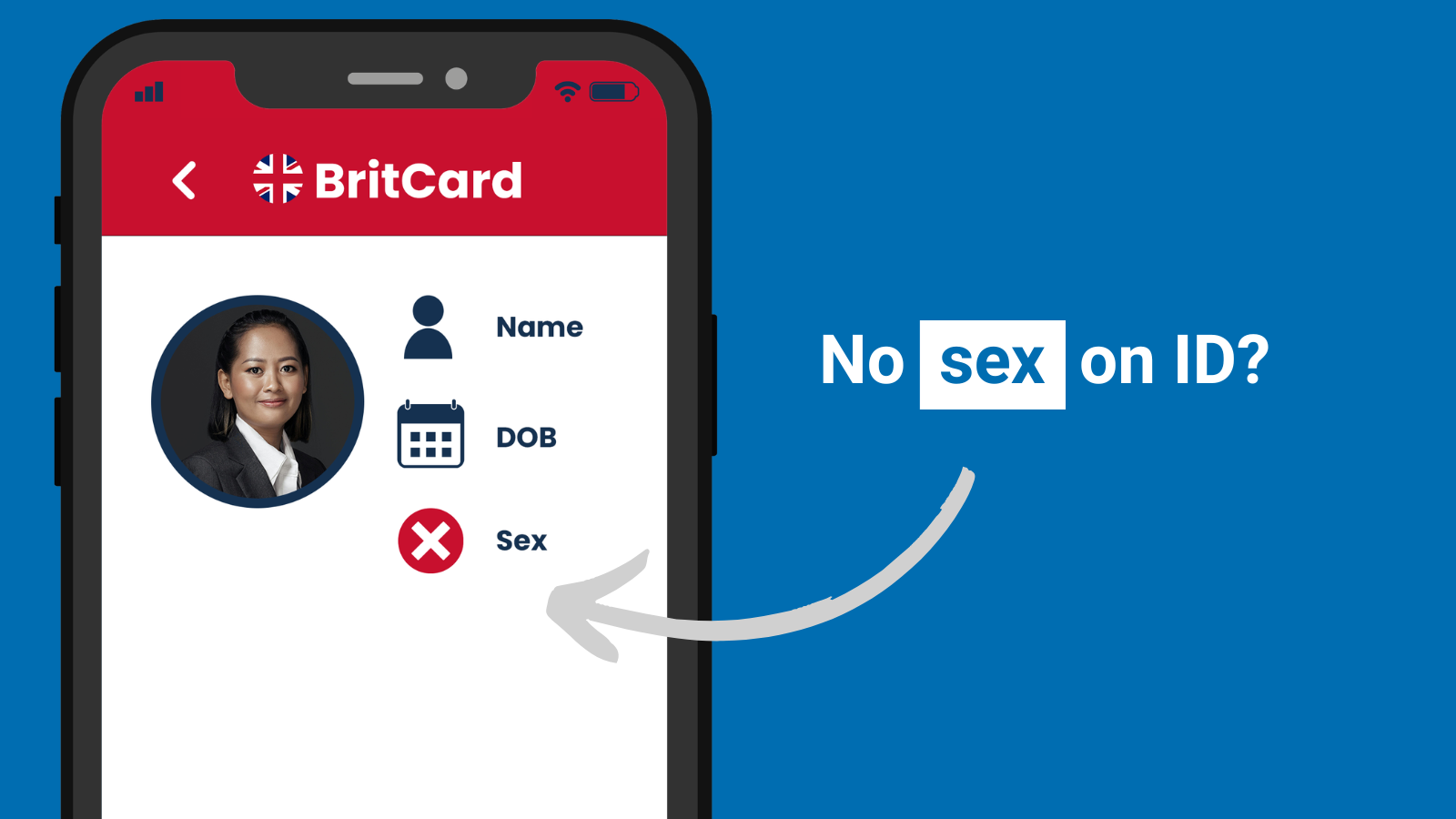
Will the government solve the sex-data problem in this Parliament?
As part of the King’s Speech on 13th May the government said that it will introduce a Digital Access...
18th May 2026
-
Update
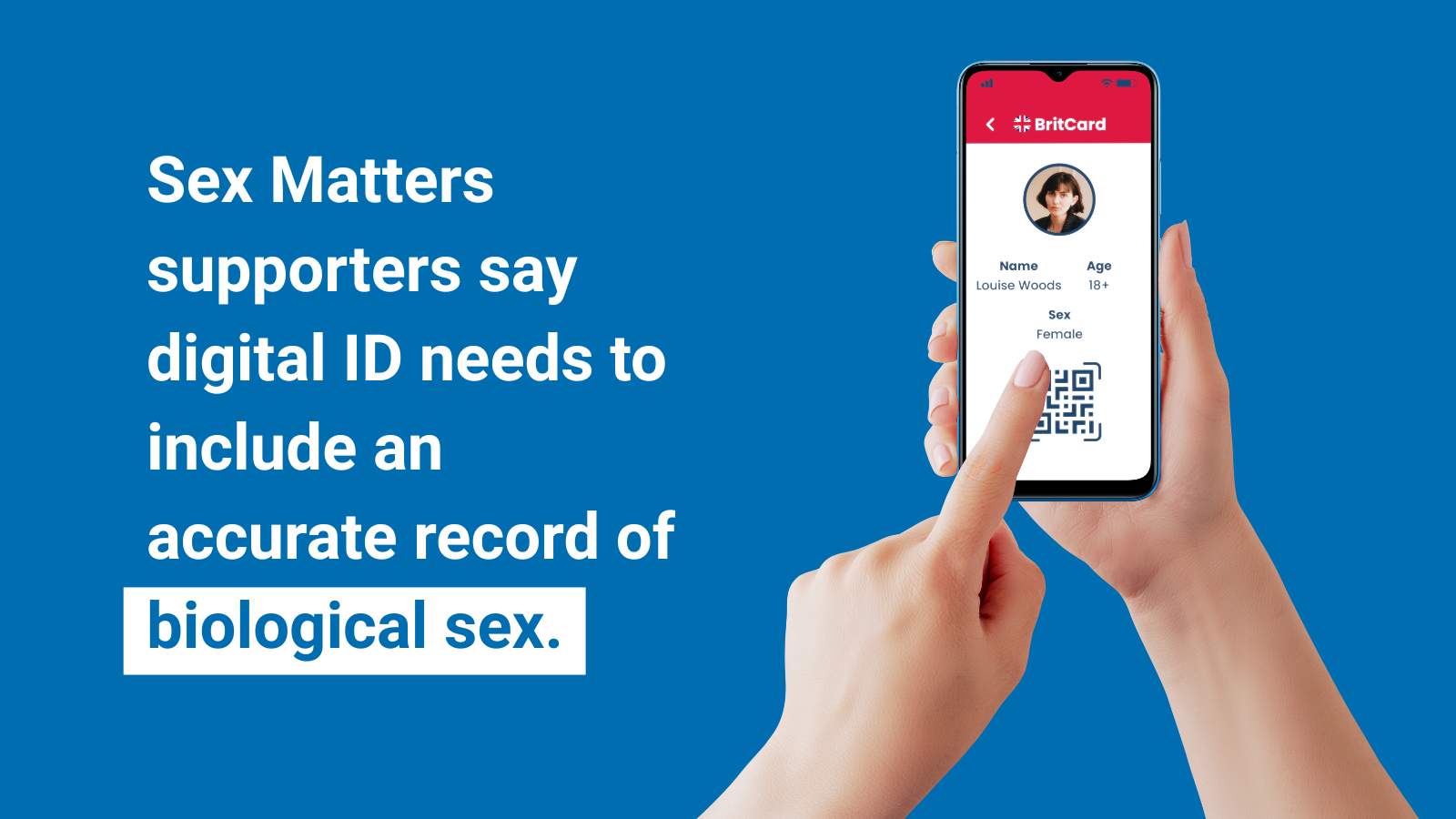
What do Sex Matters supporters think of digital identity?
We sent out a survey to Sex Matters supporters to ask for their views on digital identity. 889 people...
29th April 2026
-
Video

Putting sex on digital ID
Discussing the BritCard
24th April 2026
-
Update

Digital ID should include sex
The government has committed to creating a new national digital ID (BritCard) by the end of this Parliament, which...
23rd April 2026
-
Update
It’s time to COMMIT to fixing the data
We’re calling on the government to take the three steps that are urgently needed to protect everyone who uses...
6th November 2025
-
Update

The government must fix the flaw in its digital identity plan
Sir Keir Starmer has announced plans for a compulsory UK-wide digital ID scheme for the right to work. Whatever...
26th September 2025
Other resources
-

Reply from the Secretary of State for Science, Innovation and Technology
We received a letter from Peter Kyle MP on 15th May in response to our campaign asking you to write to him to get the sex data problem in the Data Bill fixed.
-
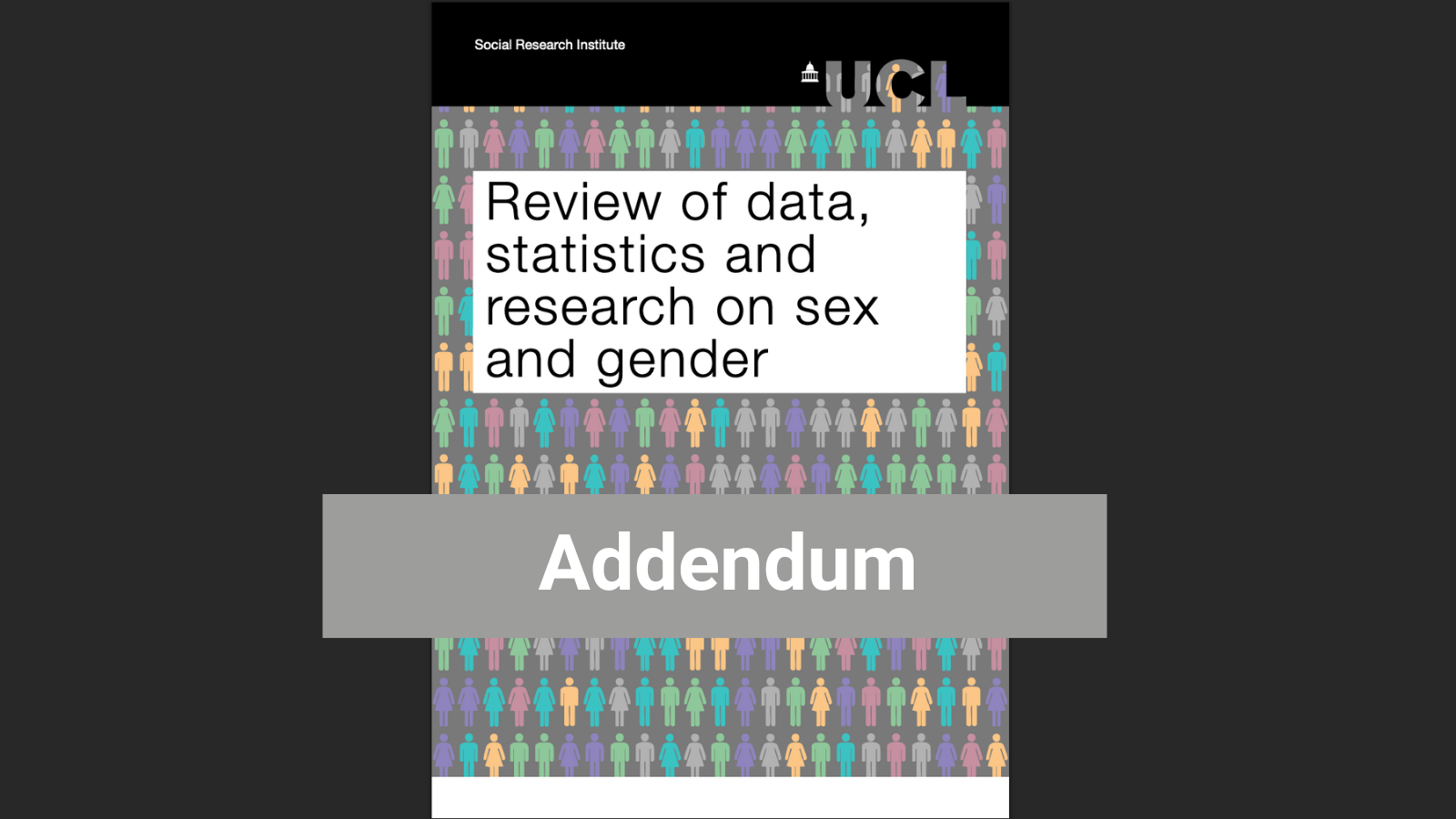
Addendum to the Sullivan Review
Following judgment given on 16th April 2025 in For Women Scotland Ltd v The Scottish Ministers.
-

Public data should not conflate sex and gender, review says
Aoife Walsh and Euan O'Byrne Mulligan for BBC News report on the Sullivan Review and how it found that cancer screenings have been missed and criminal convictions overlooked because of how data is collected about people's biological sex and gender identity.
-

Summary of the Sullivan Review
Background, executive summary and key recommendations of the government-commissioned review of data, statistics and research on sex and gender.
-

Legal advice for the Sullivan Review
Legal advice on the government-commissioned review of data, statistics and research on sex and gender.
-

Review of data, statistics and research on sex and gender (the Sullivan Review)
The 226-page review by Professor Alice Sullivan of University College London, commissioned by the government, sets out in careful detail the grave problems with official data in areas including health, justice, education and the economy.
-

Is the government sleepwalking into a digital disaster?
The digital identities framework needs to account for individuals’ sex, says James Arbuthnot.
-

Digital ID flaws risk Post Office-scale scandal, peer warns
Inaccurate recording could lead to incorrect or inappropriate care, fears Lord Arbuthnot – Geraldine Scott reports (paywalled).
Publications
-
Publication
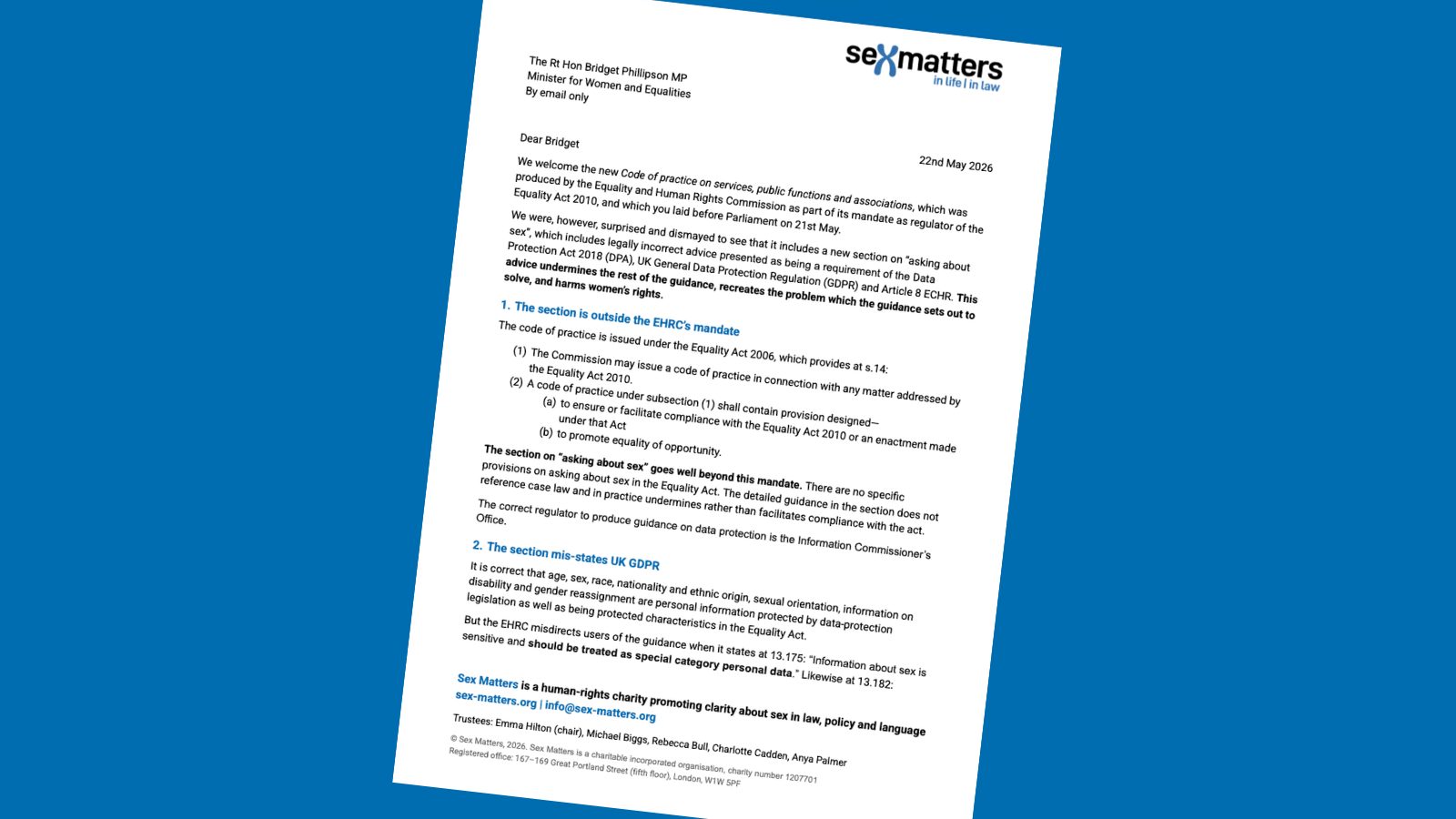
Letter to the Minister for Women and Equalities about the EHRC guidance
Sex Matters wrote to Bridget Phillipson MP to raise our concerns about the fact that the new code of practice for service providers produced by the Equality and Human Rights Commission includes a new section on “asking about sex”, which includes legally incorrect advice.
22nd May 2026
-
Publication
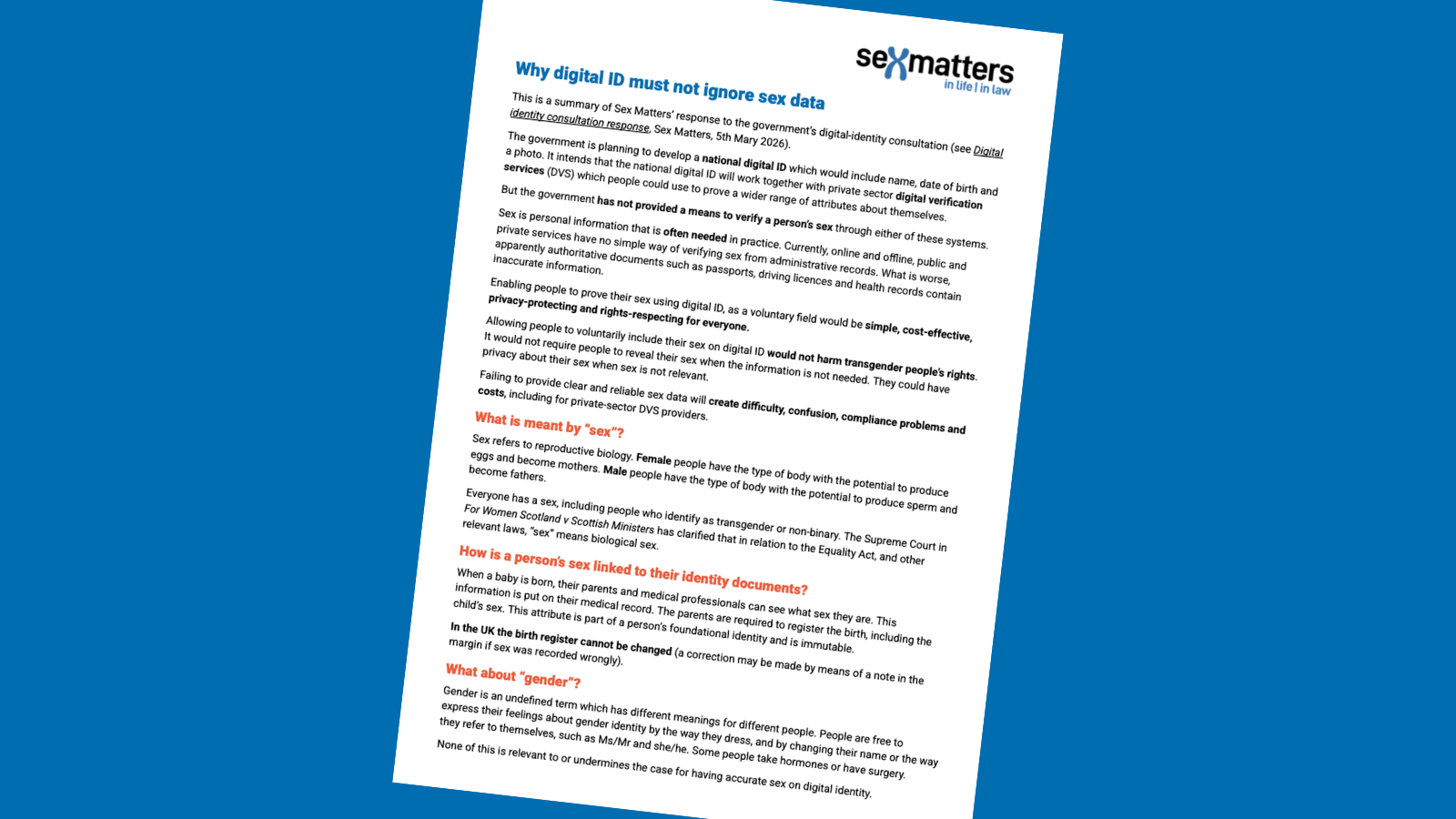
Why digital ID must not ignore sex data
A summary of Sex Matters’ response to the government’s 2026 digital-identity consultation.
18th May 2026
-
Publication

Putting sex on digital ID – a briefing
If a national digital ID is developed we think it should include sex as a voluntary field, and that field must be accurate.
23rd April 2026
-
Publication

Letter to the Minister of State for Science, Research and Innovation
Sex Matters wrote to Lord Vallance about comments he made in the House of Lords debate on amendments to the Data (Use and Access) Bill on 12th May 2025.
13th May 2025
-
Publication

The Sullivan Review and the Data Bill – Parliamentary briefing
The Review of data, statistics and research on sex and gender was published by the Department for Science, Innovation and Technology on 19th March – we look at the implications for the Data (Use and Access) Bill.
20th March 2025
-
Publication

Digital ID can’t be gender self-ID
We all have a right to have the fact of our sex correctly and reliably recorded.
3rd March 2025
-
Publication

Data (Use and Access) Bill: Lords report stage – Parliamentary briefing
The government’s Data (Use and Access) Bill was introduced in the House of Lords on 23rd October 2024. Report stage sittings are scheduled for 21st January and 28th January 2025: bills.parliament.uk/bills/3825/stages/19280.
21st January 2025
-
Publication
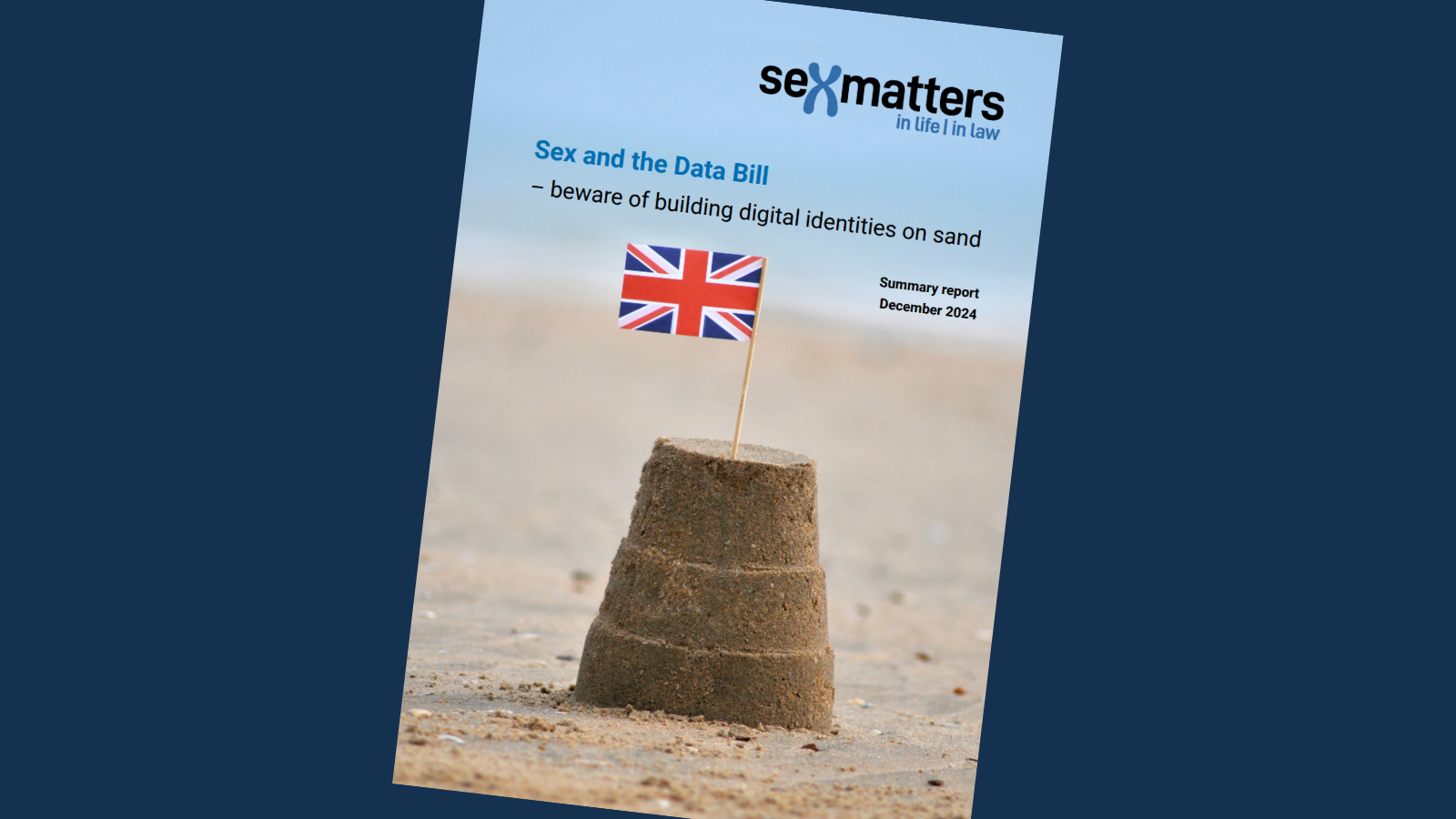
Sex and the Data Bill – summary report
The government’s new trust framework for digital verification services has a critical flaw: government data itself is not trustworthy when it comes to the core personal characteristic of sex.
6th December 2024