(For facilities open to the public or a section of the public, the law is different: see Changing rooms and toilets.)
What does the law say?
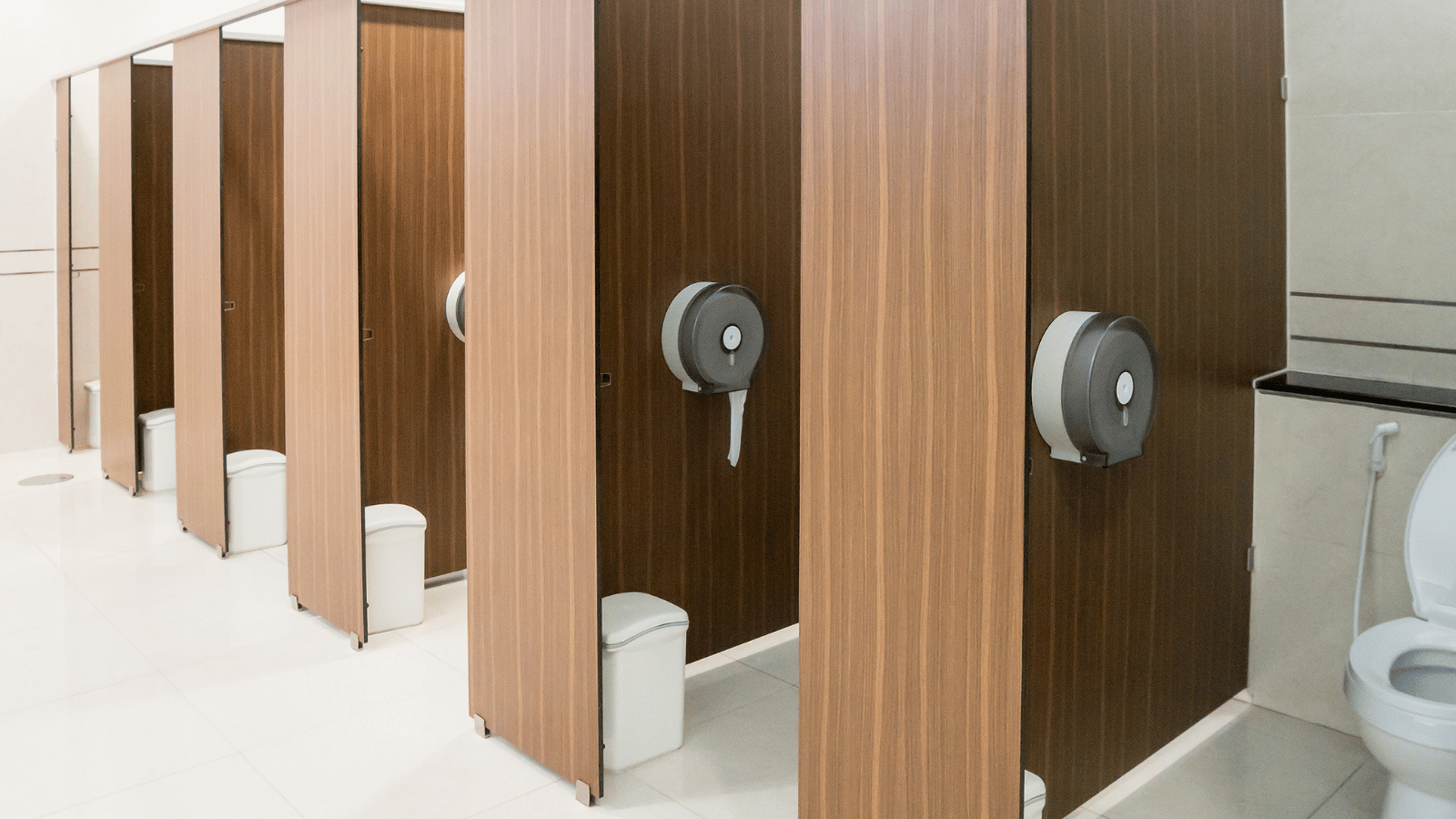
Under the 1992 Workplace Regulations, workplaces must provide single-sex toilets for their employees, and washing facilities where required. While toilets can be single-user fully enclosed rooms, the most common approach in larger workplaces is two or more cubicles inside an enclosed room, with handwashing facilities in a shared area, all behind a door marked either Male or Female. There will often be a unisex single-user accessible toilet as well.
Where employees need to wear special clothing for work and remove more than outer clothing, employers also need to provide single-sex changing rooms, which must be sufficiently large and include seating.
The Supreme Court judgment in For Women Scotland v The Scottish Ministers was crystal clear that any space designated single-sex is solely for the use of people of that sex. This is because in order for a space (or service) to be lawfully provided for one sex only, it must satisfy one of several criteria called the “single-sex exceptions” in the Equality Act. Roughly speaking, these criteria are various situations in which including people of the other sex would be inappropriate. If an employer designates a space as “single sex” and then states in its policies that certain people of the other sex can enter, then the space automatically fails to meet these criteria.
The Supreme Court judgment therefore means that all employers need to make clear in their policies that whenever a space is marked as being for one sex or the other, it is not for use by members of the opposite sex, regardless of claimed identity, certification or lifestyle.
The widely promoted idea that people may choose the facilities that suit their gender identity, or that they feel comfortable with, is legally wrong. Facilities are either for one sex only or for both sexes, with no exceptions. There can be no excuse for an employer to let people use the facilities marked for the other sex. This deprives everyone else of the single-sex provision they are entitled to under the Workplace Regulations.
The signs on the doors of workplace toilets and other facilities are health and safety signs. They should no more be ignored than signs that say not to block the fire exit or warnings about hazardous materials.
Whose job is it to enforce this?
Your employer
Your employer is responsible for complying with the law. No individual employee should have to request that it do so, nor should anyone have to challenge someone using the wrong facilities.
It is not enough for employers to provide men’s and women’s toilets or changing rooms. They must also ensure that the rules for use are clear and complied with by everyone.
The Health and Safety Executive is the regulator that oversees the 1992 Workplace Regulations. In response to a letter from Sex Matters, the chief executive of the HSE wrote:
“For legislation that requires an employer to provide an item or facility for their workers, HSE would consider not just whether it is actually present, but also whether an employer takes steps to ensure that it is used as they intend. For provision of men’s and women’s toilet facilities for workers, we would consider the availability of separate facilities and whether or not the employer is following a clear policy and decision-making process as to their use.”
This is unambiguous: employers have a responsibility to communicate and enforce their policies and ensure that men are not using the women’s facilities (and vice versa).
If there are men using the women’s facilities or if the policy is that anyone can use whichever facilities they prefer, or if traditional cubicled communal spaces are relabelled “unisex”, you should complain.
You could report the problem to your supervisor or your immediate manager. Employers are required to display a health and safety at work poster in the workplace that includes details of the health and safety representative. Explain the issue and suggest a solution (there should be a clear policy that male and female facilities are provided on the basis of biological sex).
If your concern is not taken seriously, you can escalate to either your head of health and safety or human resources. Explain the same concerns that you previously expressed and why you believe your concerns have not been acted upon.
You are protected by law from suffering a detriment if you raise health and safety concerns with your employer or the enforcing authority. In fact, under the Management of Health and Safety at Work Regulations 1999, employees in Britain have a responsibility to report any matter which a person with their training and instruction would “reasonably consider represented a shortcoming in the employer’s protection arrangements for health and safety”.
Use our template emails and factsheet to raise concerns with your employer:
Your union
If you are in a trade union and you are concerned that your employer does not take the issue seriously, you can report the issue to your trade union safety representative.
Their role is to check and follow up on management’s actions or lack of action on health, safety and environmental issues in the workplace. This includes the regulations on toilets, changing and washing facilities. Trade-union safety representatives can also report the issue to the HSE.
The regulator
If your employer does not respond by adopting or confirming that it has a clear sex-based policy, and that it will enforce that policy, you can make a report to the regulator.
Health and Safety Executive
For health and safety in workplaces, including schools and colleges, hospitals and nursing homes, central and local government premises, factories, farms, building sites, mines and offshore installations, the regulator is the Health and Safety Executive (HSE).
- In Great Britain, you can report employers in these sectors that do not comply with the 1992 Workplace Regulations to the HSE via its website.
- In Northern Ireland, the regulator is the HSE NI.
Workplaces not covered by the HSE are covered by a local authority.
Your local authority
If you work in an office, hospitality, retail, wholesale or distribution, or leisure, the relevant regulator is your local authority – your district council or local unitary authority.
Search online with the name of your council and “health and safety at work” to find a number or online form for reporting the problem.
The Equality and Human Rights Commission
The Equality and Human Rights Commission issued an interim update to back up the Supreme Court judgment. This states that in workplaces and services that are open to the public:
- trans women (biological men) should not be permitted to use the women’s facilities and trans men (biological women) should not be permitted to use the men’s facilities, as this will mean that they are no longer single-sex facilities and must be open to all users of the opposite sex
- in some circumstances the law also allows trans women (biological men) not to be permitted to use the men’s facilities, and trans men (biological women) not to be permitted to use the women’s facilities
- however where facilities are available to both men and women, trans people should not be put in a position where there are no facilities for them to use
- where possible, mixed-sex toilet, washing or changing facilities in addition to sufficient single-sex facilities should be provided
- where toilet, washing or changing facilities are in lockable rooms (not cubicles) which are intended for the use of one person at a time, they can be used by either women or men.
Organisations that fail to comply with the Equality Act 2010 can be reported to the EHRC.
If you report your workplace to the HSE or your local authority and it refuses to act, report both your workplace and the regulator to the EHRC.
What should you do?
Many organisations are reviewing their policies in the light of the Supreme Court judgment. You may want to start by asking what your employer is doing and on what timescale. You can remind them that this is the law. There is no need to wait for guidance: in fact there could be legal risk for those whose policies do not comply right now.
Don’t be tempted to go to the press or talk about your employer on social media. Your aim should be to keep your job and to follow your employer’s established processes for raising issues like this.
Keep a paper trail of your engagement with your employer and with the regulators.
Use our template emails
Use these templates to write to your employer.
If your employer responds with excuses
We’ve written about the common excuses people are getting from their employers.
If you feel you can push further in the face of these excuses, or if you have a union or workplace representative who can do so on behalf of female employees, here is an outline of what you can say.
Thank you for your email.
The law was authoritatively clarified on 16th April 2025. No further clarification is required.
If you let men who say they are women use facilities badged as for women, you are likely to be harassing your entire female workforce or directly or indirectly discriminating against them. You will have been doing that continuously for as long as the policy or practice has been in operation; the judgment of the Supreme Court in April 2025 did not change the law, but merely declared what it has always been under the Equality Act.
If female employees bring employment tribunal claims, you are likely to be liable for damages reflecting the victims’ injury to feelings over the entire period that it has affected them and a declaration that the company has committed unlawful discrimination.
Consider whether to add
Individual awards for injury to feelings may be fairly modest, but across the entire workforce they could add up to substantial sums.
(You could do the arithmetic for your specific workplace.)
If your employer says it is awaiting guidance from the EHRC
The Equality and Human Rights Commission’s code of practice for services, public functions and associations does not cover workplaces or employers. The EHRC has in any case clearly stated that employers must comply with the Supreme Court ruling now.
If your employer says it can’t police the toilets
As an employer it is your responsibility to make the position clear and to take action where colleagues do not comply.
If your employer says that FWS only relates to the Equality Act and not the Workplace Health and Safety Regulations
It is very unlikely that the Workplace Regulations would be interpreted on the basis of anything other than biological sex, and in any case, my claim and that of female colleagues is under the Equality Act, which is clear.
Please take urgent legal advice on the content of this email. No doubt you are already aware that it is a protected act, for which I cannot lawfully be subjected to any detriment.