
This is part of our The law is clear – so get on with it! campaign
Changing rooms and toilets
How can you be sure that shared toilets or changing rooms that have a sign saying “women” are genuinely single-sex? What can you do to persuade service providers to follow the law?
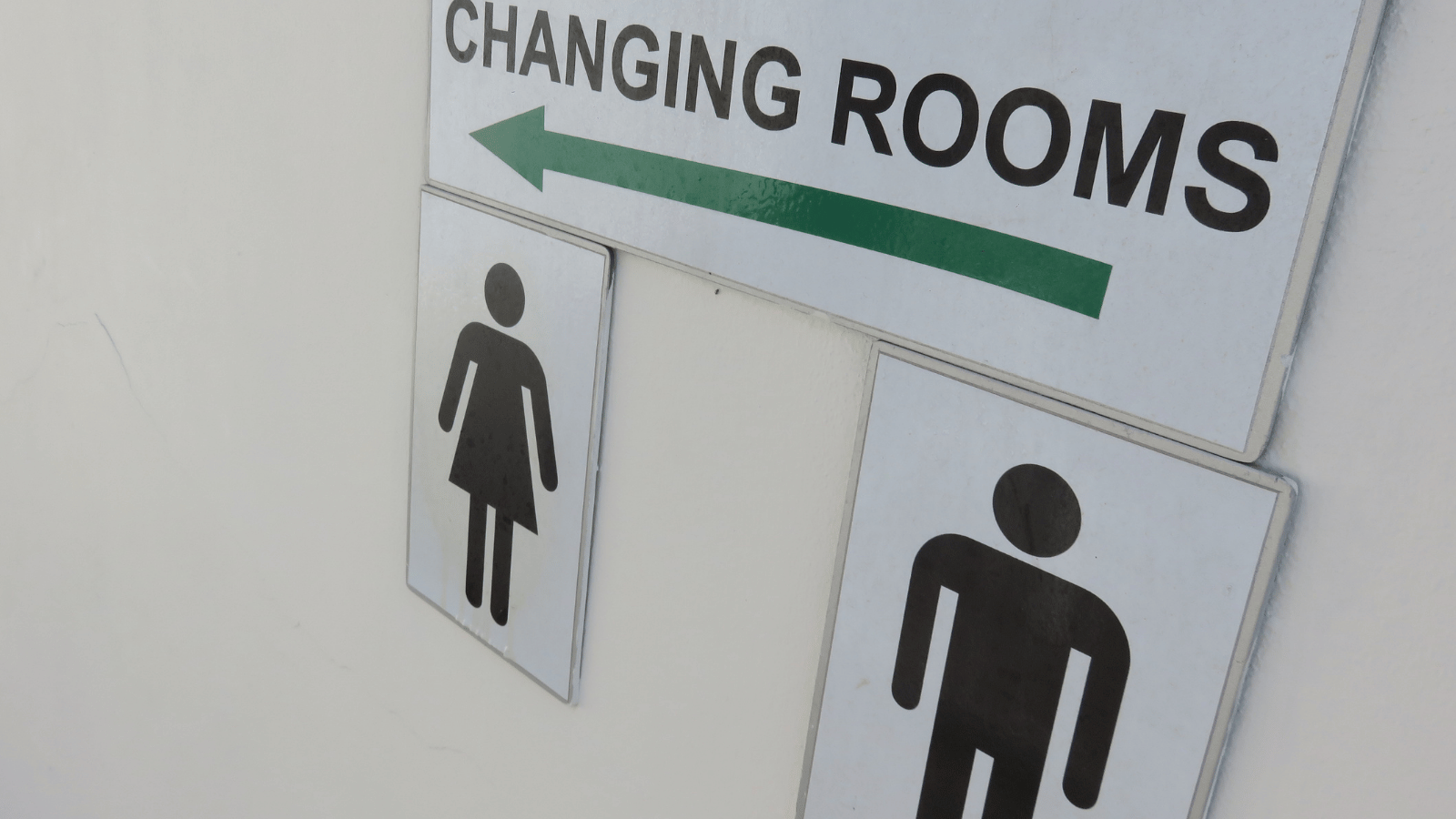
(This advice covers facilities open to the public or a section of the public, including toilets, changing room, showers and sleeping accommodation. For workplace facilities, the law is different: see Workplace toilets and changing rooms.)
We hear from women who want assurance that they won’t run into a man in the women’s changing rooms of the gym they use, or the leisure centre, or even the shop. But the service provider may fail to put their policy in writing.
Some who do claim that their policy is for everyone to feel comfortable and that this is both lawful and inclusive. But a policy allowing men into women’s facilities is neither lawful nor inclusive. So what can you do? Follow our step-by-step guide.
What does the law say?
The Supreme Court judgment in For Women Scotland v The Scottish Ministers was crystal clear that the Equality Act requires that single-sex services are provided based on biological sex. This is because in order for a space (or service) to be lawfully provided for one sex only, it must satisfy one of several criteria for “single and separate sex exceptions” in the Equality Act. These list situations in which it is appropriate to provide a service for one sex only, or for members of both sexes separately. If a service provider designates a space as for men or for women and then states in its policies that certain people of the other sex can enter, then the space is likely to fail to meet these criteria.
Often these situations relate to bodily privacy (such as washing and changing). Once a service provider puts a sign up which labels a space as being just for women (or just for men), they have created a situation where, if someone of the opposite sex ignores the sign and makes their way into the space, this is likely to be “unwanted conduct” which has “the purpose or effect of violating a person’s dignity, or creating an intimidating, hostile, degrading, humiliating or offensive environment”. This meets the definition of harassment under section 26 of the Equality Act, related to the protected characteristic of sex, and creating an environment in which service users are subject to such harassment is unlawful.
The widely promoted idea that people may choose the facilities that suit their gender identity, or that they “feel comfortable with”, is legally wrong. Facilities are either for one sex only or for both sexes (sometimes called “unisex” or “gender-neutral”). There can be no excuse for a service provider to let people use the facilities marked for the other sex based on their gender identity.
Providing single-sex facilities is not generally compulsory outside workplaces and schools. But once a service provider has indicated by a sign that something is single-sex, they are relying on the single-sex exceptions in the Equality Act to defend this as a lawful approach. What the Supreme Court judgment made clear is that this is legally defensible only if it is based on biology.
What should you do?
If there is a proposal to make everything unisex or gender-neutral
Write promptly to the service provider to point out why this is not the preferred solution. Since they have operated single-sex facilities for some time, they already recognise that these are a “proportionate means to a legitimate aim”. Explain to them that removing single-sex facilities is making things worse, not better: it is likely to be detrimental to everyone but especially to female users (read more about why unisex toilets are a bad idea). Neither is changing the signs from Female and Male to Cubicles and Cubicles with urinals an acceptable solution.
Use our template email to explain why this is a bad idea and ask the service provider to reconsider.
If you see a man in the women’s changing room or toilets
It is not up to individual service users to police the facilities. If another service user is using the wrong facilities, first make sure you are safe. It’s best not to address the person directly as they may have been told that they are permitted, and they could claim harassment.
Report the issue to a member of staff and ask if someone can intervene – though this may not always be possible.
Make a note of what happened and how you felt – this may be useful later, if you take legal action or talk to the media or to politicians. Then write a follow-up complaint and ask the service provider to clarify their policy in writing. Creating a hostile environment represents a detriment to you as a result of the policy, or lack of policy.
If facilities are labelled as single-sex – but you are not sure they are
If you think that a service provider is not following the law, you can take action.
Take action
Keep records of your engagement with the service provider and with the regulators.
Step one: find out what the policy is
The first step is to find out what the service provider’s policy is, and ideally to get it in writing. Everyone needs to know the policy so that they can all act accordingly. It’s always better to establish a clear policy before it becomes a conflict about an individual. Check the website first. If it’s not there, or not clear, send an email asking what the policy is and how it is communicated to service users and staff.
If you can’t get a straight answer
Be persistent. Keep asking. After all, how can anyone follow a policy that has not been communicated? This applies to all staff and all service users. A person with a transgender identity needs to know what to expect, just as we all do. If you are referred to head office, keep asking.
If you are told the policy is informal or done on a “case by case” basis
It is not lawful for a service provider to have a policy that will sometimes let some men into women’s facilities. That is a failure to adhere to the requirements of the Equality Act that permit the exclusion of one sex from the facilities designated for the other. At that point, you should move to step two: a letter that advises the service provider they are acting unlawfully.
If the policy is that the women’s facilities include “transwomen” or are on the basis of gender identity
Move to step two: a letter that advises the service provider they are acting unlawfully.
Step two: advise them that they are acting unlawfully and need to change their policy
Use our template email to ask the service provider to amend their policy immediately, and to communicate the change to all staff and service users. Write to the CEO, or use the complaints process.
If you don’t get a response, follow up.
If they confirm that they will not change or publish their policy, it’s time to consider taking action against them.
Step three: take action against them to force them to follow the law
There are three options, and you can do one or all of them.
Option A: report them to regulators
You can report them to the regulator of the Equality Act: the Equality and Human Rights Commission (EHRC). The EHRC has enforcement powers to compel organisations in England, Wales and Scotland to comply with the Equality Act.
- In England and Wales, email [email protected]
- In Scotland, email [email protected].
- In Northern Ireland, the law is different but it is still covered by the Supreme Court so it is likely that the interpretation of sex as biological is the same. The regulator is the Northern Ireland Equality Commission, which you can contact through its website.
It’s also worth contacting any other relevant regulator:
- For licensed venues like pubs, clubs and restaurants, contact the local authority.
- If the facilities are in a space that belongs to a public body or hospital you can complain to the Health and Safety Executive – which regulates workplaces but also the health and safety of visitors to workplaces.
- If the facilities are part of a hospital or health care service, you can also complain to the Care Quality Commission.
Option B: involve other influencers
Ask influencers such as your Member of Parliament or local councillor to intervene. You also have the option at any stage of telling the media what has happened.
Tell us too. In some cases, we may be able to provide support and direction.
Option C: bring a claim to court
You may be able to bring a claim of discrimination or harassment, or both (based on sex or gender-critical belief) if you have suffered a detriment – such as not being able to use a service advertised as women-only because there were men present.
There are strict time limits for going to court. You need to make your claim within six months less one day of the event you’re complaining about. You must tell the Equality and Human Rights Commission that you are bringing a claim.
You will need to set out the facts of how you were discriminated against and the impact on you. Keep good records of dates, times and details. Include details of:
- the facilities
- the policy
- what was said or done
- how it was said or done
- evidence of the impact of the discrimination on you, the victim (for example, were you unable to use the service, did you experience harassment?).
Goods and services claims are often relatively low value if they are a one-off incident, so if you pay for legal advice, you’re unlikely to get that money back. This is why most people deal with small claims without a solicitor’s help using the “small claims” procedure. This is called a Money Claim (in England and Wales) and Simple Procedure in Scotland.
The first stage is to tell the person or organisation you want to take action against (the defendant) why you want to take action. You do this by sending them a letter called a letter before claim. Your letter should explain what happened to you and why you think unlawful discrimination has taken place. Say in the letter that you are giving them 14 days to reply. (Read the practice directions.)
The defendant will then write back to you to explain their position. This will help you both decide if you can find a solution to the problem without going to court – but be aware of the time limits.
To bring a claim, you will need to say how much money you think you are owed. This includes any financial losses (such as if you were unable to use the gym membership you paid for) and an amount for “injury to feelings”. In most services cases, the discrimination is likely to be a one-off incident, and the award is likely to be in the lower band of possible awards – £1,200 to £12,100. The court fees are based on the amount you are claiming.
- The Citizen’s Advice Bureau has useful general advice.
- The Equality Advisory Support Service (EASS) helpline advises on issues relating to equality across England, Scotland and Wales. Telephone: 0808 800 0082. Open Monday to Friday 9am – 7pm, Saturday 10am-2pm. You can also email them using their online contact form.
- HM Courts and Tribunals explains what happens next.
The defendant might offer to settle, either directly or using mediation.
The general position in civil litigation in England and Wales is that the loser pays the winner’s legal costs (“adverse costs”). But in most cases if you are bringing a small claim both sides will pay their own legal costs, and the costs are fixed. This is because the procedure is designed to enable individuals to litigate in person, without using a legal representative. You can be ordered to pay the other side’s costs if you behave unreasonably, for example, making unnecessary applications or refusing to co-operate, or by issuing a fraudulent claim.
Feedback
Tell us about your complaint, whether you succeed or hit a brick wall. We will treat it in confidence and will not share anything publicly without your consent.
It’s useful for us to track how organisations are responding to the Supreme Court’s clarification of the law, and to have an idea of compliance and non-compliance by sector.