
Ben Cooper KC explains the implications of FWS
For Women Scotland v The Scottish Ministers: why the Supreme Court’s judgment does not remove, diminish or breach the rights and protections of trans people
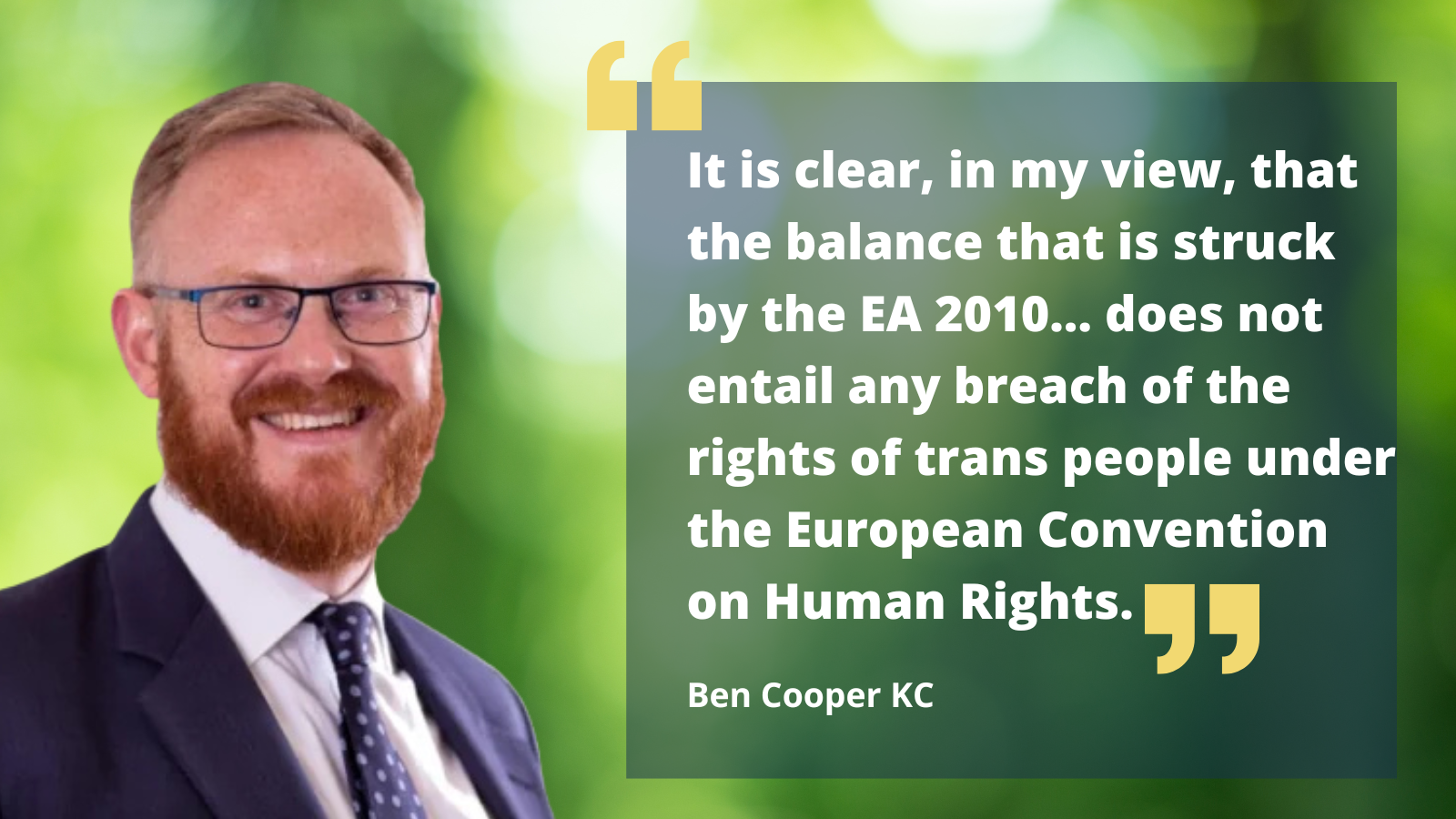
Ben Cooper KC of Old Square Chambers appeared in FWS for Sex Matters. The Supreme Court acknowledged his contribution in its judgment:
“We are particularly grateful to Ben Cooper KC for his written and oral submissions on behalf of Sex Matters, which gave focus and structure to the argument that ‘sex’, ‘man’ and ‘woman’ should be given a biological meaning, and who was able effectively to address the questions posed by members of the court in the hour he had to make his submissions.”
He has written this paper independently to explain the implications of the judgment.
Introduction
- On 16 April 2025, the Supreme Court ruled in For Women Scotland v The Scottish Ministers (‘FWS’) that the terms ‘sex’, ‘woman’ and ‘man’ in the Equality Act 2010 (‘EA 2010’) refer to biological sex and that a person’s sex for these purposes is not modified by possession of a Gender Recognition Certificate (‘GRC’) issued under the Gender Recognition Act 2004 (‘GRA 2004’).
- Perhaps inevitably given the subject matter, this decision has provoked strong and polarised reactions. For many, it is seen as returning clarity and coherence to the protection of sex as a protected characteristic, and of sex-based rights, under the EA 2010, in circumstances where understanding and practice had become muddled by a tendency to favour ideology and wishful thinking over robust legal analysis.
- For others, the decision has been seen as reducing or ‘removing’ rights and protections for trans people, and as introducing new uncertainty about how trans people should be treated, particularly as regards access to single sex services and spaces.
- In this paper, I aim to explain why the Supreme Court’s ruling in FWS does not remove or diminish any rights previously afforded to trans people, or make their position in law less clear, but instead results in a coherent and practical framework under the EA 2010 which strikes a proportionate balance between sex-based rights and interests – particularly those of women – and the rights and interests of trans people.
The legal context of the court’s decision
- It is necessary to begin by setting the decision in FWS within the relevant legal context in order to identify what the Supreme Court did, and did not, actually decide. This is necessary in order to dispel any misconception that the decision in FWS has swept aside a settled consensus about how the EA 2010 applied in relation to use by trans people of single sex services and spaces, still less that it has overturned any established legal ‘right’ for trans people generally to use single sex
- It is certainly true that, as a matter of practice, many public bodies, service providers and employers had (often under the influence of campaigning or advocacy groups) put in place policies which made provision for trans people to use single sex services or facilities provided for the sex with which they identify. But anyone who thought this practice was based on settled law, or settled understanding and application of the EA 2010, had not been paying attention, or had been gravely misled.
The core functions of the definition of ‘sex’ in the EA 2010
- The starting point for understanding the true context of the decision in FWS is to identify the core functions that the definition of ‘sex’ performs within the scheme of the EA 2010.
- There are two main types of protection under the EA 2010. These are described by the Supreme Court in §§130-150 of its judgment in FWS. The first is protection against individual less favourable or unfavourable treatment because of relevant individual characteristics or circumstances. Provisions of this kind include protection against direct discrimination (s13), pregnancy and maternity discrimination (ss17-18), and discrimination because of certain circumstances connected with gender reassignment (s16) or disability (s15). These protections are intended to achieve formal equality of treatment irrespective of specified personal characteristics or circumstances (R (E) v Governing Body of JFS & another [2010] 2 AC 728, SC, §56 per Baroness Hale JSC).
- The second main type of protection under the EA 2010 is protection from group disadvantage, aimed at achieving substantive equality of results by addressing the fact that people who share certain characteristics are more likely to suffer disadvantage because of the way that measures adopted by employers, service providers or other duty bearers interact with those characteristics, or with wider social attitudes or structures (Essop & others v Home Office (UK Border Agency) [2017] ICR 640, SC, §§1, 25-26 & 39 per Baroness Hale DPSC). Provisions of this kind include protection against indirect discrimination (ss19 and 19A), the public sector equality duty (‘PSED’) (s149), and provisions permitting positive action in limited circumstances (ss158 and 159). These provisions recognise that people who share particular characteristics often have common experiences or needs which give rise to particular disadvantages (FWS, §153).
- The protected characteristics which are the subject of both types of protection are listed and defined in Chapter 1 of Part 2 of the EA 2010, and include both ‘gender reassignment’ (s7) and ‘sex’ (s11). The definition of each protected characteristic includes both a definition of that characteristic in relation to any individual, and a definition of the group(s) who share the same characteristic. In the case of the definition of ‘sex’ in section 11 of the EA 2010, references to an individual’s sex are to being either a ‘man’ or a ‘woman’, and references to groups who share the same characteristic are to persons of the same sex – i.e. to men as a group or women as a group.
- The core functions of those definitions thus correspond to the two main types of protection: they both identify the grounds on which any person is protected from individual less favourable treatment, and the groups with shared experiences or needs whose circumstances need to be analysed when considering the provisions that address group disadvantage.
- For the second of those functions, in particular, it is vital to be able to identify with clarity who does, and does not, fall into a group that shares a particular protected characteristic, and the group thus identified must be susceptible to coherent analysis of the shared experiences and needs of its members. Moreover, that exercise needs to be capable of being performed in practice ‘on the ground’, by a range of employers, service providers and other duty bearers to whom the EA 2010 applies. The Supreme Court explained the importance of clarity and consistency in that regard at §§151-154 of its judgment in FWS.
- For present purposes, the important point which emerges from this is that the primary function of the definition of ‘sex’ in section 11 of the EA 2010 is to provide a coherent foundation for the protection of sex-based rights and protections, including in particular protection against disadvantages arising from the shared experiences or needs of women as a group, or men as a group. The critical question for the Supreme Court was which of the available alternative interpretations would enable the coherent application and operation, in practice, of those sex-based rights and protections.
- It was, therefore, always wrong to treat the meaning of ‘sex’ under the EA 2010 as being fundamentally about ‘trans rights’, rather than sex-based rights and protections. The primary basis for the rights and protections of trans people under the EA 2010 is by reference to the separate protected characteristic of ‘gender reassignment’, defined in section 7.
The potential interpretations of ‘sex’ available to the Supreme Court
- The second point which it is necessary to appreciate in order to understand the context for the Supreme Court’s decision in FWS and what it did, and did not, decide, is the narrow scope of the possible alternative meanings between which the Court had to choose.
- The position at common law is that sex is binary, biological and fixed at birth (Chief Constable of West Yorkshire Police v A (No 2) [2005] 1 AC 51, HL, §3 per Lord Bingham, §19 per Lord Rodger, §30 per Baroness Hale; Forstater v CGD Europe [2022] ICR 1, EAT, §114 per Choudhury J).
- Subsection 9(1) of the GRA 2004, read with subsections 9(2) and (3), modifies the common law position for a person who has obtained a GRC in the opposite sex, with the effect that from that point onwards their sex becomes the ‘acquired sex’ for all legal purposes, subject to contrary provision. It is important, however, to emphasise that this only applies where someone has a GRC, which requires that the person has a diagnosis of gender dysphoria, meets various other criteria, and has completed a successful application to a gender recognition panel (see FWS, §§71–74). The vast majority of people who identify as ‘trans’ do not have a GRC (FWS, §26). For all of those people, there was never any question but that their sex for the purposes of the EA 2010 (and in law generally) is their biological sex.
- Moreover, the effect of subsection 9(1) may be dis-applied by subsection 9(3), which provides that subsection (1) is ‘subject to provision made’ either in the GRA 2004 itself or in any other enactment or subordinate legislation.
- The question for the Supreme Court in FWS was whether subsection 9(1) applied so as to modify the sex of persons with a GRC for the purposes of the EA 2010, or whether the terms of the EA 2010, properly construed, constitute ‘provision made’ for the purposes of subsection 9(3) of the GRA 2004 so that ‘sex’ in the EA 2010 retains its ordinary, biological meaning.
- In short, the only possible meanings of ‘sex’ in the EA 2010 were either (i) biological sex, or (ii) biological sex, except for people who have obtained a GRC. There was never any question of ‘sex’ in the EA 2010 referring to a person’s self-identified gender, or to how they dress or present themselves, or to any other possible variation on a broadly ‘trans inclusive’ definition of sex.
The implications of the alternative meanings for single sex services and facilities
- The final aspect of the context which it is necessary to understand is the relevance of those two alternative meanings of ‘sex’ to the use by trans people of single sex services or facilities.
- The starting point here is that the provision of single sex or segregated services or facilities will almost always involve direct sex discrimination against those people who are excluded from any particular service or facility. (I explain the reasons for this in more detail below, in the context of analysing how the scheme under the EA 2010 will apply, in light of the judgment in FWS, so as to strike a fair and proportionate balance between relevant conflicting rights.)
- Therefore, in order for a service provider, employer or other duty bearer under the EA 2010 lawfully to provide single sex or segregated services or facilities, they need to be able to rely on an exception to the general prohibition against direct discrimination. Again, I will consider the relevant exceptions in more detail below, but for present purposes the salient point is that, where they apply, all of those exceptions permit (only) services or facilities that are provided for members of one sex only, or that are segregated by sex so that each of the segregated services or facilities is provided for members of one sex only.
- Consequently, the meaning of ‘sex’ under the EA 2010 determines who can, and who cannot, be admitted to any particular single sex or sex-segregated service or facility in order for it to operate lawfully.
- Thus, the effect of the Supreme Court’s decision in FWS is that, in order to operate lawfully within an exception, admission to such facilities or services must be based on biological sex. I examine the implications of this, and explain why it does not breach the rights of trans people, in more detail below.
- For present purposes the important point is that, even if the Supreme Court had adopted the alternative meaning of ‘sex’ for the purposes of the EA 2010, that would not have provided support for the widespread practice of generally allowing trans people to use services or facilities provided for the sex with which they identify. If the Supreme Court had adopted the (only) alternative meaning of ‘sex’ open to it – i.e. biological sex, except for people with a GRC – any service provider, employer or other duty bearer providing a single sex service or facility would, in order to operate that service or facility lawfully within an exception, have had to limit admission to (i) members of the relevant biological sex who did not have a GRC, and (ii) members of the opposite biological sex who did have a GRC.
- Therefore, in order lawfully to operate such services or facilities, duty bearers would still have had to exclude all members of the opposite biological sex who did not have a GRC, including the great majority of trans people. Moreover, as the Supreme Court noted in FWS (§§202, 213), since neither possession of a GRC nor the protected characteristic of gender reassignment under the EA 2010 requires any particular physiological change or other change in outward appearance, there is no way of distinguishing between a trans person with the protected characteristic of gender reassignment who has a GRC and a trans person with that characteristic who does not – other than by ascertaining whether each individual has a GRC, which is subject to strict confidentiality restrictions (with the potential for criminal liability if breached: GRA 2004, s22) and unlikely to be practicable in most circumstances.
- Therefore, any suggestion that, prior to the decision of the Supreme Court in FWS, there was a clear and settled understanding of the law, which supported the adoption of policies that provided for trans people generally to use single sex services or facilities provided for the sex with which they identify, is simply wrong. Not only was the question of which of the two possible alternative meanings of ‘sex’ applied not settled, but even if it were assumed that the modified meaning pursuant to section 9(1) of the GRA 2004 applied, that would not by itself have provided a legal basis for a policy of generally permitting trans people to use single sex or segregated services or facilities based on self-identification, or manner of dress or presentation, or any other broadly ‘trans inclusive’ approach. Although the case law on this topic prior to FWS was limited, such authority as there was supported the view that access to single sex spaces on the basis of self-identification was not appropriate (Croft v Royal Mail Group plc [2003] ICR 1425, CA, §42 per Pill LJ) and that, on the assumption that a modified meaning of sex would apply pursuant to the GRA, possession of a GRC would thus determine who should have access to facilities provided for the opposite biological sex (Croft, §39 at 1439G-H per Pill LJ).
- Consequently, even on the basis of that alternative understanding of ‘sex’ in the EA 2010, any service provider, employer or other duty bearer who adopted a broadly ‘trans inclusive’ policy for access to single sex services or facilities would potentially have been exposed to liability, not only for direct discrimination against (non-trans) members of the biological sex mostly excluded from the services or facilities in question, but also for indirect discrimination against (non-trans) members of the biological sex for whom the services or facilities were provided, on the basis that using (for example) self-identification as the criterion for admission to a women-only facility would have placed women at a particular disadvantage that could not be justified, by undermining women’s rights and interests as to safety, dignity and privacy which constituted the basis for operating a single sex facility in the first place (again, see further below on this point). It is notable that, prior to the decision in FWS, claims had already been brought by women to challenge such
policies (see for example here and here), demonstrating that these issues were far from settled.
The decision of the Supreme Court, seen in context
- Once the context outlined above is properly understood, it ought to come as little surprise that the Supreme Court reached the conclusion that it did in FWS. The alternative conclusion – that ‘sex’ meant biological sex, except for people with a GRC – would have required sex-based rights and protections under the EA 2010 to be applied by reference to artificial, heterogenous groups, with some but not the majority of trans people treated as belonging to the sex with which they identify, depending not on any observable distinction, or on any difference in their subjective self-identification, but on whether or not they possessed a (confidential) GRC. Most importantly, this would have fundamentally undermined the coherence and purpose of the core, sex-based rights and protections under the EA 2010 because, ideology aside, it is an obvious truism that (biological) women and (biological) men have shared experiences and needs based on their shared biology and the ways in which society and its structures treat them, which are different from the needs and experiences of trans people of the opposite (biological) sex. A modified meaning of ‘sex’ in the EA 2010 would have meant that, despite their obvious shared characteristics, needs and experiences, the biological classes of men and women would not have been protected as such under the EA 2010.
- Moreover, the alternative meaning of ‘sex’ (i.e. biological sex, except for people with a GRC) would also have produced incoherence and inconsistency, for which there could be no rational basis, as regards the categorisation and treatment of trans people with the protected characteristic of gender reassignment. Thus, for all sex- based rights and protections under the EA 2010 (including the provision of single sex services and facilities within the statutory exceptions) it would have meant drawing distinctions between how different trans people should be categorised and treated not based on any observable distinction, or any difference in their subjective self-identification, or any other characteristic that might be rationally connected to the ways in which they may be discriminated against or to the experiences or needs that they share with others, but solely on the basis of whether they possessed a (confidential) GRC.
- In short, therefore, once the context outlined above is properly understood, it is (or ought to be) obvious that, between the (only) two possible meanings of ‘sex’, only EA 2010 to operate coherently and effectively by reference to a readily identifiable characteristic that is often a reason for individual unfavourable treatment and that is liable to give rise to particular needs and disadvantages for those who share the same characteristic. The alternative meaning (i.e. biological sex, except for people with a GRC) would have produced incoherence and impracticality both as regards the operation of the core sex-based rights and protections, and as regards the categorisation and treatment of trans people themselves. These points are at the heart of the Supreme Court’s reasoning in FWS (see in particular §§172-173, 200- 203 & 209) and in light of those points its conclusion was (or ought to have been) entirely unsurprising. As the Court said (at §209):
‘To reach any other conclusion would turn the foundational definition of sex on its head
and diminish the protection available to individuals and groups against discrimination
on the grounds of sex.’
- I address further below why the implications of that decision do not, conversely, result in any breach of the rights of trans people, or diminution in their protections. But before turning to those issues, and by way of drawing the threads together at this stage, the following important conclusions follow from the discussion so far:
- 33.1. The fundamental purpose of the definition of ‘sex’ in the EA 2010 is to provide the foundation for sex-based rights and protections under that Act. It is not fundamentally about ‘trans rights’.
- 33.2. The Supreme Court in FWS was not choosing between a biological meaning on the one hand and a broadly ‘trans inclusive’ definition of sex on the other. It was choosing between one meaning (biological sex) which enables sex-based rights and protections to be applied coherently and effectively by reference to an identifiable characteristic that is often a reason for direct discrimination and often gives rise to particular needs or disadvantages for people who share that characteristic; and an alternative meaning (biological sex, except for people with a confidential GRC) that would have produced incoherence and impracticality, both for the operation sex-based rights and protections and for the categorisation and treatment of trans people.
- 33.3. Neither of those alternatives would enable the statutory exceptions for the provision of single sex or sex-segregated services or facilities to operate on a generally ‘trans inclusive’ basis. Even if the Supreme Court had adopted the alternative meaning (biological sex, except for people with a GRC), in order to rely on those exceptions service providers, employers and other duty bearers would arguably still have had to exclude the vast majority of trans people who do not have a GRC from services or facilities provided for the sex with which they identify – with the added complication of needing to know whether someone had a (confidential) GRC in order to ascertain if they could be admitted or not.
- 33.4. Therefore, whilst there was a widespread practice of adopting broadly ‘trans inclusive’ policies for single sex services and facilities, that was never based on a settled understanding of the law under the EA 2010, and there was certainly no legal consensus in support of such policies.
- 33.5. Consequently, anyone who suggests that the effect of the Supreme Court’s decision in FWS is to ‘remove’ any settled or established ‘rights’ of trans people generally to be treated as the sex with which they identify for the purposes the EA 2010 – including as regards the statutory exceptions for single sex or segregated services or facilities – is simply wrong.
What FWS means for the rights and protections of trans people
- I turn now to what the Supreme Court’s decision in FWS actually means for the treatment of trans people – including as regards the use of single sex or sex-segregated services and facilities – and why it does not remove, diminish or breach any of their rights or protections.
Protection from individual less favourable treatment
- The Supreme Court expressly addresses the protections from individual less favourable treatment available to trans people and explains why they remain fully protected at §§249-257 of its judgment in FWS.
- In summary, trans people remain fully protected from less favourable treatment because of any conceivable aspect of their sex and/or gender identity on the following basis:
- 36.1. The fact that gender reassignment is a distinct protected characteristic under section 7 means that trans people are protected, under section 13, from less favourable treatment because of that characteristic and, under section 26, from harassment related to that characteristic.
- 36.2. Trans people are also given special protection, under section 16, in relation to absences from work that are because the person is proposing to undergo, is undergoing or has undergone a process (or part of a process) of gender reassignment, if they are treated less favourably in relation to any such absence than their employer treats or would treat someone who is absent because of sickness or injury, or for some other reason in circumstances where it is not reasonable to treat the gender reassignment-related absence less favourably.
- 36.3. Since the protected characteristic of ‘sex’ means biological sex, if, notwithstanding their identification with the opposite sex, a trans person is treated less favourably because of their biological sex or subjected to harassment related to that sex, they will again be protected under sections 13 and 26 respectively. So if, for example, an employer discriminates against women because of an assumption that they may get pregnant and place a burden on the business, and applies that same assumption and treatment to a trans identifying woman, notwithstanding the fact that she identifies as a man, then that would constitute direct sex discrimination based on her actual protected characteristic of (biological) sex.
- 36.4. In addition, it is well-established that the definitions of direct discrimination and harassment under sections 13 and 26 respectively do not require someone actually to possess the protected characteristic in question: if they are perceived as possessing that characteristic and treated less favourably because of it, or subjected to harassment related to that characteristic, that will constitute direct discrimination or harassment (Chief Constable of Norfolk Constabulary v Coffey [2020] ICR 148, CA, §11 per Underhill LJ; FWS, §249). Indeed, even if they are not actually perceived as possessing the protected characteristic in question but are treated less favourably because they are associated with it, that will suffice (English v Thomas Sanderson Ltd [2009] ICR 543, CA, §§37-40 per Sedley LJ; §§45-46 per Lawrence Collins LJ). Therefore, if a trans person is treated less favourably because they are perceived as being of the sex with which they identify, or because they are associated with that sex in some way, or if they are subjected to harassment related to such perception or association, then they will again be protected under sections 13 and 26 respectively. So, for example, if a service provider perceives a particular trans individual to be a woman, when in fact that person is a biological man, and subjects that person to patronising, sexist treatment because of that perception, that will constitute direct sex discrimination and/or harassment related to sex no less than if that person were a biological woman.
Protection from group disadvantage
- Again, the Supreme Court expressly addresses the protections from group disadvantage available to trans people and explains why they remain fully protected at §§258-261 of its judgment in FWS.
- In summary, trans people remain fully protected from any group disadvantage connected with any conceivable aspect of their sex and/or gender identity on the following basis:
- 38.1. If trans people with the protected characteristic of gender reassignment are put at a group disadvantage by a provision criterion or practice (‘PCP’) applied by an employer, service provider or other duty bearer, that will be unlawful indirect gender reassignment discrimination contrary to section 19, unless justified, and any trans person who is put at that disadvantage will be able to claim.
- 38.2. If members of one sex are put at a group disadvantage by a PCP applied by a duty bearer that cannot be justified, then trans people of the same (biological) sex who are also put at that disadvantage notwithstanding their identification with the opposite sex will similarly be protected by way of indirect discrimination under section 19.
- 38.3. In addition, it has long been established that where people who share a particular protected characteristic are put at a group disadvantage by a PCP that cannot be justified, then other members of the disadvantaged group who do not share that characteristic but who are put at the same disadvantage are also entitled to claim (Chez Razpredelenie Bulgaria AD v Komisia za zashita ot discriminatsia (Case C-83/14) [2015] IRLR 746, §§56-61; British Airways plc v Rollett & others [2024] EAT 131, §61 per Eady J). That protection has now been given distinct statutory footing under section 19A of the EA 2010. Therefore, where members of one sex are put at a group disadvantage by a PCP applied by a duty bearer that cannot be justified, and a trans person of the opposite (biological) sex is put at the same group disadvantage as the sex with which they identify, they will be able to claim under section 19A.
Equal pay and terms of employment
- The Supreme Court in FWS was under the impression (on the basis of an analysis presented by the Equality and Human Rights Commission) that a trans person would not be able to claim based on perceived or associative discrimination in relation to pay or other terms of employment under Chapter 3 of Part 5 of the EA 2010, in the same way as under the ‘ordinary’ direct and indirect discrimination provisions considered above (see FWS, §§262-263).
- In fact, this is one point on which the Supreme Court’s understanding was not correct: the answer is somewhat technical and, unfortunately, the point did not assume sufficient importance in argument to enable it to be comprehensively examined.
- The answer, so far as direct discrimination by perception is concerned, is to be found in section 71 of the EA 2010, which concerns the relationship between the ‘equality of terms’ provisions in Chapter 3 of Part 5 and the ‘ordinary’ direct sex discrimination provisions in section 13. The drafting of section 71 is somewhat opaque, but the effect is that, where a claimant wishes to complain that they have been directly discriminated against because of sex in relation to their pay or other terms of employment, but cannot bring their claim under the ‘equality of terms’ provisions in Chapter 3 of Part 5 because they are unable to identify an actual comparator of the opposite sex (which is a pre-requisite for the operation of those provisions), they may instead make their claim under the ‘ordinary’ provisions in section 13 (see BMC Software v Shaikh [2017] IRLR 1074, EAT, §76 per HHJ Hand QC).
- Thus, if a trans person were to be perceived by the employer as belonging to the sex with which they identify and, because of that, paid less than a non-trans person of the same biological sex, they would not be able to claim under the ‘equality of terms’ provisions in Chapter 3 of Part 5 because they would not be able to point to a comparator of the opposite sex, but the effect of section 71 would be that they could claim for direct sex discrimination by perception under section 13.
- Similarly, it is well established that where members of one sex (usually women) are put at a particular disadvantage in relation to pay or other terms, members of the opposite sex who are also in the disadvantaged group are able to bring ‘contingent’ claims under the ‘equality of terms’ provisions in Chapter 3 of Part 5. This is on the basis that, if the primary claims succeed, it would then amount to direct discrimination to exclude members of the opposite sex who are in the disadvantaged group from the same benefit (see Hartlepool Borough Council v Llewellyn & others [2009] ICR 1426, EAT, §22 per Underhill J). Therefore, by this route, claims for other terms of employment may also be brought, in essentially the same way as under section 19A in relation to other types of group disadvantage.
- In short, therefore, contrary to the understanding of the Supreme Court in FWS, trans people are able to claim for both direct discrimination by perception and indirect discrimination by association in relation to pay or other terms of employment, in the same way as in relation to other types of treatment. This does not, of course, undermine the Supreme Court’s overall conclusion as to the meaning of ‘sex’ in the EA 2010, but on the contrary reinforces that conclusion by further demonstrating that a biological meaning of ‘sex’ does not deprive trans people of any relevant protection from either individual or group disadvantage in relation to pay or terms of employment.
Treatment in relation to exceptions for the protection of women and/or men
- The final area to consider is the exceptions in the EA 2010 which permit differential treatment of the sexes. It is in this area – and this area alone – that the meaning of ‘sex’ as determined by the Supreme Court in FWS does affect the treatment of trans people and require that they be treated differently from people of the sex with which they identify. That is because, as already indicated, where a provision permits differential treatment based on sex, a trans person’s sex (and not their gender identity) will determine how they must be treated in order for that exception to apply.
- However, it is essential to begin consideration of this area by noting that it is also, by definition, an area in which the rights and interests of one or both sexes are necessarily engaged, because the EA 2010 only provides for limited exceptions to the general prohibition on direct sex discrimination where there are sufficiently important overriding rights or interests at stake. In short, this is an area where sex matters, and matters strongly.
- Therefore, the treatment of trans people in relation to the operation of sex-based exceptions under the EA 2010 inherently engages not only their rights and interests but also the rights and interests of members of one or both sexes. To the extent that applying an exception based on a biological meaning of sex would entail some restriction of the rights of trans people, the question, therefore, is whether that restriction is justified by the sex-based rights and interests that constitute the basis for the exception in the first place.
- In order to keep length of this paper within manageable bounds, I will focus primarily on the exceptions for single sex and sex-segregated services under paragraphs 26-27 of Schedule 3 to the EA 2010, which provide a good illustration of the essential points that will apply in relation to all relevant exceptions. I will then briefly consider some of the other main exceptions, to outline how an equivalent analysis will apply to all sex-based exceptions under the EA 2010 and to address a few further specific points in relation to those other exceptions.
Single sex and sex-segregated services (EA 2010, Schedule 3, paragraphs 26–27)
- In order to examine whether the effect of the Supreme Court’s decision in relation to the exceptions for single sex and sex-segregated services strikes a fair and proportionate balance between competing rights, it is necessary first to understand how those exceptions operate in practice in light of that decision.
Why an exception is needed for restricted or segregated services
- The starting point is to identify why an exception is necessary in the first place. This is because providing single sex or sex-segregated services would otherwise constitute direct sex discrimination against those excluded from any particular service, which is generally prohibited in relation to the provision of services pursuant to section 29 of the EA 2010.
- That is obviously the case where the service is provided only to one sex and not to members of the other sex at all, or where, in the case of sex-segregated services, the service provided for one sex may reasonably be regarded as being generally more favourable. But the exceptions also proceed on the assumption that segregation of the sexes is, by itself, capable of constituting unlawful direct sex discrimination (R (Coll) v Secretary of State for Justice [2017] 1 WLR 2093, SC, §34 per Baroness Hale DPSC; R (Al Hijrah School) v Chief Inspector of Education, Children’s Services and Skills [2018] 1 WLR 1471, CA, §§63-68 per Sir Terence Etherton MR & Beatson LJ). That is because, even if separate services are genuinely equivalent at a general level, looked at from the perspective of each individual, there will almost inevitably be circumstances in which individuals will reasonably perceive it to be less favourable treatment to be excluded from the service provided for the opposite sex: the availability of an alternative service for one’s own sex does not negate the less favourable treatment of being excluding from the benefit of sharing the service provided for the opposite sex (see Al-Hijrah School, §§45-51 per Sir Terence Etherton MR & Beatson LJ).
- I have seen it suggested that this inherent direct sex discrimination might be avoided if restricted or segregated services are provided on a ‘trans inclusive’ basis – that is, applying some variation of eligibility criteria with the effect that a service is provided for members of one biological sex, except for some or all trans members of that sex who identify as the opposite sex, but including some or all trans members of the opposite sex who identify as the eligible sex. Which trans people are excluded or included for these purposes might be defined on the basis of self-identification, manner of presentation, possession of a GRC, or in some other way – the precise definition will not affect the relevant analysis.
- The suggestion that a restricted or segregated service operated on such a basis does not entail direct sex discrimination in the same way as a single sex or sex-segregated service appears to rely on the test of ‘indissociability’ that applies in order to ascertain whether a criterion is really a proxy for a protected characteristic – the suggestion being that, since ‘trans inclusive’ eligibility criteria of this kind do not correspond exactly with (biological) sex, they do not entail direct sex discrimination (cf Onu v Akwiwu & another [2016] ICR 756, SC, §§27-29 per Baroness Hale DPSC). If correct, this would mean that, although the criteria would still disproportionately disadvantage members of the (biological) sex that is mostly excluded, that would fall to be analysed through the framework of indirect discrimination under section 19 of the EA 2010, rather than as direct discrimination under section 13. It would therefore be susceptible to justification and, if justified, there would be no need to rely on the specific exceptions for single sex or segregated services under Schedule 3, which are only relevant where the arrangements entail direct sex discrimination (see Al-Hijrah School, §67 per Sir Terence Etherton MR & Beatson LJ).
- However, in my view, this suggestion is wrong and it is clear that operating restricted or segregated service on the basis outlined would still inherently involve misunderstanding of the ‘indissociability’ test. It involves two principal errors. First, the ‘indissociability’ test is only relevant where sex itself is not a ground for the treatment in question (Coll, §29 per Baroness Hale DPSC). However, in the type of scenario posited, sex itself is plainly one of the grounds for determining eligibility, in conjunction with whether someone identifies as the opposite sex (whatever the precise definition that may adopted in that regard). It is, of course, a basic principle of discrimination law that, to constitute direct discrimination, the protected characteristic in question need only be a reason for the treatment in question; it does not have to be the sole reason, and it is not necessary that everyone with that protected characteristic suffers the relevant disadvantage (see Nagarajan v London Regional Transport [1999] ICR 877, HL, 886E-F per Lord Nicholls; R (E) v Governing Body of JFS [2010] 2 AC 757, SC, §89 per Lord Mance; Coll, §30 per Baroness Hale DPSC).
- The second reason why it is wrong to suggest that operating a restricted or segregated service based on ‘trans inclusive’ eligibility criteria does not necessarily entail direct sex discrimination is because that suggestion involves a failure to recognise the importance of identifying the relevant comparison and confining the analysis to that comparison. Pursuant to section 23(1) of the EA 2010, the comparison that is required in order to determine whether there is direct discrimination under section 13 must be between individuals in materially the same circumstances. The material circumstances are those which, excluding the protected characteristic in question, the alleged discriminator does or would take into account when determining the relevant treatment of the claimant or comparator (Shamoon v Chief Constable of the Royal Ulster Constabulary [2003] ICR 337, HL, §§134–136 per Lord Rodger).
- In the scenario posited, whether or not someone identifies as a member of the opposite sex (under whatever precise definition may have been adopted) is plainly a material circumstance other than sex because it will necessarily be a circumstance that the service provider will take into account when determining an individual’s eligibility to use the service, applying ‘trans inclusive’ eligibility criteria. Therefore, the correct comparator for a non-trans member of the excluded sex is a non-trans member of the eligible sex (cf Macdonald v Ministry of Defence [2003] ICR 937, HL, §§64-66 per Lord Hope). As between those individuals, the difference in their sex is not merely a reason for the difference in treatment, it is the only reason: whatever the precise formulation used to define the relevant ‘trans inclusive’ eligibility criteria, for all people who do not meet the relevant definition of being trans (whatever that may be), those criteria will be indissociable from sex (cf Preddy v Bull [2013] 1 WLR 3741, SC, §§24-31 per Baroness Hale DPSC).
- Therefore, once the comparison is properly confined to persons in materially the same circumstances, even applying the ‘indissociability’ test leads inexorably to the conclusion that operating a restricted or segregated service based on ‘trans inclusive’ eligibility criteria will still inherently involve direct sex discrimination against the majority of (non-trans) members of the sex that is mostly excluded. For members of the opposite sex are eligible, is the difference in sex, and it is nothing to the point that the service provider also discriminates, within each of the (biological) sexes, based on whether or not someone is trans (however defined).
- The foregoing analysis is, in my view, clearly correct applying basic and well-established principles of discrimination law. But the analysis may be tested further by reference to an analogous scenario in which a service provider adopts eligibility criteria to the effect that, in order to use a particular service, someone must be either white, or disabled. Applying the foregoing analysis, the relevant comparator for a non-disabled black person who is thus excluded would be a non-disabled white person. It is clear that the exclusion of that person would constitute direct race discrimination and it would be nothing to the point that, within the group of non- white people, the service provider also discriminated in favour of disabled people. This analysis is consistent with the way in which similar situations – both real and hypothetical – have been consistently analysed by the Supreme Court in multiple cases over many years (see again, and in particular: JFS, §89 per Lord Mance JSC;
- In short, therefore, operating any restricted or segregated service for which eligibility is determined in whole or in part by reference to sex – including operating such a service by reference to ‘trans inclusive’ criteria – will inherently entail direct sex discrimination against members of the ineligible sex who are excluded.
Practical implications of the decision in FWS for single sex and sex-segregated services
- It follows that, in order lawfully to operate a restricted or segregated service for which eligibility is determined in whole or in part by reference to sex, a service provider will need to rely on an exception to the general prohibition against direct sex discrimination in the provision of services, pursuant to section 29 of the EA 2010.
- The relevant exceptions are contained in paragraphs 26 and 27 of Schedule 3 to the EA 2010. Where the criteria for reliance on those exceptions are met (as to which see below), paragraph 26 permits provision of ‘separate services for persons of each sex’ or ‘separate services differently for persons of each sex’, and paragraph 27 permits provision of a service ‘only to persons of one sex’.
- Since, pursuant to the Supreme Court’s decision in FWS, ‘sex’ means biological sex, it follows that those exceptions only permit the provision of segregated or single sex services based on biological sex.
- Therefore, the effect of the Supreme Court’s decision in FWS is that, in order lawfully to operate single sex or sex-segregated services, a service provider must do so by reference to biological sex – otherwise, they cannot rely on the exceptions and must allow anyone of either sex to use the service.
- How, then, should a service provider approach these issues in practice in order to comply with the EA 2010 in light of the decision in FWS? Answering this question requires analysis of the different interests that are engaged, the potential causes of action under the EA 2010, and their interaction with the exceptions under Schedule 3.
- The first set of interests to consider are those which may provide a basis for providing single sex or sex-segregated services under the exceptions in paragraphs 26 and 27 of Schedule 3 to the EA 2010. To state the obvious, such services are not provided as a vehicle for people to express their gender identity. They are provided because there are important reasons for doing so, related to (biological) sex, which are sufficiently weighty to override the normal prohibition against direct sex discrimination.
- Paragraphs 26 and 27 of Schedule 3 to the EA 2010 set out the conditions which must be met in order to be able to rely on those exceptions. Pursuant to paragraph 26(1), separate but equivalent services may be provided for persons of each sex if a joint service would be less effective and the separate provision is a proportionate means of achieving a legitimate aim.
- Pursuant to paragraph 26(2), separate and different services may be provided for persons of each sex if a joint service would be less effective, the extent to which the service is required by one sex makes it not reasonably practicable to provide the service other than as separate and different services, and that provision is a proportionate means of achieving a legitimate aim.
- Pursuant to paragraph 27, a single sex service may be provided only to members of one sex if one or more of 6 specified conditions are met and the single sex provision is a proportionate means of achieving a legitimate aim. The 6 specified conditions are:
- 68.1. that the service is needed only by people of one sex;
- 68.2. that the service is also provided jointly for both sexes but that provision alone would not be sufficiently effective without further single sex provision;
- 68.3. that a joint service would be less effective than single sex services and the need for the service by one sex is so much greater that it would not be reasonably practicable to provide a separate service for the other sex as well;
- 68.4. that the service is provided in a hospital or other care establishment;
- 68.5. that the service is likely to be used by more than one person at a time in circumstances where a person of one sex might reasonably object to the presence of a person of the opposite sex; and
- 68.6. that provision of the service is likely to involve physical contact between service users and the person or people who actually deliver the service, in circumstances where those people might reasonably object to such physical contact with members of the opposite sex.
- There are three important points to note about those criteria for reliance on the exceptions in both paragraphs 26 and 27 of Schedule 3 to the EA 2010. First, in order to apply they must, by definition, justify the adoption of a general rule excluding, from a service provided for members of one sex, all members of the opposite sex. It is well-recognised that a general rule may be justified where the legitimate aims in question can only be achieved by the application of such a rule, as opposed to case-by-case consideration of individual circumstances (see e.g. Seldon v Clarkson Wright & Jakes [2012] ICR 716, SC, §§63-66 per Baroness Hale JSC).
- The Supreme Court in FWS recognised that the kinds of legitimate aim relevant to the provision of single sex or sex-segregated services will inherently justify such general rules or policies because it would be difficult, if not impossible, to meet those objectives if some members of the opposite sex were admitted. The Court explained (at §211):
‘These provisions are directed at maintaining the availability of separate or single spaces or services for women (or men) as a group – for example changing rooms, homeless hostels, segregated swimming areas (that might be essential for religious reasons or desirable for the protection of a woman’s safety, or the autonomy or privacy and dignity of the two sexes) or medical or counselling services provided only to women (or men) for example cervical cancer screening for women or prostate cancer screening for men, or counselling for women only as victims of rape or domestic violence.’
- The Court further explained (e.g. at §213) that such aims would be intrinsically undermined if some members of the opposite sex were admitted. For example, where separate toilet or changing facilities are maintained to protect the rights of women who, for religious reasons or reasons of privacy and/or dignity, reasonably object to sharing such facilities with men, then that aim simply cannot be met if some men are admitted. Similarly, such separate facilities may be maintained for women’s safety, based on the fact that the vast majority of sexual crimes are committed by men against women and the nature of toilet or changing facilities means that women using them would be especially vulnerable if men were admitted, because they may be in a state of undress, or because the nature of such facilities affords particular opportunities for sexual offending such as indecent exposure, voyeurism, or physical attack. Of course, most men do not commit such crimes, but since there is no way of telling which men will and which men will not, the only way of meeting the aim of protecting women’s safety is to have a general rule excluding all men. Similar points may be made about any grounds capable of justifying the operation of single sex or sex-segregated services or facilities: if such grounds exist, they will only be met, in practice, by applying a general rule excluding all men (or women) from the service in question.
- The second key point to note about the exceptions in paragraphs 26 and 27 of Schedule 3 to the EA 2010 is that it is also necessary, in determining how to operate a service where a relevant legitimate aim is engaged, to consider the needs and interests of members of the excluded sex and what alternative provision (if any) it is reasonably practicable to make in order to meet those needs or interests. This is because part of the test of proportionality, which must be met in order for any of the exceptions under paragraphs 26 and 27 to apply, requires that the measure adopted should minimise the discriminatory disadvantage to the greatest extent possible without compromising the legitimate aim(s) in question (Chief Constable of West Yorkshire Police v Homer [2012] ICR 704, SC, §§23-25 per Baroness Hale JSC). Thus, read subject to this principle, paragraphs 26 and 27 in effect provide for a hierarchy of alternatives:
- 72.1. If it is reasonably possible to meet the particular needs of one or both sexes without having single sex or sex-segregated services at all – for example, if sufficient toilet facilities for all service users can be provided by way of separate rooms, each containing toilet and washing facilities, that are designed in a way that avoids increased opportunities for offending (see further below in relation to the specific statutory provisions governing workplace toilet and washing facilities, which support the view that unisex facilities of this kind are likely to be regarded as suitable for all) – then it will not be proportionate to provide separate services at all and the exceptions will not be available.
- 72.2. If the needs of one or both sexes can only be met by having separate services, that should be done where (reasonably) possible by providing services which are equivalent under paragraph 26(1). For example, a gym with equal numbers of male and female members ought in principle (in the absence of some specific practical impediment) to have changing facilities of an equivalent size and standard for each sex.
- 72.3. Where, however, it is necessary to provide separate services but not (reasonably) possible to provide them on an equivalent footing, for example because the needs of the sexes differ or because there is a much greater demand for the service by members of one sex, the service provider should still, so far as (reasonably) possible, provide separate services tailored to the (different) needs of each sex under paragraph 26(2). For example, the number and size of toilet facilities available for each sex may legitimately differ to reflect a significant imbalance in the numbers of men and women using the service in question, or simply to reflect the fact that men’s needs can be accommodated in part through the provision of urinals.
- 72.4. Finally, therefore, it will only be proportionate to provide a single sex service to members of one sex only under paragraph 27 where it is not (reasonably) possible to meet the relevant aim by providing separate but equivalent, or separate and different, services – and where one or more of the 6 more narrowly drawn criteria are met. Even then, it may still be (reasonably) possible to make some provision for members of the other sex, for example by providing a joint service for both sexes alongside the single sex service for one sex only (see paragraph 27(3)). For example, a group counselling service for victims of male sexual violence will inevitably have much greater demand from women and will only be effective for most women if it is provided on a women- only basis. Provision of a single-sex service is, therefore, very likely to be justified. But some men do also experience sexual violence at the hands of other men. Therefore, whether it is justified to provide a women-only service with no provision at all for men will depend on whether it is (reasonably) viable to make some other provision, either for men alone or jointly for men and any women (likely to be few and far between) for whom the effectiveness of the service would not be compromised by the presence of men. This will require consideration of the particular circumstances, including the level of demand from men, the availability of provision from other service providers in the area, and any other factors relevant to the (reasonable) practicability of making such alternative provision.
- The third key point to note about the criteria for reliance on the exceptions in paragraphs 26 and 27 is that, whereas on the face of it they are merely permissive – in the sense that they are framed as exceptions which allow, but do not require, a service provider to operate single sex or sex-segregated services where the criteria apply – in practice, where the circumstances are such that in fact one or more of the criteria are met, it is highly likely that failing to provide a single sex or sex-segregated service would put members of one or both sexes at a particular disadvantage. In those circumstances, therefore, a failure to make use of the available exception in order to provide a single sex or sex-segregated service would constitute unlawful indirect sex discrimination contrary to section 19 of the EA 2010, unless justified in turn by some countervailing legitimate aim.
- For example, failing to provide adequate single sex toilet or changing facilities for service users would be likely (in the absence of sufficient safe, single-room facilities) to put women at a particular disadvantage because of the greater threat to their safety, privacy and dignity from having to share facilities with men. In an extreme case, this might even amount to direct sex discrimination (see e.g. Earl Shilton Town Council v Miller [2023] IRLR 352, EAT, §28 per Judge James Tayler). But in any event, failing to provide such single sex facilities is likely to be unlawful indirect sex discrimination, unless that is in turn justified by some sufficiently weighty countervailing objective. It is difficult, if not impossible, to envisage any such objective that might justify a failure to make adequate, safe single-sex provision for women – remembering that the alternative is to provide the service or facility equally for everyone irrespective of sex.
- In summary, therefore, where one of the conditions for a single sex or sex- segregated service is met, provided as much alternative provision as is (reasonably) possible is made for the other sex, not only will a service provider be justified in excluding all members of the opposite sex but it is likely that failing to provide a single sex or sex-segregated service on this basis would constitute unlawful indirect sex discrimination.
- Against that analysis of the interests of the sexes (and women in particular) in relation to single sex and sex-segregated services under the EA 2010, I turn next to how the interests of trans people fall to be analysed and addressed in relation to such services. The starting point in that regard is that it is undoubtedly the case that many trans people will feel disadvantaged by not being permitted to use single sex or sex-segregated services or facilities provided for the sex with which they identify. The question is whether that may be unlawful under the EA 2010 and, if so, in what circumstances.
- It is clear from the judgment of the Supreme Court in FWS that the exclusion of trans people from services or facilities provided for the sex with which they identify will not constitute direct gender reassignment discrimination because the Court makes clear that, where sex is a material circumstance – as it will be by definition in relation to single-sex or sex-segregated services – the relevant comparator for the purposes of a complaint of direct gender reassignment discrimination by a trans person is someone of the same (biological) sex as that person (FWS, §134). That is clearly right applying the basic principles for identifying a relevant comparator discussed above (see again Macdonald v MoD, §§64-66 per Lord Hope). To the extent that the Court of Appeal’s judgment Croft previously suggested anything different, that cannot now be regarded as good law since that case pre-dates both the GRA 2004 and the EA 2010 and the Court of Appeal’s analysis proceeded on the basis of two assumptions that the Supreme Court’s decision in FWS makes clear are wrong, namely (i) that undergoing a ‘process’ of gender reassignment referred to in the definition of that protected characteristic would entail a change in legal ‘sex’ for the purposes of discrimination legislation (Croft, 1439A-B, 1442G per Pill LJ), which is explicitly rejected by the Supreme Court in FWS, at §200; and (ii) that the GRA would modify the meaning of ‘sex’ for the purposes of discrimination legislation and so determine the point at which someone’s ‘sex’ would change for those purposes (Croft, 1439G-H per Pill LJ), which is of course the key point rejected by the Supreme Court in FWS.) Thus, treating trans people in the same way as non-trans members of the same (biological) sex, by excluding them from single sex or sex-segregated facilities provided for members of the opposite sex, will not constitute direct gender reassignment discrimination.
- Nor will it constitute harassment related to gender reassignment within section 26, both because the treatment is related to sex not gender reassignment and because (provided the issue is handled sensitively) it would not be objectively reasonable to regard providing a single sex or sex-segregated service that is justified under paragraphs 26 or 27 of Schedule 3 as having the prescribed effect (cf Pemberton v Inwood [2018] ICR 1291, CA, §75 per Underhill LJ).
- However, excluding trans people from a service or facility provided for members of the sex with which they identify would be likely to put people with the protected characteristic of gender reassignment at a particular disadvantage because such people are, as a consequence, more likely than non-trans people to be unable to use the service or facility with which they feel most comfortable. Or, indeed, in some cases trans people might experience risks to their safety if required to use the same services or facilities as other members of their (biological) sex. This could, therefore, result in unlawful indirect discrimination, unless justified.
- As already discussed, where one of the criteria for providing a single sex or sex- segregated service is met, that will by definition justify a general rule excluding all members of the opposite sex, provided that as much alternative provision as is (reasonably) possible has been made for members of the opposite sex. This proposition applies as much in respect of trans members of the excluded sex as other members of that sex. The reasons why single sex or sex-segregated services are justified within paragraphs 26 and 27 of Schedule 3 will almost always be based on particular needs associated with biology, safety, privacy or dignity. So far as reasons associated with biology are concerned, those reasons will continue to apply irrespective of a person’s gender identity. The fact that a man identifies as a woman does not, for instance, mean that he requires cervical cancer screening.
- So far as reasons associated with privacy and dignity are concerned, they will necessarily be based not on the subjective identification of the person whose presence may undermine those interests, but on the beliefs and/or perceptions of those whose dignity or privacy may be undermined. As the Supreme Court recognised in FWS, having the protected characteristic of gender reassignment does not require any particular physiological change or other change in appearance and a trans person’s (biological) sex may continue to be readily perceivable (FWS, §202). Other service users may therefore perceive their sex, and there is no reliable criterion for distinguishing when a trans person’s (biological) sex will or will not be apparent to others. Not only will the ability to ‘pass’ as the opposite sex differ between different trans people, but the ability of others to perceive the (biological) sex of any particular trans person will also differ. Moreover, an objection may (reasonably) be based on a principled objection to sharing a particular type of service with a member of the opposite (biological) sex, including religious objections, which will not depend on whether the particular service user happens to recognise the sex of any particular trans person.
- As to reasons based on safety, usually that of women, there is no evidence that the greater risk which men pose to women is reduced when those men identify as women. Note: this is not to suggest that men who identify as women pose a greater threat than other men, still less that all men who identify as women pose a threat to women, any more than safety-related grounds for single sex provision in general are based on the proposition that all men pose a threat to women. The point is simply that there is no evidence that the risk is reduced for the sub-category of men comprising men who identify as women.
- As these points illustrate, it is clear that any justification for excluding all men from services provided for women (and vice-versa) in the first place will apply with equal force in respect of men who identify as women, notwithstanding any detriment to them or to men generally. As the Supreme Court put it in FWS (at §221) by reference to a hypothetical group counselling service for female victims of sexual assault:
‘[P]rovided it is proportionate, the female only nature of the service would engage paragraph 27 and would permit the exclusion of all males including males living in the female gender regardless of GRC status.’
- Importantly, however, this is subject to the same proviso that the measures adopted must be proportionate overall, meaning that the arrangements will not be justified if the disadvantage to trans people could be reduced without compromising the legitimate aim(s) in question. So, for example, in relation to toilet facilities, the provision of unisex facilities alongside single sex provision for men and women would reduce the disadvantage to trans people who do not feel comfortable using the facilities provided for their (biological) sex. That is particularly important since some trans people may also be lawfully excluded, under a separate exception for gender reassignment discrimination in paragraph 28 of Schedule 3 to the EA 2010, from the facilities provided for members of their (biological) sex – for example, where a woman who identifies as a man has undergone a process of masculinisation which means that the underlying aims of separate provision also justify excluding that person from the women’s toilets (see FWS, §221). Therefore, in the absence of unisex provision, those individuals would have no facilities to use at all. Alternative provision might also be particularly important if (for example) men who identify as women would face particular safety risks using the same services or facilities as other men. Unisex provision would not, of course, wholly eliminate the disadvantage to trans people, but if it were (reasonably) possible to reduce the disadvantage in this way, then that should be done in order to meet the test of proportionality, and particular effort should be made to do so in the kinds of circumstances outlined where the disadvantage would otherwise be especially acute.
- Overall, therefore, the net practical implications of the decision in FWS for the provision of single sex or sex-segregated services under the EA 2010 may be summarised as follows:
- 85.1. In order to operate lawfully, a single sex or sex-segregated service must be provided on the basis of biological sex. Otherwise, it must be open to all members of both sexes equally. There is no lawful basis for operating a single sex or sex-segregated service using a ‘trans inclusive’ definition of ‘sex’.
- 85.2. A service provider should first consider whether there are, as a matter of fact, particular needs of one or both sexes which would meet the criteria for one of the exceptions under paragraphs 26 or 27 of Schedule 3 to the EA 2010, so as to justify providing a service on a single sex or sex-segregated basis.
- 85.3. If there are such needs, it is likely to constitute unlawful indirect sex discrimination (or in an extreme case direct sex discrimination) not to provide the service on a single sex or sex-segregated basis in order to meet those needs. Service providers should, therefore, provide single sex or sex-segregated services in order to meet such needs, or they risk acting unlawfully.
- 85.4. Moreover, those grounds will also inherently justify excluding, from a service provided for members of one sex, all members of the opposite sex whatever their gender identity. This may mean that trans people are put at some degree of disadvantage. But that will not constitute direct gender reassignment discrimination or harassment related to gender reassignment. Moreover, meeting the sex-based needs in question will in principle justify the single sex or sex-segregated provision, notwithstanding any particular disadvantage to trans people, for the purposes of the test for indirect gender reassignment discrimination.
- 85.5. Whether the arrangements are in fact justified in any particular case will depend on whether, in the circumstances, the service provider has done all that is (reasonably) possible to minimise the disadvantage to trans people, for example by making reasonable alternative provision. Particular effort should be made to make alternative provision where the disadvantage to trans people would otherwise be especially acute, for example because there may be risks to their safety from using the same facilities as other members of their (biological) sex, or because they may also be lawfully excluded from those services (under paragraph 28 of Schedule 3 to the EA 2010).
No breach of the ECHR rights of trans people
- It is clear, in my view, that the balance that is struck by the EA 2010, as summarised in the preceding paragraph, does not entail any breach of the rights of trans people under the European Convention on Human Rights (‘ECHR’).
- It is necessary to begin consideration of this issue by identifying the relevant rights of trans people, and their limits. The European Court of Human Rights has recognised that the right to respect for private and family life under ECHR, Art. 8 encompasses a right to gender identity and personal development. Consequently, member states have a positive obligation to provide quick, transparent and accessible procedures for giving some legal recognition to the new gender identity of trans people who have adopted a social role in the opposite sex, without imposing conditions (such a requirement to undergo surgery with a high risk of sterilisation) that would require the person to relinquish other fundamental rights. In that regard, the margin of appreciation is a narrow one, though conditions such as the need to establish a relevant psychiatric diagnosis may be imposed (see e.g. AP, Garçon and Niçot v France, Cases 79885/12 52471/13 and 52596/13, 6 April 2017, §121-125; TH v Czech Republic, Case 33037/22, 12 June 2025, §§49-53).
- However, the obligation to provide a mechanism for giving some legal recognition to a trans person’s new gender identity does not mean that they have an unqualified right to be treated in all respects, or for all legal purposes, as being the sex with which they identify. Article 8 is a qualified right that may be subject to restrictions in accordance with the law, where they are necessary in a democratic society for (amongst other things) the protection of the rights and freedoms of others (see Art. 8(2)).
- Thus, on the one hand, the European Court has held that failing to recognise a trans person’s gender identity for the purposes of legal measures such as state pension age or social security would place that person in an unsatisfactory ‘intermediate zone’ in which there is ‘discordance’ with their social role. Therefore, where such recognition would not engage the rights of others, or any other significant competing factors of public interest, failure to recognise a trans person’s gender identity in those areas will breach Art. 8 (see e.g. Goodwin v UK (2002) 35 EHRR 18, §§76-77 & 89-93). The UK met its obligations in that regard by passing the GRA 2004 (Grant v UK (2007) 44 EHRR 1, §41).
- On the other hand, the Court has repeatedly held that, where delineating the substantive consequences of legal recognition of a trans person’s gender identify does require a balance to be struck between competing private and public interests, or between competing Convention rights, a wide margin of appreciation applies. That is particularly so because the full substantive consequences of legal recognition for gender identity undoubtedly raise sensitive moral or ethical issues on which there is no consensus amongst members states (see e.g. Parry v UK, Case 42971/05, 28 November 2006, pp9-10 & 12-13; Hämäläinen v Finland, Case 37359/09, 16 July 2014, §§66-67 & 73-75; TH, §53).
- Moreover, just as with justification under the EA 2010, it is a well-established principle of ECHR jurisprudence that general rules or measures may be justified, ‘even if this might result in hard cases’ at an individual level. The key question will be whether a general measure is within the state’s margin of appreciation in the particular area in question (see e.g. Parry v UK, pp12-13; Animal Defenders International v UK (2013) 57 EHRR 21, §§106-110; In re JR123 [2025] 2 WLR 435, SC, §§64-66 per Lord Sales JSC & Sir Declan Morgan).
- Turning to the balance struck under the EA 2010 in relation to single sex or sex-segregated services, as summarised above, the first point to emphasise is that this undoubtedly involves a genuine and inescapable conflict of rights. There is no solution which will fully satisfy everyone’s interests. If some men were to be admitted to women’s services because they identify as women, that would undoubtedly interfere with the rights of some women who would (reasonably: see FWS, §217) object on grounds such as safety, dignity, privacy and/or religion, and would consequently self-exclude from potentially important services (see FWS, §203). It is nothing to the point that other women might not object: there would still be an interference with the rights of those women who do.
- Conversely, excluding men who identify as women from services provided for women (and vice-versa in respect of biological women who identify as men) necessarily involves restricting the scope and effect of recognition of their gender identity under Art. 8. There is no way of squaring this circle. The question is whether the balance struck by the EA 2010 is justified.
- As summarised above, the practical effect of the balance struck by the EA 2010, in light of the decision of the Supreme Court in FWS, is to apply a general rule that, where there are sufficiently weighty needs of one or both sexes to justify the provision of single sex or sex-segregated services, service providers should provide those services on the basis of biological sex and trans people should be excluded from the services provided for members of the sex with which they identify, but that alternative provision should be made so far as (reasonably) possible.
- Having regard to the wide margin of appreciation that will apply in this area, it is in my opinion clear that the balance struck by this general rule will be justified within that margin. Many of the relevant points have already been made above: in essence, single sex or sex-segregated services can only be provided in the first place where there are good reasons sufficient to justify the exclusion of all men from women’s services (and vice-versa); and such reasons will not be negated by the fact that some men identify as women (or vice-versa). Conversely, any adverse impact on trans people will be limited: it is important to stress again that the premise here is that all (reasonably) possible efforts should be made to provide suitable alternative provision for trans people, with a requirement that the effort made is proportionate to the nature and extent of the disadvantage to which they would otherwise be put. Thus, trans people will only be put in the position of having to use the same service as other members of the same sex, or of having no service available at all, if it is not (reasonably) possible for alternative provision to be made. In those circumstances, that position will be justified by the reasons which justify a general rule excluding all members of the opposite sex in the first place. That will be so even if application of the general rule results in some individual ‘hard cases’ where the impact on some trans people is more acute.
- It may be objected that trans people are very small in number, so it would be disproportionate not to make an exception for them. There are four reasons why that is a bad argument. First, for the reasons already explained, the sex-based rights and interests which justify the provision of single sex and sex-segregated services in the first place will inherently be undermined by a relaxation of the general rule, irrespective of the numbers. If women know that any single-sex space or service may be used by some men who identify as women, to whose presence they may (reasonably: FWS, §217) object, their right to such spaces will have been compromised. Second, the numbers therefore cut both ways: purely on weight of numbers, the balance would clearly favour the desire of women to have safe and private spaces and services free from (all) men over the desire of men who identify as women to use women’s spaces and services. Third, the numbers of trans people are not that small. On the census figures cited by the Supreme Court (FWS, §26), there are just under 100,000 trans people in England and Wales and just under 20,000 in Scotland. Any large service provider is therefore likely to have a number of trans service users, and it will not be uncommon for trans people to be among the service users of any provider, large or small.
- Fourth, focusing solely on the numbers ignores the wider effect on the underlying sex-based rights and interests that would result from relaxing the general rule excluding all men from women’s services (and vice-versa). In particular, an additional, and important, factor relevant to justification of a general rule under Art. 8(2) is the risk of abuse (see Animal Defenders, §108). As has already been observed, the biological sex of many trans people remains readily identifiable. Often, the principal signifier that someone identifies as trans is that they adopt a manner of dress and/or other forms of presentation or behaviour stereotypically associated with the sex with which they identify. There is no way of telling whether a man who does this and says he identifies as a woman does actually identify as a woman: a person’s subjective gender identity is not verifiable by any observable or objectively identifiable feature or criterion. As has also been observed already, men are overwhelmingly responsible for sexual crime and women are overwhelmingly their victims. Again, most men do not commit such crimes and I do not suggest that men who identify as women have any greater propensity than other men (though there is no evidence to suggest they have a lower propensity). But enough men do commit such crimes that this is an important reason why many single-sex services and facilities are provided in the first place. And those men who do commit such crimes, and who do so deliberately with planning and forethought, will look for opportunities to exploit. They will look for opportunities to insert themselves into women’s spaces and to obtain the thrill that they derive from making women feel uncomfortable, or from exposing themselves to women, or from watching women in their private and vulnerable moments, or from physically assaulting them. So if such men can assert a right to enter women’s spaces by putting on women’s clothes and saying that they identify as women, there is every reason to think that they will do so. And if the rule excluding all men is relaxed on this basis, then no woman will be able effectively to challenge the presence, in women’s spaces or services, of any man who asserts that he is a woman.
- This, therefore, is a further important reason – in addition to those already identified above – why a general rule excluding all men from women’s services must also extend to all men who identify as women, if it is to achieve the important objectives which underpin the provision of single sex or sex-segregated services for women in the first place. If that general rule were relaxed, not only would that inherently undermine the objectives in themselves – because women would have to share their services with people they recognise to be men and whose presence would undermine their safety, dignity and privacy no less than that of other men – but that would also open the door to obvious abuse of the kind outlined in the preceding paragraph.
- Therefore, in my view, it is clear that the balance struck by the general rule which, in effect, applies under the EA 2010 is one that is clearly necessary and justified if the important objectives that underpin the provision of single sex and sex- segregated services in the first place are not to be compromised. That is especially so having regard to the wide margin of appreciation that will apply in this area. Indeed, the analysis above suggests that, where the criteria for single sex or sex- segregated services under the EA 2010 are met, anything less than a general rule for single sex provision based on biological sex would fail to protect those important interests. Therefore, if anything, it would be failure to make such single sex provision that might not strike a proportionate balance and might fall outside the margin of appreciation for protecting sex-based rights.
- Finally, as noted, provided all (reasonably) possible steps have been taken to minimise the disadvantage to trans people, it will be no answer to this justification to point to individual cases in which the consequences for particular trans people may seem (or be) especially acute: as the authorities cited above (Animal Defenders and In re JR123) make clear, where a general rule is justified, that justification applies even though there may be hard individual cases because, hard though those individual cases may be, those individual consequences are outweighed by the collective rights protected by the general rule, which would be undermined if the rule were relaxed.
Other sex-based exceptions
- With two exceptions, a parallel analysis to the one set out above will apply in relation to the other main sex-based exceptions under the EA 2010. The two exceptions are the exception for positive action and the exception for single characteristic associations, which raise slightly different questions. I will turn to those two exceptions after briefly addressing the other main exceptions, in relation to which the analysis will mirror the one set out above.
Workplace toilets and changing facilities
- The position in respect of workplace toilets and changing facilities is substantively the same as in relation to services as discussed above, though the statutory footing is different. As in the case of services, absent an exception, the provision of separate sex toilets in the workplace would give rise to unlawful direct sex discrimination contrary to EA 2010, s39. The relevant exception in this regard is to be found in paragraph 2 of Schedule 22 to the EA 2010, which provides an exception in relation to sex discrimination where the act in question is required in order to comply with (amongst other things) regulations made under section 15 of the Health and Safety at Work Act 1974 (‘HSWA 1974’) where the purpose (or one of the purposes) is the protection of women in relation to any circumstances giving rise to risks specifically affecting women.
- The Workplace (Health, Safety and Welfare) Regulations 1992 (‘1992 Regulations’), which are made under HSWA 1974, s15, include provisions, in regulations 20, 21 and 24, that require separate toilet, washing and changing facilities to be provided for each sex at work. In summary, the overall effect of those provisions is that separate toilet and washing facilities must be provided for men and women respectively – unless sufficient toilet and washing facilities for all workers can be provided in the form of separate, lockable rooms (i.e. with floor to ceiling walls, not merely cubicles) for use by one person at a time and each containing toilet, sink and drying facilities. Similarly, where workers need to change clothes at work and, for reasons of propriety, need to do so separately from members of the opposite sex, the employer must provide separate facilities for, or separate use of facilities by, men and women
- By definition, given their subject matter and statutory basis, regulations 20, 21 and 24 of the 1992 Regulations are clearly intended secure the specific health, safety and welfare needs at work of women (and men) (see HSWA 1974, s1(1)). Action taken to comply with those provisions will therefore fall within the exception in paragraph 2 of Schedule 22 to the EA 2010.
- Whilst the Supreme Court’s decision in FWS does not directly address or apply to the 1992 Regulations, it is overwhelmingly likely that the Court’s analysis of the single sex service and communal accommodation exceptions under the EA 2010 will apply equally to the 1992 Regulations because the underlying purposes of securing the health, safety and welfare needs of the sexes, including privacy and dignity, could not coherently be met if the distinction had to be drawn based on possession of a (confidential) GRC (cf FWS, §§211-225).
- Therefore, the position in relation to workplace toilets is that – unless a sufficient number of unisex toilets can be provided to meet the needs of all workers in the relevant workplace in the form of single, lockable rooms each containing a toilet, sink and drying facilities – all employers must (in order to comply with the 1992 Regulations) provide separate toilets for each (biological) sex. That separate provision will fall within the exception in paragraph 2 of Schedule 22 to the EA 2010 and so will not give rise to any unlawful sex discrimination. Nor will it constitute direct gender reassignment discrimination or harassment related to gender reassignment, for the same reasons as in relation to the provision of single sex services (see above). Moreover, complying with the 1992 Regulations will also necessarily mean that such provision is justified for the purposes of indirect gender reassignment discrimination, provided that the employer does all that is (reasonably) possible to make alternative provision for trans people who are not comfortable using the toilets provided for members of their (biological) sex.
- For essentially the same reasons as in relation to the balance struck under the EA 2010 regarding single sex or sex-segregated services, that position in relation to workplace toilets will also be justified for the purposes of ECHR, Art. 8 and so will not entail any breach of the rights of trans people under that Article.
Communal accommodation
- Paragraph 3 of Schedule 23 to the EA 2010 provides an exception in relation to communal accommodation which ‘for reasons of privacy should be used only by persons of one sex’, provided (amongst other things) it is ‘managed in a way which is as fair as possible to both men and women’. The grounds for, and proviso to, this exception are thus similar to the single sex services exceptions discussed above and the analysis will be essentially the same.
Charities
- Section 193 of the EA 2010 provides a general exception which allows charities to restrict their beneficiaries to persons who share the same protected characteristic (except for colour, or in certain circumstances belief), where that restriction is a proportionate means of achieving a legitimate aim, or for the purpose of preventing or compensating for a disadvantage linked to the protected characteristic. Again, therefore, as regards restricting beneficiaries to members of only one sex, the analysis and application of the grounds for this exception, including the requirement for the restriction to be proportionate, will mirror the analysis and application of the exceptions for single sex services discussed above.
Sport
- Section 195 of the EA 2010 provides an exception from the prohibition on both sex discrimination and gender reassignment discrimination for anything done in relation to participation in competitive sports in which performance is affected by differences in strength, stamina or physique between average persons of each sex. The exception for gender reassignment discrimination applies only where the measures are to secure fair competition or safety.
- Although the interests of fair competition and safety in this context are not the same as the kinds of interest that will generally justify providing single sex or sex- segregated services, they are nevertheless interests which inherently justify a general rule excluding all men from women’s sport: if one man with the advantage of having gone through male puberty participates in a women’s race, all the women competitors are at a disadvantage and objective of fairness will have been compromised. Or if one man participates whose physique increases the risks associated with participation in the sport, the objective of safety will have been compromised. Therefore, the analysis will again mirror that which applies in respect of single sex services, as set out above, and will require application of a general rule that all competitive sports in which fairness and/or safety are affected by sex should be conducted on the basis of separate competitions for each sex, which will be justified for the purposes of ECHR, Art. 8. (As will the further exception allowing for the exclusion of women who identify as men, where they have undergone a process or treatment resulting in physical masculinisation that would compromise fair competition or safety.)
Higher education
- Paragraph 1 of Schedule 12 to the EA 2010 provides an exception in relation to sex discrimination for single sex higher education institutions. The effect of the Supreme Court’s decision in FWS is that admission to such institutions must be based on biological sex. The (only) alternative is fully integrated provision. This exception thus preserves the traditional ability to provide single sex education, to which many people attach value and importance, which may be grounded in religion or other social or philosophical values. On the basis of an analysis that will again mirror the analysis in relation to single sex services set out above, those interests will justify maintaining single sex education on the basis of biological sex, but could not be sustained on the basis of admitting some members of the opposite sex without admitting all members of the opposite sex. Thus, again, the balance under the EA 2010 will be justified.
Positive action
- The positive action exceptions are not limited to sex and a somewhat different analysis applies from the one considered above in relation to single sex services. Section 158 of the EA 2010 makes general provision for positive action in favour of persons who share the same protected characteristic (other than in respect of recruitment and promotion at work, which is governed by s159) where (a) the duty bearer has a reasonable belief that such persons suffer a disadvantage connected to the characteristic, have particular needs that differ from those of people who do not share the characteristic, or are underrepresented in a particular activity; and (b) the positive action is a proportionate means of addressing such disadvantage, needs and/or underrepresentation.
- Section 159 provides a more limited exception for positive action in respect of recruitment and promotion at work: where an employer reasonably believes that persons who share the same protected characteristic suffer a disadvantage connected to that characteristic or are underrepresented in a particular activity, the employer may favour a candidate for recruitment or promotion with that characteristic over a candidate who does not, but only where the two candidates are equally qualified.
- The effect of these provisions is therefore to provide exceptions to the general prohibition on direct discrimination to enable people who share a particular characteristic to be treated more favourably than people who do not, where the defined criteria are met. The decision of the Supreme Court in FWS means that, in applying these exceptions, the needs and interests of women (or men) and those of people with the protected characteristic of gender reassignment must be considered separately, and cannot be conflated. Thus, men who identify as women cannot benefit from positive action to meet the needs or interests of women, but can benefit from positive action in favour of trans people. (In fact, since not having the characteristic of gender reassignment is not a protected characteristic, it is not strictly necessary to rely on the exception at all in order to take positive action in favour of trans people, compared with non-trans people, because that does not constitute unlawful direct discrimination in any event.)
- The Supreme Court explained in FWS why it is necessary to consider the needs and interests of people with these different protected characteristics separately: essentially because those needs and interests are based on different shared characteristics and experiences which may conflict, such that it would undermine the coherence and effectiveness of the positive action provisions if they were conflated (FWS, §§240-243).
- The objective of protecting each of those different sets of group-based rights and interests coherently and effectively will thus justify any disadvantageous effect on trans people resulting from any incongruence with their gender identity as a result of not being treated as members of the sex with which they identify for the purposes of positive action. Indeed, that objective will clearly outweigh any such disadvantage because any such disadvantage cannot be regarded as significant in this context. That is because (a) the particular needs of trans people as a group can in any event be considered and addressed by way of positive action; and (b) as the Supreme Court noted, the positive action provisions are inherently concerned with group-based needs and disadvantages, not individual treatment: ‘They do not concern individual rights that affect how transsexuals are treated in their general lives, or their ability to bring claims for any form of unlawful discrimination’ (FWS, §244).
- In short the balance of rights and interests struck by the EA 2010 in relation to positive action is again fair and proportionate and does not entail any breach of the rights of trans people under ECHR, Art. 8.
- There is, however, one further point to address in relation to the positive action provisions. It concerns a suggestion I have seen made, to the effect that the general positive action provisions in section 158 may provide an alternative basis for modifying the eligibility criteria for single sex or sex-segregated services or facilities to allow them to operate on a ‘trans inclusive’ basis in order to meet the needs of people with the protected characteristic of gender reassignment. In my view, that suggestion is misplaced. As regards workplace toilets and changing facilities, the positive action provisions in the EA 2010 cannot on any view obviate the obligation to comply with the 1992 Regulations: subsection 158(6) expressly provides that section 158 does not permit anything that is prohibited under any enactment other than the EA 2010.
- As regards single sex or sex-segregated services, the positive action provisions under section 158 cannot provide a basis for modifying the eligibility criteria for any particular service to include some or all trans members of the opposite sex for three reasons. First, simply on a straightforward reading of the terms of section 158 itself, it is not applicable to the situation in question. Where the criteria for positive action are met, the effect of section 158 is to render lawful any ‘action’ that is done in order to achieve one or more of the specified aims and is a proportionate means of doing so (s158(2)). Section 158 does not, however, make lawful any otherwise unlawful act that is not done in order to achieve one or more of those specified aims. So, in short, the otherwise unlawful act must itself be (part of) the ‘action’ taken to meet one or more of the specified aims. In the case of providing a single sex service on a ‘trans inclusive’ basis, the ‘action’ taken in the interests of people with the protected characteristic of gender reassignment would be modifying the eligibility criteria for a single-sex service so as to encompass people of the opposite sex who have that characteristic. But that is different from the act which, in the absence of an exception, will constitute unlawful direct sex discrimination against those (non- trans) members of the opposite sex who are excluded. The relevant ‘act’ in that regard is the difference in treatment between (non-trans) members of the excluded sex and (non-trans) members of the eligible sex. That difference in treatment is not the result of the decision to extend the eligibility criteria, but of the decision to have a single-sex service in the first place. Moreover, as discussed in detail above, the reasons which might justify that decision would in fact be undermined by the extension of the eligibility criteria. In short, therefore, section 158 cannot be relied on for this purpose because there is a mis-match between the purported positive action and the unlawful act for which an exception is needed.
- Second, that approach is reinforced by the fact that Parliament has made detailed express provision (in paragraphs 26 and 27 of Schedule 3) as to the basis for, and limits to, exceptions for single sex or sex-segregated services. The positive action provisions (which are targeted at a different issue) should not in principle be interpreted or applied in a way that would circumvent those detailed express provisions.
- Third, in any event, for reasons discussed in detail above the adoption of ‘trans inclusive’ admissibility criteria for a single sex or sex-segregated service will inherently compromise the reasons for having such a service in the first place. It is, therefore, impossible to see how maintaining a segregated or restricted service could be justified at all when the primary basis for doing so has been undercut. As the Supreme Court explained in detail in FWS (§§211-221), such services can only be coherently justified based on the relevant needs and interests of the sexes if they are operated on the basis of biological sex. Therefore, the entire premise and justification for providing single sex services at all collapses into incoherence if they are instead provided on a partially mixed-sex basis. As the Supreme Court put it: ‘if a service provider… provide[s] services previously limited to women also to trans women [i.e. men who identify as women]… even if they present as biological men, it is difficult to see how they can then justify refusing to provide those services also to biological men and who also look like biological men’ (§213).
Single characteristic associations
- Paragraph 1 of Schedule 16 to the EA 2010 provides a general exception for associations which restrict membership, and associated benefits, facilities and services, to persons who share the same protected characteristic (other than colour). The basis for this exception is somewhat different from the other exceptions discussed above, because the competing right in issue here is the right to freedom of association, which is protected under Article 11 of the ECHR, and the exception applies generally to all protected characteristics (other than colour), not just sex. The premise is that the right to freedom of association encompasses a right (subject to proportionate restrictions) for people to be able to associate with one another, to the exclusion of others, because of they share common characteristics, interests or beliefs, and/or to assert and promote a particular identity, and/or to pursue shared objectives (Gorzelik & others v Poland, Case 44158/98, §§92-93; ASLEF v UK, Case 11002/05 (2007) 45 EHRR 34, §39).
- The Supreme Court recognised that a non-biological meaning of ‘sex’ in the EA 2010 would have required single-sex associations to admit trans members of the opposite sex and would therefore have involved a serious and unjustified restriction on the right to associate based on biological sex (FWS, §231). A biological interpretation was therefore plainly needed and justified in order to avoid that consequence.
- However, a different problem remains: the right to associate must equally encompass a right to associate on a ‘trans inclusive’ basis for people who wish to do so. But the requirement in paragraph 1 of Schedule 16 for associations to be restricted to ‘persons who share a protected characteristic’ does not naturally cover associations restricted to a group which cuts across more than one protected characteristic.
- It is important to note, however, that this problem does not arise from the meaning of ‘sex’ per se, and is not restricted to the particular issue of an association that wishes to operate on a ‘trans inclusive’ basis: for example, the problem would arise equally in relation to an association for the exchange of ideas between Christians and Muslims, which wished to restrict its membership to people of those two faiths.
- Moreover, there are various potential ways around the problem. One might be for people who wish to associate on a ‘trans inclusive’ basis (or other multi- characteristic basis) formally to constitute two associations – one for members of the relevant sex, and another for members of the opposite sex with the protected characteristic of gender reassignment – which could then collaborate in practice. Another might be, if the point were to arise in an individual case in a way that would otherwise give rise to an unjustified infringement of Art. 11, to apply a strained reading to paragraph 1 of Schedule 16 – pursuant to the obligation under section 3 of the Human Rights Act 1998 to read and give effect to legislation in a manner compatible with the ECHR – so as to read the phrase ‘persons who share a protected characteristic’ as encompassing more than one group of persons, each of which shares a protected characteristic.
- The important point is that this is clearly a solvable problem which is not specific to the issue of putative ‘trans inclusive’ associations. It does not, therefore, have a bearing on the meaning of ‘sex’ or the overall fairness of the balance struck by the EA 2010 between sex-based rights and protections and the rights of trans people. It is simply one example of a potential but solvable problem of a more general kind, though the details of the solution will need to be worked out if and when the matter arises in any particular future case.
Conclusions
- Following the decision of the Supreme Court in FWS, trans people remain fully protected from both individual and group disadvantage under the core direct and indirect discrimination provisions of the EA 2010 – both on grounds of the protected characteristic of gender reassignment and on grounds of the sex with which they identify, insofar as they are perceived as being of that sex or experience the same group disadvantages as members of that sex.
- The only context in which the decision in FWS has a direct impact in delineating the treatment of trans people is in circumstances where the EA 2010 allows for men and women to be treated differently because there are good reasons for such differential treatment. In the case of single sex or sex-segregated services or facilities, that will be because it is a proportionate means of achieving one or more legitimate aims – usually to do with safety, dignity and/or privacy – to adopt a general policy of excluding all members of the opposite sex. Where such reasons apply, it would inherently undermine the grounds for having single sex or sex-segregated services in the first place to allow some members of the opposite sex to use such facilities because they identify as the sex in question: single sex and sexsegregated services are not provided as vehicle for gender expression but because, in certain circumstances, there are good reasons for excluding members of one or other (biological) sex from the services or facilities of the other.
- Therefore, the effect of the decision in FWS is that, in those limited circumstances where sex matters, such that differential treatment of the sexes is justified, trans people will have to be treated in the same way as other (non-trans) members of their (biological) sex and excluded from a service, facility or other provision made for members of the sex with which they identify. Duty bearers will, however, be obliged to do all that they (reasonably) can to make alternative provision for trans people where necessary.
- This does not involve any breach of the rights of trans people because any interference will, by definition, be justified by the overriding grounds which justify the provision of single sex or sex-segregated services or facilities in the first place. It certainly does not involve ‘removing’ any established rights previously enjoyed by trans people because there never was any established legal ‘right’ for trans people generally to use single sex facilities or services provided for members of the sex with which they identify.
- What the Supreme Court’s decision in FWS does, therefore, is to provide coherence and clarity where previously there was confusion and uncertainty, and to strike a fair and proportionate balance between sex-based rights and protections, and those of trans people.
Footnote
- It has been drawn to my attention that a number of commentators on social media (which I avoid) have suggested that the implications of the Supreme Court’s decision in FWS are in some way unclear and/or that they do not take effect until the Equality and Human Rights Commission (‘EHRC’) publishes its final updated guidance taking account of that decision. Consequently, there seems to have been some encouragement to service providers, employers and other duty bearers to do nothing in response to the Supreme Court’s judgment and to await the EHRC’s guidance.
- Duty bearers would be ill-advised to follow such encouragement. All duty bearers should understand the following points (which really ought not to need stating, and certainly ought to be obvious to any lawyer):
- 135.1. The Supreme Court’s decision in FWS as to the meaning of ‘sex’ in the EA 2010 determines what the law is, and always has been.
- 135.2. It is the Supreme Court, and not the EHRC, that authoritatively determines the law. The EHRC’s role is to provide guidance to assist people to understand and comply with their rights and obligations under the EA 2010; its role is not to determine the law or to interpret the EA 2010 (see Grosset v City of York Council [2018] ICR 1492, CA, §42 per Sales LJ; §68 per Arden LJ).
- 135.3. Therefore, if a service provider, employer or other duty bearer is currently following policies or practices that, in consequence of the Supreme Court’s decision in FWS, are unlawful under the EA 2010, it will be no defence to any claim against them to say that they are awaiting guidance from the EHRC.
- 135.4. So, for example, if a service provider is currently operating a service or facility for women based on a ‘trans inclusive’ definition of ‘woman’, they will be exposing themselves to a serious risk of (i) claims for direct sex discrimination by men who are excluded from that service; and/or (ii) claims for indirect sex discrimination by women who are put at a particular disadvantage by the undermining of their sex-based protections that the admission of men who identify as women into the service is likely to represent.
BEN COOPER KC
July 2025
I would like to thank colleagues who read this paper in draft and provided invaluable comments that enabled me to improve it. Any remaining deficiencies are entirely my responsibility.