
Sex and the law
A short guide to your rights in everyday life
UPDATED after the Supreme Court judgment on 16th April 2025
Introduction
Sex Matters is a charity that campaigns for clarity about sex in law and in life.
Everyone should be able to understand and use the law. It shouldn’t be confusing.
We work to explain the law, help organisations follow the law, and shine a light on those that are breaching it. We bring legal cases to make the law clear, and we campaign for changes where they are needed.
The Equality Act 2010 is the law that protects everyone in Britain against unlawful harassment and discrimination related to their sex, as well as other characteristics.1
In 2025 the Supreme Court agreed with us that “sex”, “man” and “woman” in that law relate to biology.2
That judgment has made the law clear, after years in which activist organisations promoted a misunderstanding of the law. It hasn’t taken anyone’s rights away, but it has clarified what they are.
This guide uses ordinary language to explain the facts and the law about the two sexes.
You can find more about our work, and the steps you can take if an organisation is not following the law, at: sex-matters.org/find-out-more
If you like what we do, sign up for our weekly memo and support us with a donation.
What sex means

Speaking about the two sexes – male and female – should not be difficult.
The law is clear: being a man or woman is a matter of biology – whether someone’s sex is female or male.3
- Women and girls have the type of body with the potential to produce eggs and become mothers.
- Men and boys have the type of body with the potential to produce sperm and become fathers.
Everyone has a sex. Some people develop without a full set of reproductive organs. Some people have those organs removed later in life or are infertile (unable to reproduce). None of this changes their sex.
The ordinary meaning of the words concerning the two sexes is simple common sense. Children develop this understanding in early childhood.
Recognising that there are two sexes does not mean you have to take a traditional view of men’s and women’s roles in society, or what they should do or wear.
Everyone can be expected to follow sex-based rules that are clearly communicated using ordinary words.
Clear language is important
We all need to be able to refer to the two sexes, using ordinary language, to express what we are thinking and to make our own choices, as well as to understand and follow rules.
Millions of years of evolution have made human beings very good at recognising each other’s sex. A person’s sex is also memorable: you may forget someone’s name, but not whether they are male or female.
Many everyday concepts relate to the sexes: mother, father, husband, wife, son, daughter, same-sex, opposite-sex, lesbian, gay, bisexual, homosexual and heterosexual.
The English language has pronouns based on sex, so people automatically think of someone they perceive to be female as “she” and someone they perceive to be male as “he”. Freedom to think and express yourself using these ordinary words is a human right.4
Sometimes “gender neutral” language is a good idea. For example, not all children live with a mother and father, so a letter home from school might be addressed to “parents and carers”. Nor should a school assume that the parent to call in an emergency is the mother. When describing people at work, it shouldn’t be assumed that firefighters and CEOs are male or that school lunches are served by “dinner ladies”.
But when sex matters, including in everyday situations and particularly where we think about privacy, risks and keeping people safe, clear sex-based language is needed to explain rules and policies, and to describe the individual people these policies refer to.
What about gender?
The word “gender” is confusing.5 Sometimes it is used to mean sex (in terms such as “gender pay gap”), and sometimes to mean social expectations of men and women (“gender stereotypes”).
Some people use it for the idea of “gender identity”, a feeling of being male, female, both or neither, and prefer this to ordinary words for their sex. Some people identify as “transgender” or “non-binary”, or as “transsexual” or “transvestite” or “cross-dresser”.
None of this changes a person’s sex. It is less confusing just to say “sex”.
What about intersex?
“Intersex” is an old-fashioned term for a group of rare medical conditions that affect sex development. People who have these disorders of sex development (DSDs) are still male or female: they are not a third sex or “in between” male and female.6 Almost all DSDs affect only one sex or the other. Unless you are treating someone medically or organising elite sport it is unlikely that you would need to know that someone has a DSD.
Sex means biology
“The distinction between male and female exists throughout the animal world. It corresponds to the different roles played in the reproductive process. A male produces sperm which fertilises the female’s eggs.”
Bellinger v Bellinger – a case decided by the UK House of Lords in 20037
Sex is not paperwork
When a baby is born, their parents and medical professionals can see what sex they are. This information is put on their medical record.8 The parents register the birth, including the child’s sex, and a certified copy of the record is made for the parents to take home (the “birth certificate”).9
In a tiny number of births (less than 0.02%), a baby’s sex may be hard to tell even for medical professionals, so tests are needed to check whether a child is male or female.
The record from your birth certificate goes onto your NHS record and passport.
In the UK, it has become the practice that some official records can be changed. This has happened over time, without legislation or clear rules. People who are male can ask to be recorded as “female” on their passport10 or driving licence11 or even in their medical records12; people who are female can ask to be recorded as “male”. It is not known how many people have done this. It could be 100,00013. This means that you cannot rely on a person’s passport, driving licence or medical records to be accurate.14
Some people have been given a new birth certificate which makes it look as if they were recorded as being the opposite sex at birth. Around 9,000 people in the UK have done this under the Gender Recognition Act 2004.15 This means that you cannot rely on an adult’s birth certificate reliably showing what is really recorded on the birth register.
These problems with official records mean that if you need to know or record someone’s sex, the best thing to do is use common sense.
Everyone knows what sex they are and should be expected to give an honest answer. Human beings cannot change sex, and other people can usually perceive what sex people are.
What are sex-based rights?

Most laws do not distinguish between the sexes. But some laws refer specifically to men and women.
One of the most important is the Equality Act 2010. This protects people against discrimination based on “protected characteristics”, including sex, across employment, education and public and private services.
The act also sets out situations where it is lawful to treat women and men differently in order to provide single-sex or separate-sex services, sports and other benefits just for women or men.
The Equality Act applies across England, Scotland and Wales.16 In Northern Ireland there is a similar law on sex discrimination.17 Other laws also relate to the two sexes, such as laws on police searching and workplace toilets and changing rooms.
For the past 15 years many organisations have misunderstood the words “man”, “male”, “woman” and “female” in the Equality Act and other laws.18 In April 2025, the Supreme Court confirmed that these words and the groups of people they describe take their ordinary, commonsense, biological meaning.19
This makes the law clear to understand. Wherever you are thinking about provisions for women and girls or men and boys, that means biology, not identity.
Sex in the Equality Act
“The words ‘sex’, ‘woman’ and ‘man’… mean (and were always intended to mean) biological sex, biological woman and biological man.”
Supreme Court judgment in For Women Scotland v The Scottish Ministers, 16th April 202520
Schools

Schools are required by law to register each pupil’s sex and to pass this information to the child’s next school.21
All children deserve to learn in an environment that is calm, safe and supportive, where they are treated with dignity and safeguarded from danger.22
To do this schools need to:
✔ know what sex each child is
✔ have simple, clear routines and rules for behaviour designed to keep everyone safe
✔ use clear language about girls and boys to communicate rules and expectations.
And schools must not:
✘ record a child as anything but the sex that they are
✘ admit a child as if they are the opposite sex (for example to a school for the opposite sex)
✘ permit pupils to use opposite-sex toilets, showers and changing rooms
✘ enable pupils to participate in sports or other lessons provided for pupils of the opposite sex on the basis of “gender identity”
This means that schools should not misrepresent a child’s sex or promise a child that their sex can be kept confidential or can change.
Single-sex services

It is lawful to provide a single-sex service where it is a “proportionate means to a legitimate aim”.23
This includes services that support women who have been the victims of domestic or sexual violence such as women’s refuges and rape crisis services. It also includes specialist services such as men’s mental-health groups, as well as everyday services like changing rooms and toilets.
Single-sex services require clear rules to ensure that everyone knows what to expect, to avoid arguments and to keep everyone safe. These rules relate to sex, not to the idea of “gender identity”.
Some services can be provided on a mixed-sex basis to both men and women. But not providing a single-sex service where there is a particular need or vulnerability can be a form of sex discrimination.
The Supreme Court made clear there is no entitlement for anyone to use single-sex services intended for members of the opposite sex based on their gender identity.24
Everyday privacy and dignity
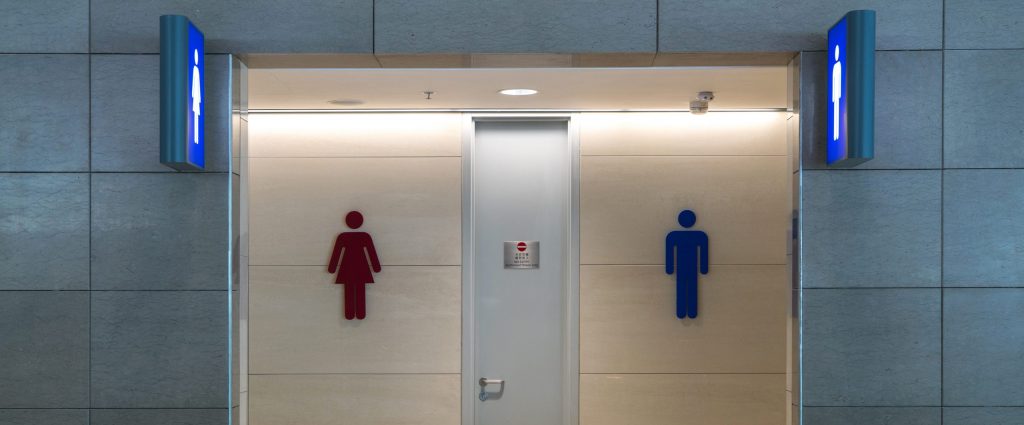
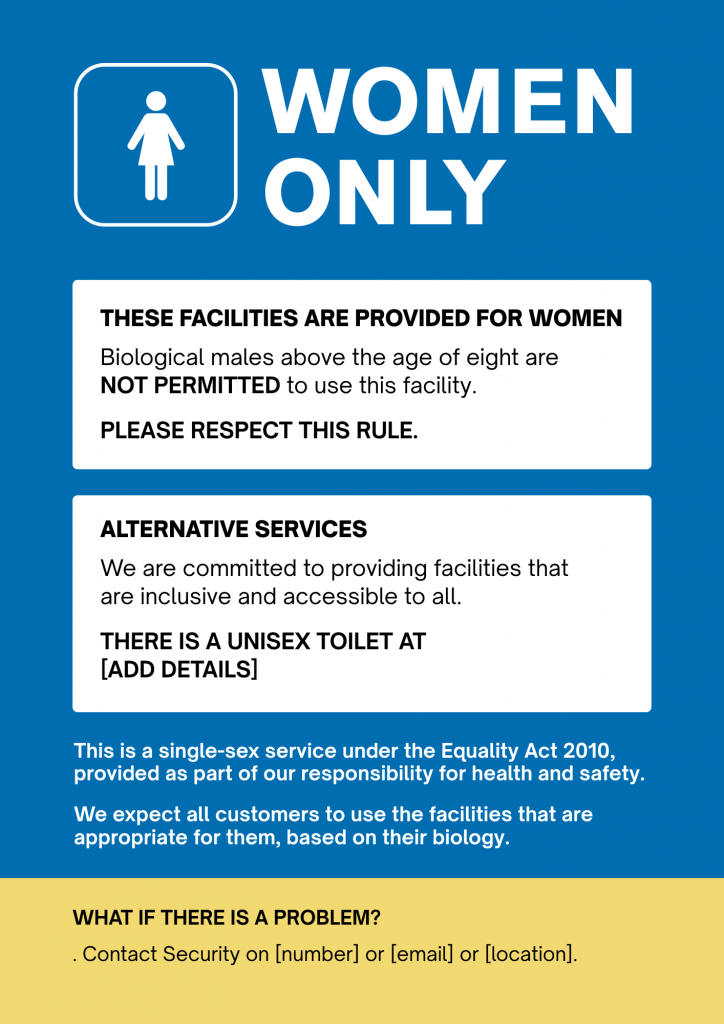
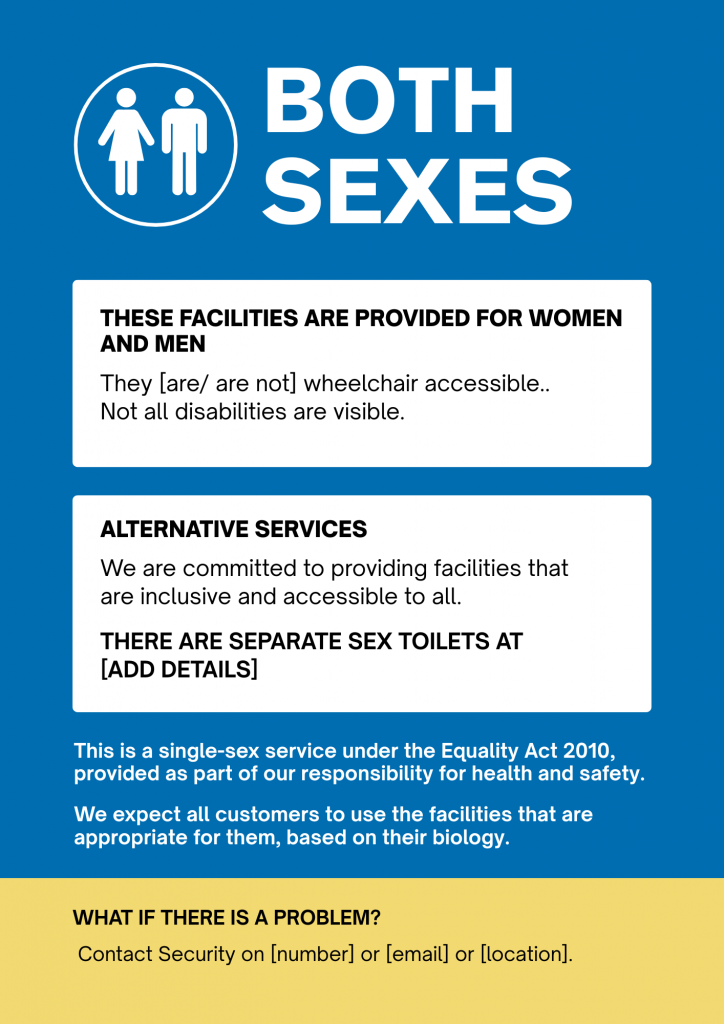
It is lawful to provide services separately to men and women where they are a “proportionate means to a legitimate aim”.25 This can include facilities provided for everyday privacy and dignity such as changing rooms, showers, toilets and dormitories.
Workplaces,26 schools27 and licensed venues28 are required to provide sufficient and adequate facilities for women and men.
It is good practice to provide separate facilities and also to have a unisex option where space allows.29
Facilities can be signposted with words or just a simple picture or icon.30 These signs are not ambiguous and should not be taken as the start of a negotiation.
Breaching single-sex privacy can be unlawful.
Except for maintenance or security staff (who usually announce themselves and put up a sign), if a man goes into a women’s toilet or changing room this could be found to be unwanted conduct that has the effect of creating an “intimidating, hostile, degrading, humiliating or offensive environment”. Statements authorising this, such as “people can choose the facilities they feel most comfortable with on the basis of their gender identity”, can be too. This is unlawful harassment related to sex.

Sport

Physical differences between women and girls and men and boys matter a lot in sport.31
As the International Olympic Committee has recognised: “Male sex provides a performance advantage in all sports and events that rely on strength, power and endurance. To ensure fairness, and to protect safety, particularly in contact sports, eligibility should therefore be based on biological sex.” 32
Inclusion and fairness for women and girls in sport at every level depends on recognising this in training, teams, competitions, equipment and talent pathways.33 Women also need separate changing facilities.
When it comes to sporting competitions, the Equality Act 2010 provides that wherever male strength, stamina or physique provides competitive advantage or presents safety risks, sex-based competition rules are lawful. This can include single-sex competitions and mixed doubles, or teams with rules requiring a minimum number of women or maximum number of men.34
If a sports organisation allows men to participate or compete “as women” within any of these rules, it is likely to be undertaking unlawful sex discrimination and harassment against women.
The UK’s sports councils are public bodies required to work to advance equality for women and men. The sports governing bodies are required not to unlawfully discriminate on the basis of sex.35 Separate-sex competition categories are lawful, and so are initiatives to encourage participation for women and girls in sport where they are underrepresented.
Healthcare

Healthcare workers need to be able to access, use and share accurate information about a person’s sex in order to treat that person safely and effectively. Your sex should be stated accurately in your medical records so that you get the correct diagnosis and treatment.
Sex also matters in your interactions with health and social-care professionals. For example, you can request to be seen by a GP of a particular sex or to have a chaperone for any procedure.
Across the UK there is a policy of providing single-sex hospital accommodation where appropriate (this doesn’t include areas such as critical care).36
But in practice NHS bodies have adopted gender self-identification, undermining these policies.37
The regulators that inspect healthcare services to check if they are safe, effective, caring and responsive to people’s needs should be clear about the meaning of the words male and female, and about what sex people are.
Associations and charities
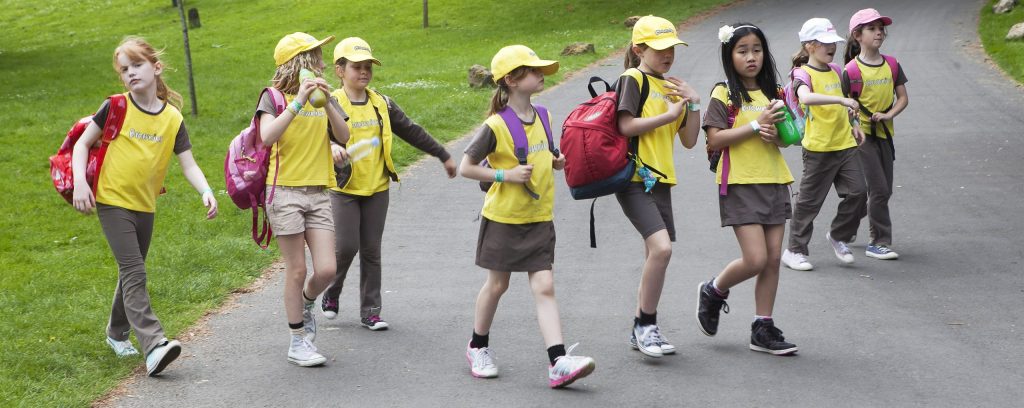
People can choose to form all kinds of associations, including single-sex associations and associations based on other protected characteristics such as sexual orientation.38 People can also form associations that don’t relate to protected characteristics at all – you can have an association of football supporters, musicians or golf players.
The Equality Act requires that formal associations (those with more than 25 members and rules about who can join) must not discriminate based on protected characteristics in who can join and how they treat members, unless the association is explicitly restricted to a group who share a protected characteristic.
This means that an association can lawfully be just for women or just for men, and is not required to allow members of the opposite sex to join or participate.
A charity is a special kind of association. Its trustees are required to ensure that the charity acts in the interests of its defined beneficiaries. Charities that are set up to provide benefits for women or men (or girls or boys) must serve this group.39 Including members of the opposite sex based on their “gender identity” is not pursuing their charity’s purpose. It is also likely to result in unlawful harassment and discrimination against the group the charity was set up for.
Crime and safeguarding

Sex is the single most important predictor of the risk of criminal behaviour.40 Men account for 75 percent of all convictions each year, 93 percent of all murder convictions and more than 98 percent of all convictions for sex crimes.41 It is therefore an important factor in the safeguarding of children and vulnerable people, crime prevention and justice.
Voyeurism (peeking) and exposure (flashing) are crimes that are commonly committed by men against women and girls.42 The law against voyeurism defines a “private act” as when a person’s genitals, buttocks or breasts are exposed or covered only with underwear, or they are using a lavatory in a place which would reasonably be expected to provide privacy.43 Separate-sex spaces are a common protection against voyeurism and exposure. In England and Wales public sexual harassment is now a crime.
Questions about sexual consent relate to a person’s sex. If a person lies or misleads another about what sex they are, and they engage in a sexual act on the basis of this deceit, they may be found guilty of a crime.44
The police, courts, prison and probation services and those involved in the protection of children and vulnerable people often need to be clear about what sex people are. For example:
- If you are searched by the police (involving removal of more than a jacket and shoes), this must be done by an officer of the same sex.45
- If you are a victim of sexual violence or domestic abuse, you have the right to request the police officer conducting the interview is of the sex of your choice.46
- If you are giving legal evidence, you must be allowed to refer to a person in terms of your experience and perception. You cannot be required to use preferred pronouns in court.47
In prisons, men and women should be detained in separate institutions as far as possible.48
Promoting equality

Organisations are allowed to take positive action to address disadvantages that people face because of protected characteristics.49 Public-sector bodies have a duty to advance equality between women and men and must consider the impact of their policies on both sexes.50
Actions for women as a group must relate to biological females.51
An award, programme or competition open only to those who are “female-identifying” has no lawful basis, as it excludes some female people and includes some male people.
Action for women must be for women
“In the case of both sets of provisions [positive action and the public-sector equality duty] the purpose of addressing the particular needs, disadvantages or participation levels of women as a group with the protected characteristic of sex, is undermined if women as a group includes trans women…
(in other words, biological men…).”
Supreme Court FWS judgment, 2025
What are “trans rights”?
People who identify as transgender or are considering doing so (or who used to and have detransitioned), and their families, have the same human rights as everyone else.
This means, for example:
- Organisations such as schools and hospitals that have a duty of care towards them must protect their safety and welfare just as they would for other people.
- They have the right to express their thoughts and beliefs, including their beliefs about transgender identity. They should not be harassed or discriminated against because of these beliefs or statements of personal identification.
- They have the right not to be subjected to humiliating or degrading treatment. This can sometimes mean providing more privacy where possible. If facilities are separated by sex it is a good idea to also provide a unisex option.
- They have the right to have their personal information recorded accurately. Sex, like all personal information, should be recorded accurately and shared where there is a lawful basis.52 The information that someone identifies as transgender or is a cross-dresser is more sensitive.
- They have the right not to be discriminated against. They should not be paid less, or refused education or a service such as transport or housing, because of identifying as transgender (the Equality Act calls this “gender reassignment”), being perceived as transgender or being associated with someone who identifies as transgender.53 But this does not mean that people who identify as transgender have changed sex, or that they have the right to use services provided for members of the opposite sex.54
Many organisations, transgender people and advocacy organisations have misunderstood the law and believe that the Equality Act gives people the right to be treated as if they were the opposite sex. The For Women Scotland judgment makes clear that this is not correct. The judgement by the High Court in Good Law Project v Equality and Human Rights Commission in 2026 confirmed the practical implications of this for separate-sex facilities.55
Everyone knows what sex they are and can be expected to comply with lawful rules. Expecting people who identify as transgender to follow ordinary sex-based rules and signs in workplaces and in public places does not involve any breach of their rights, because the rules are lawful and don’t breach anyone’s rights.
Organisations should not confuse the reality of sex with the idea of “gender identity”. Protecting the rights, freedoms and welfare of others depends on remembering that sex matters.
Many organisations have got the law wrong
“Was the Equality Act meant to treat a trans woman with a gender-recognition certificate as a woman? … we came unanimously to the view that it didn’t. Did we realise that would cause an outrage for people? Yes, because people had been led to believe by public authorities, among others, for the last 15 years that they had rights which they didn’t have.”
Lord Hodge, Supreme Court judge, in The Times, September 202556
What you can do
If your employer, or a public or private service provider or charity you are involved in, has confused sex with the idea of “gender identity”, it is likely to misunderstand the law, and could be breaking it in one of these ways:
Harassment – creating an “intimidating, hostile, degrading, humiliating or offensive environment” for you as a women, man or for person with gender-critical beliefs (someone who says that sex matters).
Discrimination – treating women or men less favourably by operating what should be a single-sex service or sport on the basis of gender identity, or by removing single-sex services altogether.
Misrecording of personal data – failing to record information about sex accurately, or mixing it up with “gender identity”.
Failure in duty of care – falling short in its responsibilities towards children, vulnerable people, patients and others or preventing you from doing your job to protect them.
If you think that an organisation is not following the law, the steps you should take are to:
- Know your rights.
- Complain and follow up.
- Tell someone.
- Take legal action.
- UK Government (2010). Equality Act 2010.[↩]
- For Women Scotland v The Scottish Ministers [2025] UKSC 16.[↩]
- Bellinger v Bellinger [2003] UKHL 21, [2003] 2 AC 467 and For Women Scotland v The Scottish Ministers [2025] UKSC 16[↩]
- Article 10 of the Universal Declaration of Human Rights; Human Rights Act 1998 Section 1; and see also European Court of Human Rights (2022). Guide on Article 10 of the European Convention on Human Rights: Freedom of Expression.[↩]
- Murray Blackburn Mackenzie (2023). ‘Clarity matters: how placating lobbyists obscures public understanding of sex and gender’ and Karleen D Gribble (2025). ‘Proposal for Terminology for Clear Communication and Avoidance of Confusion in Relation to Sex, the Social Expectations of the Sexes and Gender Identity’. Archives of Sexual Behavior (2025).[↩]
- Can-SG (accessed November 2025). ‘What are Differences/Disorders of Sex Development (or intersex conditions)?’; DSD Families (accessed November 2025). ‘FAQ’.[↩]
- Bellinger v Bellinger [2003] UKHL 21, [2003] 2 AC 467[↩]
- England, Wales and Northern Ireland: NHS England (2025). ‘Birth notification process’.
Scotland: National Records of Scotland (2024). ‘NHS Central Register (NHSCR) Privacy Notice’.[↩] - England and Wales: The Registration of Births, Deaths and Marriages Regulations 1968.
Scotland: Registration of Births, Deaths and Marriages (Scotland) Act 1965.
Northern Ireland: Births and Deaths Registration (Northern Ireland) Order 1976.[↩] - UK Government (accessed November 2025). ‘Change your name or personal details on your passport: Gender change’; HM Passport Office (2014). Gender marking in passports internal review of existing arrangements and possible future options.[↩]
- Driver and Vehicle Licensing Agency (accessed November 2025). ‘Change the name or gender on your driving licence’.[↩]
- NHS Primary Care Support England (accessed November 2025). ‘Gender reassignment’.[↩]
- Census of England and Wales: Office for National Statistics (2021). Gender identity, England and Wales: Census 2021’.
Census of Scotland: Scotland’s Census (2024). Scotland’s Census 2022 – Sexual orientation and trans status or history.[↩] - See also Sex Matters (2025). Digital ID can’t be self-ID.[↩]
- Ministry of Justice (2025). Tribunal Statistics Quarterly: January to March 2025.
For more information, see Sex Matters (2024). Applying for a gender-recognition certificate: the facts.[↩] - Equality Act 2010.[↩]
- Sex Discrimination (Northern Ireland) Order 1976.[↩]
- Sex Matters (2025). ‘The Equality Act: 15 years old today!’[↩]
- For Women Scotland v The Scottish Ministers [2025] UKSC 16.[↩]
- For Women Scotland v The Scottish Ministers [2025] UKSC 16.[↩]
- England: The Education (Pupil Registration) (England) Regulations 2006 and The Education (Pupil Information) (England) Regulations 2005.
Scotland: The Pupils’ Educational Records (Scotland) Regulations 2003 – does not specify sex must be recorded, but information recorded must be accurate.
Wales: The Education (Pupil Registration) (Wales) Regulations 2010
Northern Ireland: The Registration and Attendance of Pupils Regulations (Northern Ireland) 1974.[↩] - England: Department for Education (2022). Behaviour in schools – advice for headteachers and school staff
Scotland: Education Scotland (2025). ‘Relationships and behaviour: National policy guidance’
Wales: Welsh Government (accessed November 2025). ‘School behaviour and discipline’
Northern Ireland: Department of Education (accessed November 2025). Behaviour at school.
For more details see: Genette Crispin (2025). ‘Wales’ schools still hung out to dry on trans guidance’, Merched Cymru; For Women Scotland (2025). ‘FWS v Scottish Ministers III’.[↩] - Equality Act 2010, Schedule 3 paragraph 26.[↩]
- For Women Scotland v The Scottish Ministers [2025] UKSC 16, paragraph 211.[↩]
- Equality Act 2010, Schedule 3 paragraph 27[↩]
- Health and Safety at Work etc. Act 1974; Health and Safety Executive code of practice Welfare at work: guidance for employers on welfare provisions.[↩]
- England: The School Premises (England) Regulations 2012 and The Education (Independent School Standards) Regulations 2014, as amended.
Scotland: School Premises (General Requirements and Standards) (Scotland) Regulations 1967 and Paragraph 23 of the Schedule to The Education (Independent School Standards) Regulations 2014. See also Rosie Walker (2025). ‘Single-sex toilet order for schools’. Gilson Gray.
Wales: Regulation 3 of the Education (School Premises) Regulations 1999 SI 1999/2 (applying to Wales only) and School toilets: Good practice guidance for schools in Wales.
Northern Ireland: Department of Education (2023). Section 4 part 23 of Guidance on design of cloakroom and toilet accommodation.[↩] - Licensing Act 2003 and Section 20 of the Local Government (Miscellaneous Provisions) Act 1976.
For local authorities in Wales: Part 8 of Public Health (Wales) Act 2017 concerns their powers and obligations.[↩] - British Standard BS 6465 – and see Sex Matters (2025). ‘Happy World Toilet Day!’; Building approved documents G, M and T (England).
Scotland: Scottish Government (2020). ‘3.12 Sanitary facilities’, Building standards technical handbook 2020: non-domestic.
Wales: Building approved documents G and M.[↩] - ISO 7010 covers international standards for signage.[↩]
- Emma Hilton and Tommy Lundberg (2020). ‘Transgender Women in the Female Category of Sport: Perspectives on Testosterone Suppression and Performance Advantage’, Sports Medicine.
Emma Hilton (2018). ‘Harder, better, faster, stronger: why we must protect female sports’. FondOfBeetles.[↩] - International Olympic Committee (March 2026). ‘International Olympic Committee announces new Policy on the Protection of the Female (Women’s) Category in Olympic Sport’.[↩]
- Women In Sport (accessed November 2025). ‘Trans Inclusion & Women’s Sport’.[↩]
- Equality Act 2010 Section 195.[↩]
- Equality Act 2010 Section 149; equality policies: UK Sport, Sport England, Sport Wales, Sport Scotland.[↩]
- NHS England (2019). Delivering same-sex accommodation.
Annex B, Delivering same-sex accommodation.[↩] - See Sex Matters (2021). Reviewing Annex B and Murray Blackburn Mackenzie (2022).’The erosion of single-sex hospital accommodation in Scotland’.[↩]
- Equality Act 2010 Schedule 16. See also for example Naomi Cunningham (2025). Lesbian-only spaces: advice for FiLiA, LGB Alliance Cymru.[↩]
- Equality Act 2010 Section 193 and see also Charity Commission (2013). Equality Act guidance for charities.[↩]
- Jo Phoenix (2023). ‘Women, Men and Criminal Justice’, The Philosophers’ Magazine.[↩]
- Ministry of Justice (2025). Statistics on Women and the Criminal Justice System 2023. For more information, see Richard Garside (2024). ‘Accuracy in criminal statistics matters’, Centre for Crime and Justice Studies.[↩]
- See Sex Matters (2025). ‘Combatting exposure and voyeurism’.[↩]
- Sexual Offences Act 2003, Section 67.[↩]
- Sexual Offences Act 2003, Section 74. Case law: McNally v R [2013] EWCA Crim 1051. See also Crown Prosecution Service (2024). ‘Deception as to sex’ from chapter 6: Consent, Rape and Sexual Offences.[↩]
- England and Wales: Police and Criminal Evidence Act 1984 (PACE) codes of practice A and C.
Scotland: Scottish Government (2017). Stop and Search of the Person in Scotland: code of practice for constables.
Northern Ireland: Police and Criminal Evidence Act 1984 (PACE) codes of practice A and C.[↩] - England and Wales: Ministry of Justice (2025). The Code of Practice for Victims of Crime in England and Wales and supporting public information materials.
Scotland: Scottish Government (2020). Victims’ Code for Scotland.[↩] - Courts and Tribunals Judiciary (2025). Equal Treatment Bench Book.
Judiciary of Scotland (2025). Equal Treatment Bench Book.[↩] - United Nations (2015). United Nations Standard Minimum Rules for the Treatment of Prisoners (Nelson Mandela Rules); In the UK The Prison Rules 1999.[↩]
- Equality Act 2010 Section 159.[↩]
- Equality Act 2010 Section 149.[↩]
- For Women Scotland v The Scottish Ministers [2025] UKSC 16, paragraph 237.[↩]
- UK General Data Protection Regulation (UK GDPR); Data Protection Act 2018. See also Sex Matters (2023). Data matters and Alice Sullivan (2025). Independent review of data, statistics and research on sex and gender.[↩]
- Equality Act 2010 Section 7.[↩]
- For Women Scotland v The Scottish Ministers [2025] UKSC 16, paragraph 265. See also Ben Cooper (2025). For Women Scotland v The Scottish Ministers: why the Supreme Court’s judgment does not remove, diminish or breach the rights and protections of trans people.[↩]
- Sex Matters (2026). ‘High Court rules: EHRC guidance lawful’.[↩]
- Magnus Linklater (2025). ‘Lord Hodge: Supreme Court had a duty to rule on gender’, The TImes.[↩]