
This is part of our The law is clear – so get on with it! campaign |
Males no longer allowed in Scottish women’s prisons: the law is clear
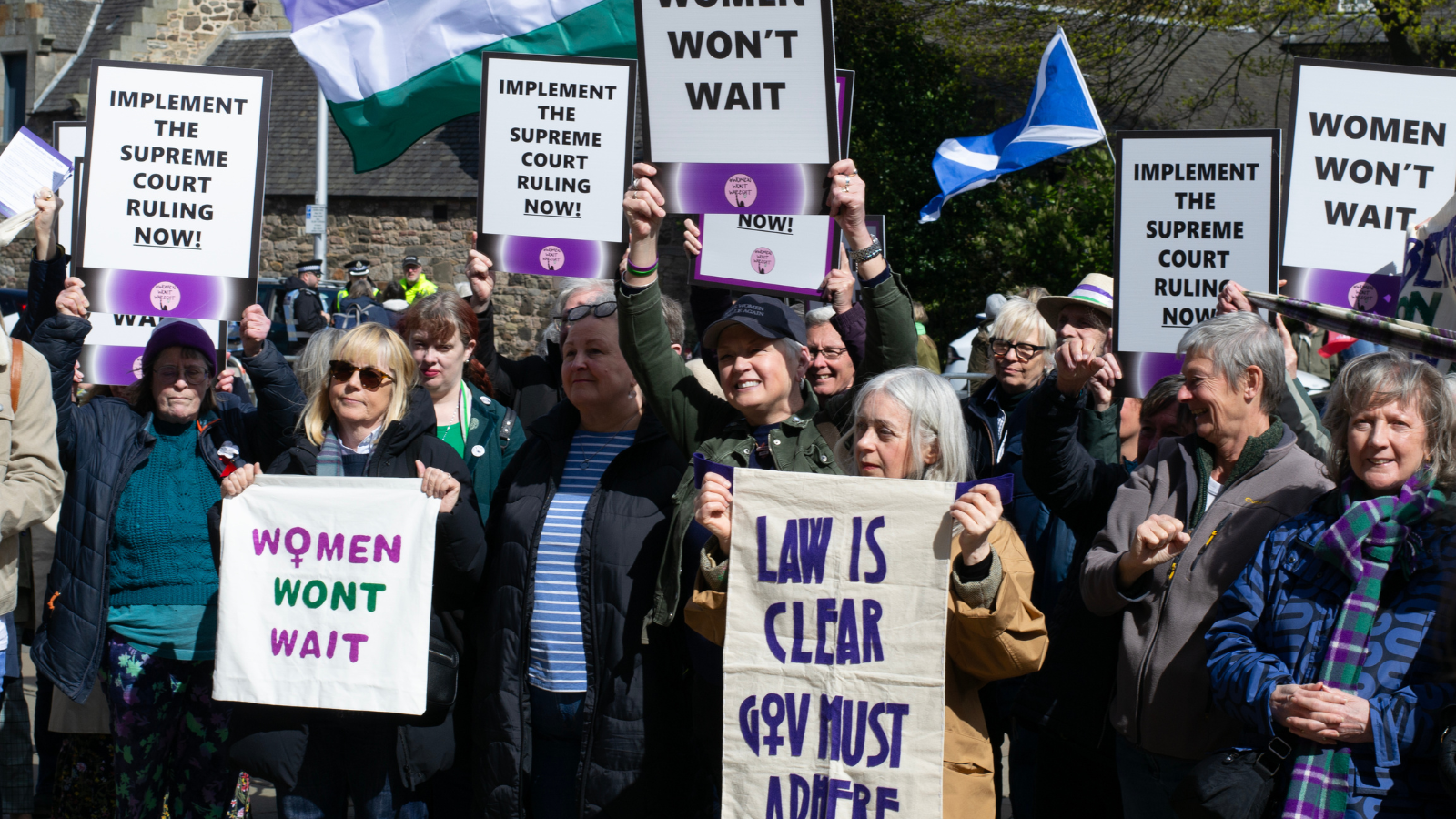
For Women Scotland has won another important victory against the Scottish Government, forcing it to finally remove all trans-identifying men from the women’s prison estate.
The Scottish Prison Service policy had been that trans-identifying male prisoners who had not committed violent, harassing or threatening crimes against women did not generally pose “an unacceptable risk of harm to those housed in the women’s estates” [paragraph 11 of the judgment]. Trans-identifying men who had been convicted of a violent crime against women in the past could be placed in a women’s prison based on an individual risk assessment.
The Scottish Government had refused to change this policy even after the Supreme Court made clear that “sex”, “woman” and “man” mean, and were always intended to refer to, biological sex, and that single-sex services are based on sex.
John Swinney, the First Minister, claimed that when it came to housing trans-identifying prisoners, it was a complicated legal issue. All of the arguments the Scottish Ministers put forward were rejected by the Court of Session in the judgment handed down on 19th June 2026.
The judge, Lady Ross, said:
“In all the circumstances, the Prisons Guidance is unlawful.” [paragraph 184]
Although many trans-identifying men had previously been removed from the women’s estate in Scotland, some remained at the time of the judgment. They are now being moved out of female prisons and Prison Service guidance regarding transgender prisoners must be changed.
Legal arguments
For Women Scotland argued that the ministers have a statutory obligation under rule 126 of the Prisons and Young Offenders Institutions (Scotland) Rules 2011, which requires that separate accommodation is provided for male and female prisoners. Women-only prison accommodation is intended for the protection of women prisoners as a group. That, they claimed, is “a bright line rule” that should not be crossed and does not need to be renegotiated every time it is used.
The Scottish minister’s main concern, as summed up by Lady Ross, was:
“to resist the argument that the only lawful policy would be the exclusion of all trans prisoners from prisons of the opposite biological sex.” [paragraph 37]
The ministers argued that:
- the petition was not relevant because the issues should be heard on a case-by-case basis, not decided on a policy level, and the Equality Act 2010 allows individuals to bring claims
- trans prisoners have rights under Articles 2, 3, 8 and 14 of the European Convention on Human Rights (concerning the right to life, freedom from torture and degrading treatment, autonomy and private life and non-discrimination)
- the Supreme Court decision in April 2025 was a starting point when deciding on where trans-identifying prisoners should be accommodated, but not the final word as it had not considered the legal intersection with the convention.
The ruling
Although the judgment sets precedent only in Scotland, it will be persuasive in other jurisdictions, and it was based on reasoning that applies to other types of single-sex and separate-sex services, not just prisons.
Policies must be lawful
There is no need or expectation that individual women harmed by the policy would have to bring legal cases in order to test whether it is lawful. Service providers and public bodies must take account of all their legal obligations when devising the policy.
“… the structure of the EA 2010 and the fact that it allows for individuals to bring claims do not provide a complete answer to this petition in the way contended for by the respondents. In general terms, service-providers and those who exercise public functions must make sure that the ways in which they carry out those responsibilities are lawful. They must be prepared to meet individual claims but they will only be able to do that in a considered and consistent way if, at the stage of devising policy, they take account of all of their obligations, including those under section 29 of and Schedules 3 and 22 to the EA 2010. If they adopt a policy which, when implemented in individual cases, will result in a breach of their statutory obligations, then that policy may be challenged as being unlawful.” [paragraph 58]
The Scottish Prison Service (SPS) tried to argue that its policy of housing trans-identifying men in women’s prisons was “pragmatic” and similar to a mother taking her young son into a female toilet or changing room. The judge disagreed. She said that when a woman takes her young son into the ladies’ toilets with her, the boy’s “presence derives from that of his mother” and a baby boy being born in a women’s prison does not stop the prison from being for women only.
Separate-sex prisons are allowed
The Equality Act does not require separate-sex prisons, but it allows them.
But there is a legitimate basis for not allowing trans-identifying men in women’s prisons, namely protecting women’s dignity, safety and privacy, and the prison context is important.
“Sex segregation in prisons is not mandated in terms by the EA 2010, but it is lawful. Sex segregation is protected by the provisions of the EA 2010 which are, as expressed by the Supreme Court, “directed at maintaining the availability of separate or single spaces or services for women (or men) as a group”. That can be accepted without the need to examine the circumstances of an individual prisoner in the context of a delictual [i.e civil] claim. For separate spaces to be maintained in a way that is foreseeable and consistent, there require to be rules, whether statutory, as in this case, or otherwise, which are capable of general application. The exemptions or carve-outs, whether in terms of Schedule 3 or Schedule 22, can only sensibly be operated on a group basis. A separate sex space is lawful if either of those exemptions applies. Following FWS 2, lawful sex segregation in prisons means that trans prisoners are excluded from prisons for the opposite biological sex. [paragraph 82]
This recognition that separate-sex spaces rely on rules that are foreseeable and consistent is a clear justification for providing straightforward separate-sex services.
Sex discrimination against women
For Women Scotland argued that placing male prisoners in the female estate would itself result in sex discrimination and would at least be perceived as having the effect of violating the dignity of women prisoners or creating an intimidating, hostile, degrading, humiliating or offensive environment for them, and that that would be harassment. The SPS argued that in both cases, evidence of individual harm would be needed.
The judge disagreed, saying that while harassment might need evidence in relation to sex discrimination, there is no need to refer to the circumstances of an underlying claim in order to bring a challenge to the policy.
She agreed that there is a basis to conclude that the accommodation of male prisoners in the female estate would result in female prisoners receiving less favourable treatment because of their sex.
“There are disadvantages associated with the sharing of accommodation by female and male prisoners; were it otherwise, there would be no need for sex segregation.” [paragraph 89]
Bright-line rules are legitimate
The law recognises the necessity for clear rules which are not subject to a case-by-case analysis in their application.
“The imposition of a bright line rule may have adverse consequences for individuals but there is a strong line of authority which makes clear that, as explained by the European Court of Human Rights in Animal Defenders at paragraph 106: ‘a state can, consistently with the Convention, adopt general measures which apply to pre-defined situations regardless of the individual facts of each case even if this might result in individual hard cases’.” [paragraph 135]
Balancing human rights
All prisoners, including trans-identifying prisoners, have rights under the European Convention on Human Rights.
Article 8 states that everyone has the right to respect for their private life. However, regardless how much a trans-identifying man believes he is a woman, he does not have the right to be placed in the women’s prison estate.
“… there is no case to support an argument that Article 8 entails a right for a trans woman to live in the same place as and in the company of women. It is precisely because of the impact of mixed sex accommodation provision on the privacy and dignity of the would-be fellow prisoners that the restriction in rule 126 exists and that immediately shows that, even if Article 8 rights are engaged, the interference is justified under Article 8(2). Sex segregation is necessary for the protection of health or morals, or for the protection of the rights or freedoms of other prisoners.” [paragraph 125]
This is because Article 8 rights are qualified and sex segregation in prisons is justified.
Under Articles 2 and 3, the SPS is obliged to protect life and not to subject prisoners to inhuman or degrading treatment. But this does not mean that it is obliged to accommodate a trans-identifying prisoner in a prison for the opposite sex. The rights of all prisoners must be considered and balanced.
Both the Scottish Human Rights Commission (SHRC) and the Equality and Human Rights Commission (EHRC) intervened and argued against the petition. They drew attention to both the need to protect the convention rights of women prisoners and the need to balance those rights in the event of a conflict. However, they were primarily focused on ensuring that, when it came to the placement of trans-identifying prisoners, there was not a “without exception” policy. They argued that this could breach the rights of trans-identifying prisoners. The SHRC’s solution was to “have a human rights framework within which to make individual assessments”. [paragraph 47]
Women’s human rights are protected
That both the SHRC and the EHRC, alongside the Scottish Government, failed to stand up for women’s human rights until a grassroots organisation brought the case is shameful.