
This is part of our Sex in the Supreme Court campaign |
Poll shows public support for the Supreme Court decision

On 16th April the UK Supreme Court issued a ruling about the definition of a woman and sex in UK equality law, in the case of For Women Scotland v Scottish Ministers. Three weeks later Sex Matters commissioned a national YouGov poll to find out what impact the judgment has had.
High awareness of, and strong support for, the judgment
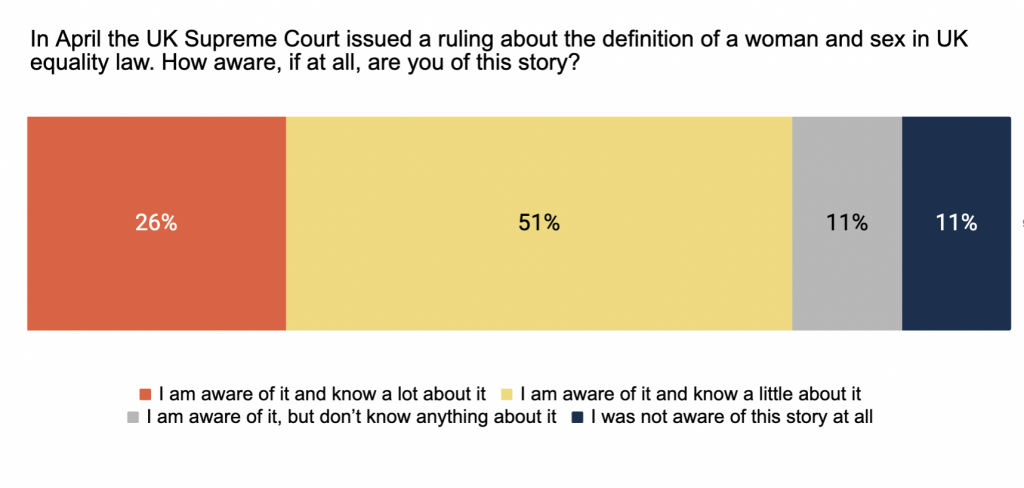
YouGov polling commissioned by Sex Matters shows that 77% of the population are aware of the judgment and knew something about it. Another 11% were aware but knew nothing about it. That leaves only 11% of those questioned who had not heard about this landmark ruling. This was huge news that got national attention.
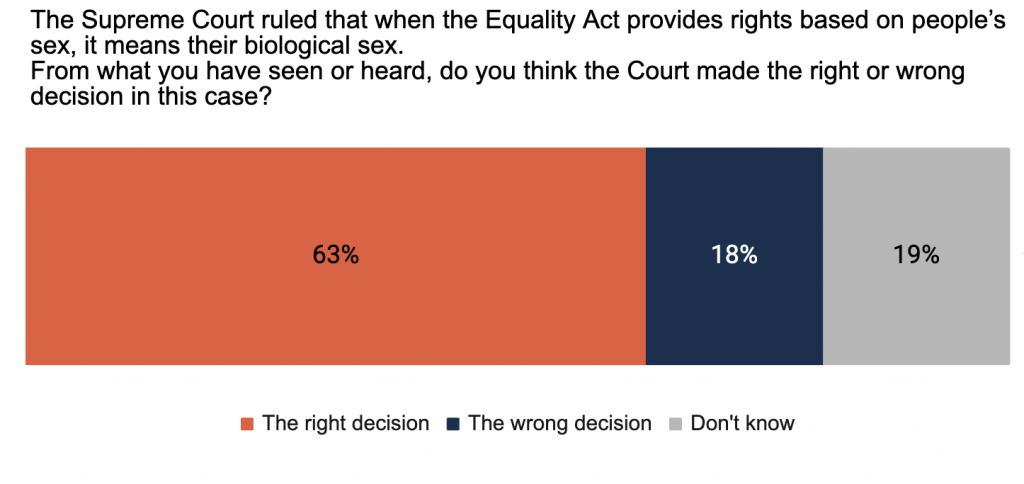
The Supreme Court confirmed that when the Equality Act refers to men and women it means biological sex. 63% of respondents thought that was the right decision, 18% thought it was wrong, and 19% did not know.
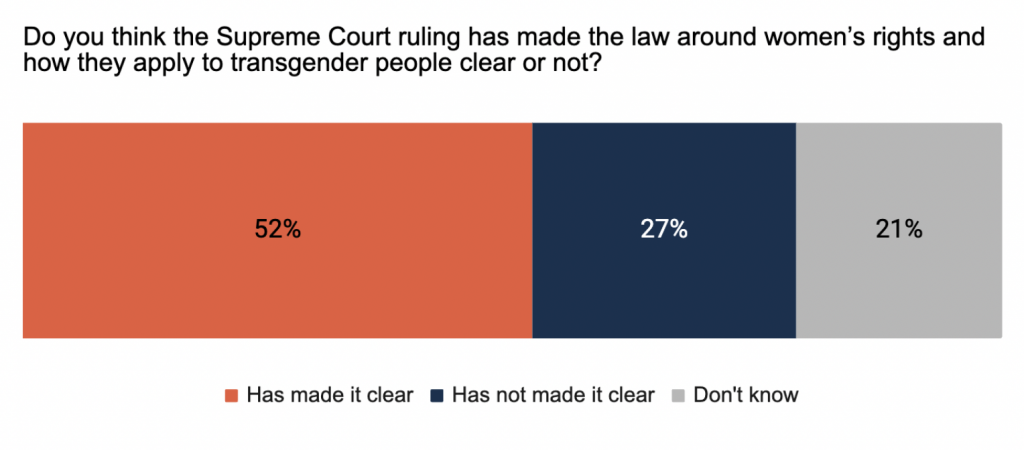
A majority think the ruling has made the law on women’s rights clearer, across all political parties and age groups.
Significant impact is expected in workplaces, and in sport and leisure activities
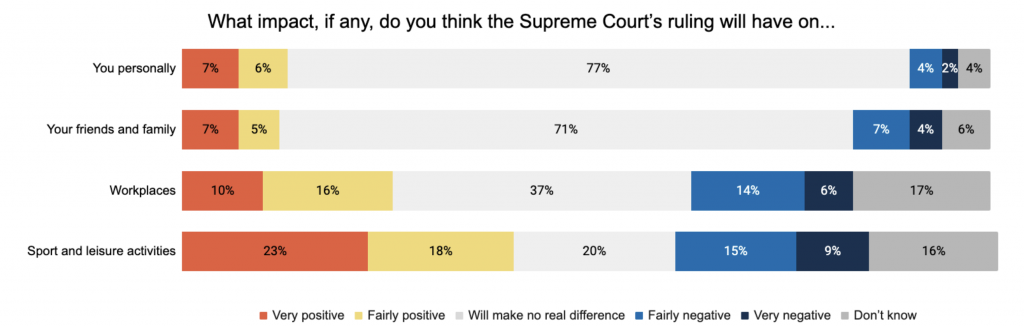
We asked what impact the Supreme Court’s ruling will have across four areas: on you personally, on your friends and family, in workplaces, and in sport and leisure activities.
Most people think the judgment will make no real difference to them personally (77%), or to their family or friends (71%). But that leaves almost a quarter of respondents who think it will affect them personally, with slightly more women than men agreeing it will affect them.
A big impact is expected in sport and leisure, with 41% expecting a positive impact from the ruling, while 24% expect negative impact. That’s three out of five across the whole survey who expect this judgment to make a difference in sport and leisure.
Almost half of those questioned expect an impact in workplaces too, 26% expecting a positive impact and 20% negative.
There is strong support for female-only sport policies
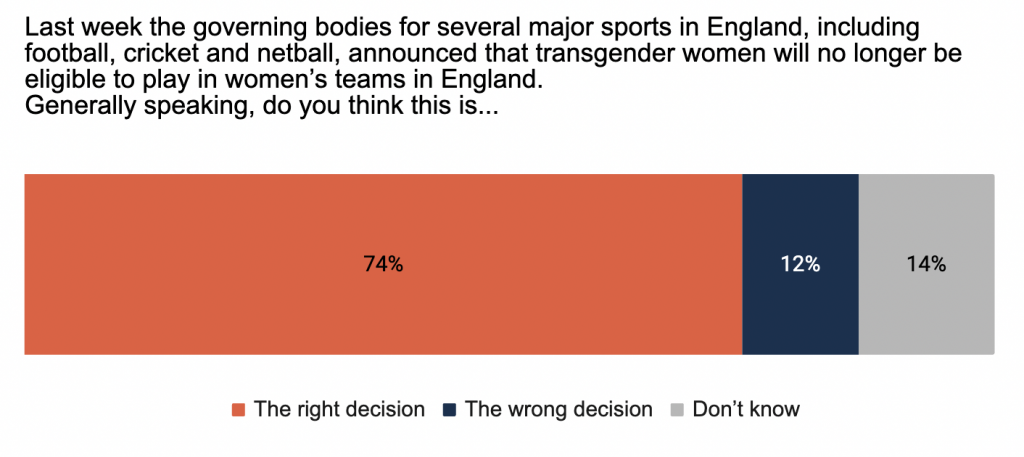
The survey asked about the decisions by major sports in England, including football, cricket and netball, that transgender women will no longer be eligible to play in women’s teams in England (and explained that “a transgender woman is someone who was biologically male at birth, but now identifies as a woman”).
74% of respondents felt this was the right decision. Only 12% felt it was wrong. Support was strong across most age groups but much weaker among 18–24 year olds, of whom 39% supported the change and 38% opposed, with 23% saying they did not know.
It remains a highly polarised issue, by age and politics
As usual, women are somewhat more supportive of centring transgender people’s interests than men are, though the differences are not large. But there are differences by political party and by age.
Responses from young people aged 18–24 are markedly different from all the other age groups, which are broadly similar. 18–24 year olds are less supportive of the judgment: only 31% think it was right, 53% think it was wrong and 16% don’t know.
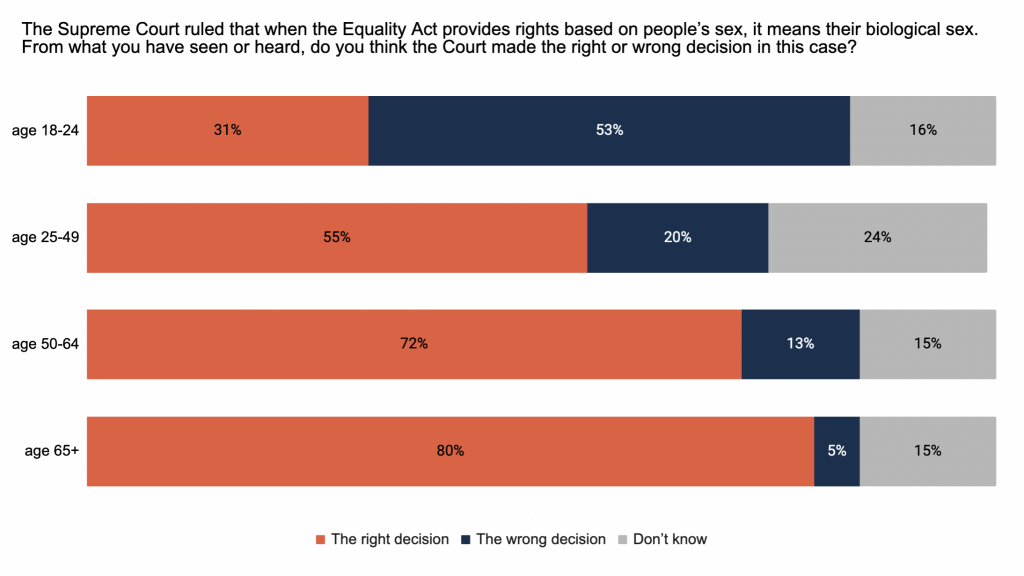
The same proportion think that the judgment will have a negative impact in sport and leisure (54%), even though only 38% said that the sports bodies had made the wrong decision. Young people also think the impact in workplaces will be more negative (47%) than positive (19%). The expected impact on their friends and family is also high in this age group, with 35% expecting negative impact. Every other age group thought that the impact would be net positive.
Across every political party the majority supported the judgment, but there was more support for policies based on gender identity among Labour and Liberal Democrat voters than Conservative and Reform voters (where it was almost non-existent).
Which toilets?
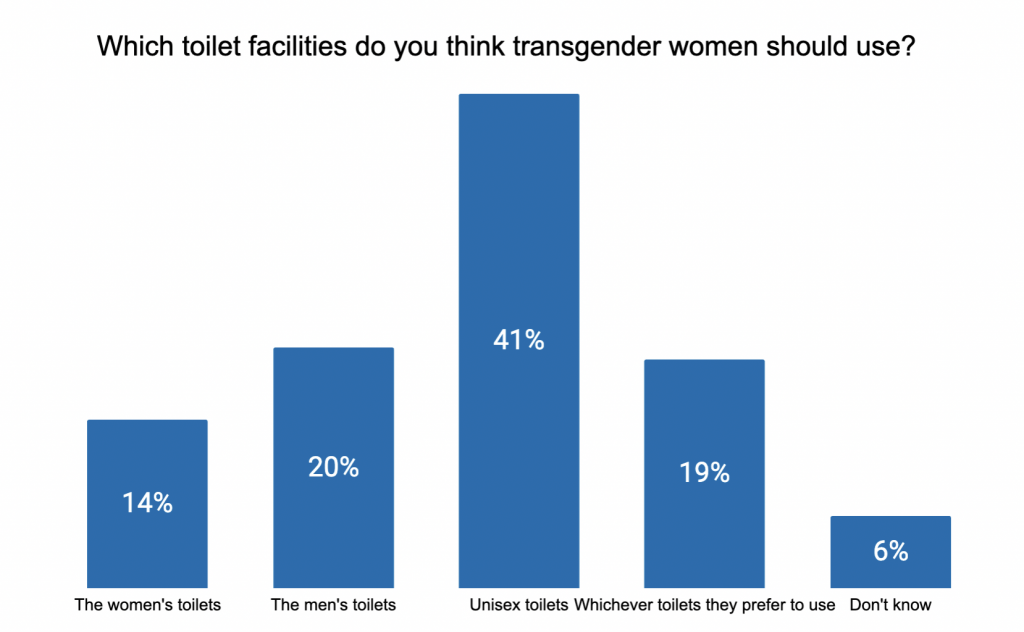
Previous polls have asked whether transgender men and women should be allowed to use the men’s or women’s toilets. This time the question was which toilet facilities they should use, and there were two additional options: unisex toilets or “whichever toilets they prefer to use”. Unsurprisingly, unisex toilets were the most popular response as a solution for transgender people.
Only 14% thought that “transgender women” should use women’s toilets, although 19% said they should be able to choose whichever toilets they preferred.
Conclusions
UK public opinion supports the Supreme Court judgment which recognises that sex means being male or female.
While awareness of the judgment is high, most people think it will not make much difference to them personally. It is expected to affect workplaces, sport and leisure activities significantly. On balance, its effects are expected to be more positive than negative.
On the much-debated issue of which toilets, there is little support for trans-identifying people to use opposite-sex toilets, and growing support for a unisex addition as the most practical option. This does not mean people want to lose single-sex provision for themselves – that question was not asked (in other polls people strongly prefer separate-sex provision).
This is true across all mainstream political parties, but young people aged 18 to 24 are outliers. They are more likely to disagree with the judgment and to think it makes the law less clear. They are the only age group that expects more negative than positive effects from the ruling. However, even they tend to agree with sports bodies’ recent policy changes restricting women’s categories to those born female.
All figures, unless otherwise stated, are from YouGov Plc. Total sample size was 2,106 adults. Fieldwork was undertaken between 8th and 9th May 2025. The survey was carried out online. The figures have been weighted and are representative of all GB adults (aged 18+).