
This is part of our Sex in the Supreme Court campaign |
It’s time for a product recall

When businesses become aware that a product they have distributed poses a risk to users, they issue urgent and clear “Product Recall” notices as soon as they can. They then carefully assess how their quality controls systems failed, to try to avoid making costly and dangerous mistakes again.
There are no similar legal requirements for policy recalls. So unless organisations have strong leaders willing to act with bravery and integrity, they tend to withdraw bad guidance slowly and quietly, concealing their mistakes with obfuscating language rather than acknowledging that they gave the wrong advice. This leaves them and those who put their trust in them at risk of continuing the unsafe practices that had been recommended.
In March 2025 Sussex University was fined half a million pounds for a policy based on gender ideology that was clearly unlawful, reflecting guidance promoted by the Equality Challenge Unit (which later became part of Advance HE). Advance HE wrote to university vice-chancellors encouraging them to review their policies. This was overdue, but it was at least an effort to come clean. More organisations need to be doing this.
Many organisations are now panicking about toilets as they recognise that the policies they have promoted of allowing people to use opposite-sex facilities are likely to lead to unlawful discrimination and harassment and do not comply with Health and Safety at work obligations.
In most cases they don’t have a practical dilemma about lack of facilities to accommodate people who don’t wish to use the correct same-sex facilities – most large buildings already have at least an accessible unisex unisex option. Their problem is one of organisational culture: they have wrongly told their staff that people can choose to use separate-sex facilities based on “gender identity” and that it is “transphobic” to say otherwise.
Now they have to recall this message.
Why did organisations get this wrong for so long?
The organisations now scrambling to work out how to respond to the Supreme Court’s judgment have had plenty of opportunities to recognise that “trans inclusive” policies that went beyond the law were unwise. Some key warning signs they ignored were:
- In 2021 the Employment Appeal Tribunal in the Forstater case ruled that gender-critical beliefs are worthy of respect in a democratic society. It should have been clear that duty bearers could not continue to try to force, trick or pressure people to share “single sex” spaces with members of the opposite sex by calling them “transphobes” if they complained.
- In 2021 the Reindorf Review commissioned by Essex University explained that the University’s policies stated “the law as Stonewall would prefer it to be, rather than the law as it is”. This should have been a wake-up call.
- In February 2022 For Women Scotland won its first case on appeal against the Scottish Ministers which made clear that sex in the Equality Act does not mean self-identified gender and that “provisions in favour of women… by definition exclude those who are biologically male”.
- In April 2022 the Equality and Human Rights Commission published guidance for providers of single-sex and separate-sex services which recognised that it is legitimate to provide services based on biological sex, and that individual case-by-case assessment of trans people seeking to use opposite-sex facilities is not required.
- In December 2024 the Office for Equality and Opportunity published the result of a call for input on misleading guidance. It said that policies which suggested that an Equality Act mandate that transgender people must be allowed to use opposite-sex services were a “clear misinterpretation of the law”.
- In January 2025 two government departments agreed a major out-of-court settlement with Eleanor Frances, a civil servant who had faced discrimination for raising this issue. They also promised to revise their policies and bring them into line with the Equality Act.
Many large employers and service providers blithely continued to ignore the risk and take advice from organisations such as Stonewall and Inclusive Employers to operate based on gender identity. Some are continuing to take advice from organisations that are now telling them to respond to the Supreme Court’s clear judgment with further delay and obfuscation.
For example, shortly after the Supreme Court judgment the for-profit consultancy Inclusive Employers wrote to its client members encouraging them to respond to the judgment by connecting with their LGBTQ+ networks, reinforcing that harassment or discrimination “based on gender” will not be tolerated, preparing for sensitive discussions with compassion and facts and stating that “true inclusion means that we all stand together and we remain committed to creating workplaces where everyone can bring their authentic selves to work every day”. What it failed to mention was that employers must make clear that people should not try to use opposite-sex facilities.
Continued failure to be clear about what the law requires puts organisations at risk of mass discrimination and harassment claims. They need to recall their previous policies clearly and robustly and avoid shoring up misunderstanding with ambiguous messages. Individuals who have previously been wrongly told that it is acceptable to go into opposite-sex facilities and to berate others for complaining need to understand clearly and simply that this is not acceptable. This is health and safety messaging. It can be done with compassion and sensitivity towards the individuals concerned, but not with ambiguity.
We have produced a template email to help employers explain their policy to staff.
Subject: HR policy changes – Equality Act 2010
Hi everyone.
You’ve probably already heard about the Supreme Court’s clarification on the meaning of “sex” in the Equality Act 2010 (https://supremecourt.uk/cases/uksc-2024-0042). On 16th April it ruled that in equality and anti-discrimination law, “sex” means biological sex, not gender identity. As a result, we’ve updated our HR policy on single-sex spaces. [INSERT LINK]
In short: The new policy says that all designated single-sex spaces in [insert company name] premises are available only to people of that biological sex. From today, none of us can use any of our facilities that are designated as for the opposite sex. We’ve made sure we have unisex, single-user alternatives.
This policy change keeps us compliant with the law. The Supreme Court clarified the meaning of “sex” in the Equality Act. It did not change the law or write a new law. It set out what is, and has been since 2010, the correct interpretation of the law. It is the UK’s highest legal authority, and this judgment overrides any previous guidance or interpretation of the Equality Act.
Like many organisations, we based our policy concerning access to single-sex spaces on what we now know to have been a misinterpretation of the law. Our legal team has scrutinised the Supreme Court decision closely and updated our policy to comply with it. If we hadn’t done this, we would now be in violation of equality and anti-discrimination law, as well as workplace regulations about single-sex toilets and changing rooms. This would have opened us up to legal and financial risk. As a responsible company that takes legal responsibilities and human rights seriously, we knew that updating our policy was the right thing to do.
This change doesn’t remove any of our protections against discrimination or harassment. The judgment was based on careful consideration of anti-discrimination law. The Supreme Court decided that taking “sex” to mean “biological sex” was the only legally coherent approach that protects the human rights of everyone, whatever their sex or gender identity.
As the court pointed out, if you’re trans, you’re still protected under the characteristic of “gender reassignment”. Having this protected characteristic does not change a person’s sex, and does not give anyone the right to use spaces that are provided for the opposite sex. The Supreme Court ruled that having a gender-recognition certificate doesn’t give people this right either. Our updated policy continues to make clear that we won’t tolerate discrimination or harassment of any kind.
As the Equality and Human Rights Commission has emphasised (https://www.equalityhumanrights.com/media-centre/interim-update-practical-implications-uk-supreme-court-judgment), everyone must have access to suitable facilities at work. We have reviewed ours, and are satisfied that we have sufficient unisex, single-user alternatives to accommodate people who do not feel comfortable in single-sex facilities for their own sex. We have improved signage to help everyone find facilities that suit them. These clear rules apply to and protect visitors to our premises as well.
Please read the new policy in full to find out how it will work and where single-user, unisex facilities are located. If you have any further questions, please drop us an email or come see us in HR.
Thanks,
[INSERT NAME]
HR Director
Umbrella bodies, charities and commercial organisations that have given out bad advice should recall their advice loudly and clearly, as they would if they had been responsible for distributing an unsafe product.
Here are some policy recalls we would like to see made more clearly, with recognition that they were simply wrong.
Government Equalities Office
In 2015 the Government Equalities Office (GEO) published guidance on providing services to transgender customers (with external lobby group Gendered Intelligence) and on recruiting and retaining transgender staff (with Inclusive Employers). It said that legislation recognises “a person’s right to determine their own gender”. This was quietly withdrawn in November 2024, when the results of the government’s call for input on misleading guidance were being analysed.

Stonewall
Some time in January 2025 Stonewall dropped its previous definition of transphobia. This is a start, but there is much more advice from Stonewall which is not in line with the Equality Act. Organisations using Stonewall’s advice are likely to find themselves in breach of the Equality Act 2010 and the Health and Safety at Work Act 1974.

Advance HE
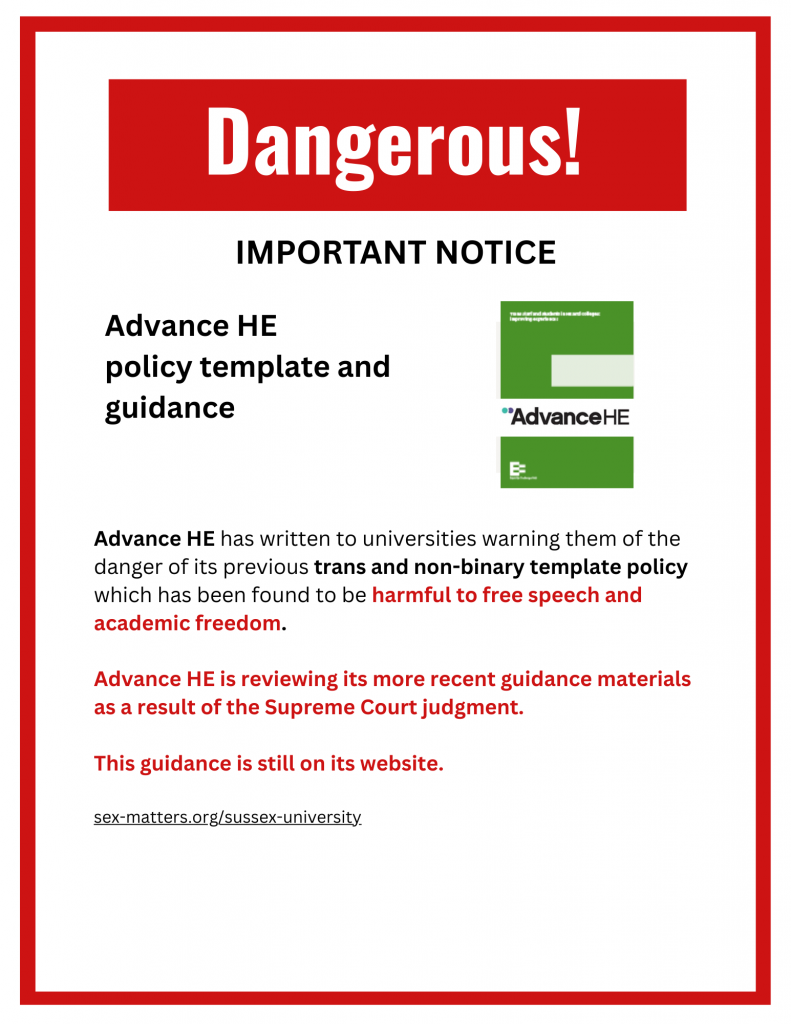
Advance HE says that it is currently reviewing its own guidance materials, but continues to feature guidance on its website (albeit with a warning message) which suggests that universities should allow people to use separate-sex facilities based on gender identity. Any universities that follow this guidance will be breaching the law.
NHS Confederation
Last Friday the NHS Confederation quietly removed its trans and non-binary allyship guidance from its website, making the statement:
“As a result of the interim guidance, certain elements of our guide, particularly in relation to single-sex facilities, are now dated. The guide was based on the situation prior to the Supreme Court ruling.“
This is wrong, and insulting to women such as Sandie Peggie and the Darlington Nurses who faced discrimination and harassment based on policies that have been unlawful since they were developed.
We have been warning Matthew Taylor of the NHS Confederation that its approach was not in line with the law since August 2022, before the NHS Confederation published its guidance.

Chartered Institute of Personnel and Development
In 2023 the CIPD published a guide to transgender and non-binary inclusion at work. We wrote to them explaining that it misinterpreted the law, and was profoundly one-sided.
The institute updated the guidance by making it more vague, and putting it behind its membership paywall. It now appears to have withdrawn the guidance altogether and issued an interim statement telling employers to “compose clear, inclusive messages to all staff explaining the ruling, its impact, and the organisation’s ongoing commitment to inclusion and respect for all identities, beliefs and views”.
On 19th May it was still saying: “The surrounding legal landscape and consequent good practice is changing and will continue to change”. This is not true: the legislation has not changed. It was never “good practice” to allow men into women’s toilets, changing rooms and showers and to discriminate against and harass women who complained. Vaguely instructing employers to compose “inclusive” messages is inadequate advice, when the CIPD itself had promoted the idea that being inclusive meant restricting people from recognising the two sexes.

Has your employer issued a new policy or an all-staff email or statement about the Supreme Court judgment or EHRC guidance? Tell us about it! [email protected]