
This is part of our Protect sport for women and girls campaign |
Enabling and protecting sport for women and girls
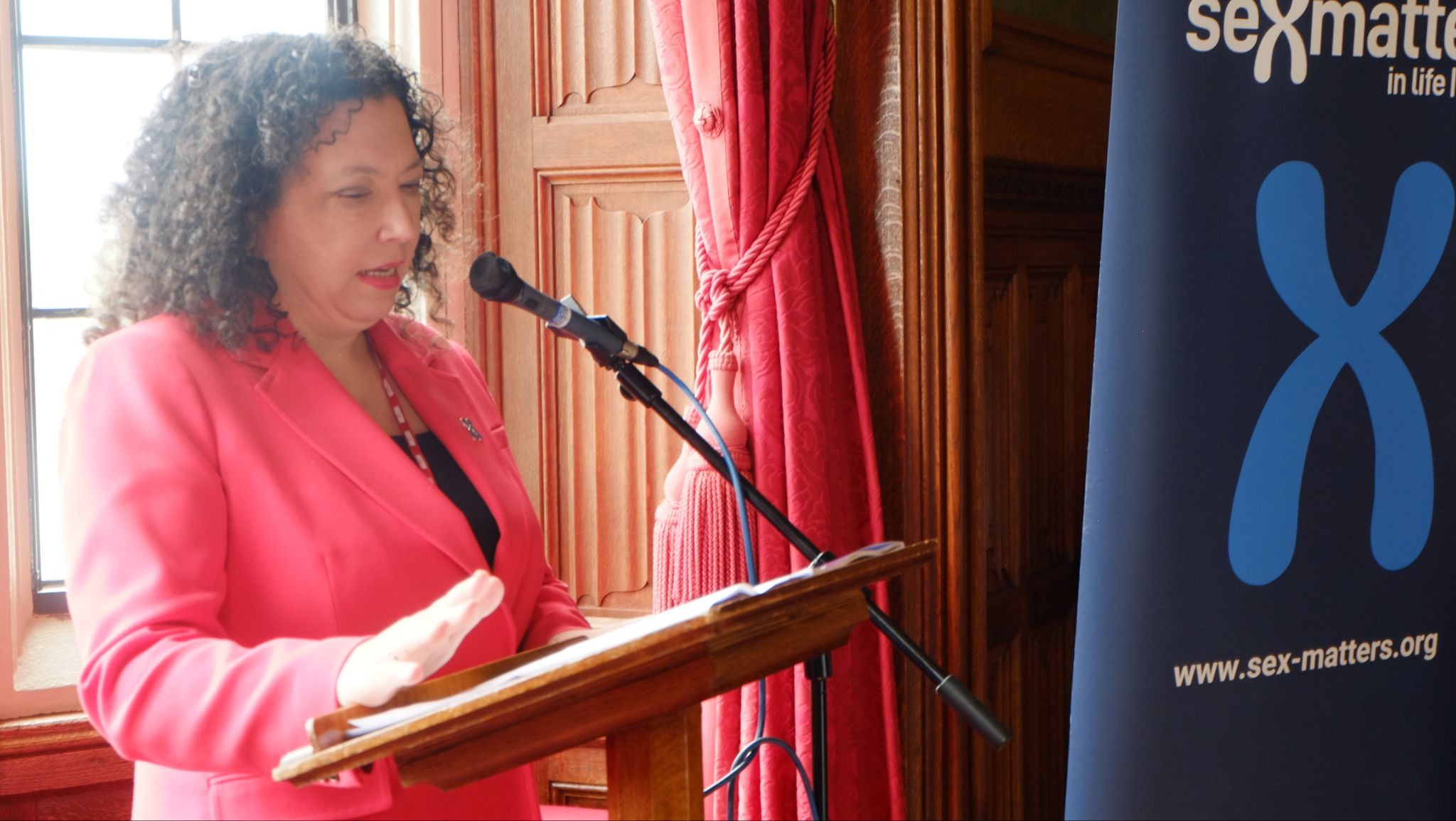
On 4th June 2026, Sex Matters launched its latest report on sport: Getting back on track: Using the Equality Act to enable and protect sport for women and girls. This is an edited version of Maya Forstater’s speech at the event, which was held in the River Room in the House of Lords.
Friends and colleagues. Thank you for joining us here today for the launch of Sex Matters’ new report. And thank you to Baroness Sharron Davies for hosting us and for everything she does for women’s sport.
Sex Matters is a charity that campaigns for clarity about sex in law and policy in the UK. We do this because such clarity matters: for fairness and safety for women, for children to grow up secure in their bodies and for institutions to work for us all.
The purpose of this report is to explain the law on sport in simple terms and to issue a call to action for ministers, sports councils and national governing bodies to stand up for women and girls in sport at every level.
We are all here because we care about sporting opportunities for women and girls, in everything from archery to Zumba, and at every level from young women who might one day play for the Lionesses or the Red Roses or compete in the Olympics to women who want to take part in their local Parkrun or go to gym and have privacy and dignity in the changing rooms.
There is so much more visibility, interest, participation and investment in women’s sport and fitness than ever before. And that is something to celebrate. But for the past 15 years a misunderstanding of the law that is supposed to protect women has been allowed to undermine the protection, focus, fairness, opportunity and resources needed for women and girls to thrive in sport.
Best intentions
In 2011 the government launched a one-page charter, Tackling homophobia and transphobia in sport. The founding signatories included the Lawn Tennis Association, Rugby Football Union, Football Association and England and Wales Cricket Board. They pledged to challenge “unacceptable behaviour” – a laudable aim.
In 2013 the Sports Councils Equality Group, made up of the five UK sports councils, published guidance on transsexual people and competitive sport. Like many organisations at the time, including the equality regulator itself, the group misunderstood the law – the Equality Act 2010 – that protects women and girls from sex discrimination and harassment.
They advised sports governing bodies that the inclusion of male participants identifying as women should be the default position unless specific concerns about safety or fairness related to an individual could be demonstrated.
Hostile environment
We now know that this was wrong in law. And it was simply not fair. It led to injustice. Women lost places on the podium, places on teams.
But more than that: women’s sport and sports organisations became a hostile environment for women who wanted to speak up for fairness and safety, and for centring women’s interests. To give just one example, in 2024 Cerys Vaughan, a teenage footballer who was playing for her local team in Wigan, asked a bearded transgender player on the opposing team: Are you a man?
The Football Association ruled that she had been abusive, indecent and insulting, and suspended her for six games. Cerys didn’t lose an Olympic medal, but the ban threatened to scupper her A-level PE coursework. And sport matters at that level.
My colleague Fiona McAnena, who leads on sport for Sex Matters, and the SEEN in Sport network, who are publishing a report this week on women’s experiences, hear from women and girls up and down the country who feel betrayed and abandoned, and stressed and angry because they have had to face men in women’s changing rooms, women’s leadership programmes, women’s yoga classes, women’s teams. They tell us their sport has been made into a hostile environment.
Cerys found help and appealed against the sanction. Ultimately, she won. But she should not have had to do this. She should have been concentrating on playing football.
She never should have faced a male player on the field and have been expected to pretend not to notice. And nor should the local club organisers and match organiser. Such a situation is not fair and it is not safe.
The “unacceptable behaviour” was not Cerys Vaughan’s. It was all the institutions that allowed this to happen and pushed the responsibility for decision-making down through the sport system who were behaving unacceptably.
And this has happened in every sport. Those running sports have lost sight of what women’s sport is for. And they lost sight of what the Equality Act is for: to protect people against discrimination and harassment, including women on the basis of sex.
The science
The chair of Sex Matters’ board, Dr Emma Hilton, is also here today. She is a developmental biologist who has done a great deal of work explaining the science of sex differences. Men are on average taller, faster and stronger. They have bigger bones, longer limbs, wider hand spans, wider shoulders and narrower pelvises. There are so many physical differences, and it turns out they matter not only in the obvious power sports such as boxing, rugby and weightlifting, and in the speed sports, where teenage boys beat the women’s 100m world record every year, but also in precision sports such as darts and pool.
If you have science questions, Emma is your woman. But this report is about the law.
The Equality Act
In the Equality Act, Parliament deliberately created a framework that combines protection against discrimination with carefully designed exceptions that allow for single-sex services and associations, positive action and the public-sector equality duty, which requires women’s needs to be considered.
Those provisions are an acknowledgement that equality is not always achieved by treating women and men identically. In many circumstances, equality requires targeted measures to address disadvantage, meet distinct needs and create fair opportunities for participation. Sport is one of the clearest examples.
Last year the Supreme Court made the law clear.
- In order to provide a facility or service for women you must exclude men, including men with a transgender identity.
- Excluding trans-identifying men from women’s sport is not “unacceptable behaviour”. It is lawful and fair. And it always was.
- Excluding men doesn’t have to be done individually, on a case-by-case basis. The Equality Act is about how you treat women and men as categories.
- Where the act says “women” and “men” it means “female” and “male”.
What we have done in this report is pull together all the parts of the act that relate to sport and show how the act works as a whole to protect women and girls in sport.
If you take away one insight from today, please make it this: “It’s not just about Section 195.” This is the part towards the end of the act you will find if you search for the word “sport”. It is specifically and only about participation as a competitor.
Because of course sport isn’t just about competition. No-one starts with competition. They start with learning, practising. They need facilities and coaching, time and space, changing rooms and investment. If women and girls are forced to share these with men and boys, it is likely that they will be disadvantaged well before they get anywhere near competition. In other words, they will face sex discrimination. So they need their own provision.
The message of this report is that to understand what the Equality Act says about sport, you need to look at the act as a whole. Its provisions for employment, associations, charities and services apply to the sport system just as they apply to every other area.
Start with sex discrimination: women and girls have a right not to be subjected to detrimental treatment related to being female when participating in sport, whether as competitors or in any other capacity. And do not lose sight of that.
Single-sex activities and facilities
The Equality Act includes a range of provisions that permit and support female-only sporting provision in order to make this lawful. These are not limited to competition. They are threaded throughout the act. They include exceptions for single-sex associations, single-sex and separate-sex services, positive action, single-characteristic charities and employment. In mixed-sex activities such as Parkrun, you must not run them in a way that disadvantages women – which is what happens when you allow men’s times to be recorded as women’s.
Taken together, these provisions create a coherent legal framework which allows women and girls to be supported, encouraged and protected in sport at every stage and at every level, with facilities, investment and fair rules.
The same framework enables individuals to bring legal claims. But they shouldn’t have to. Women and girls like Cerys Vaughan should be focusing on playing the sports they love, not fighting through the courts. And you shouldn’t have to be a scientist or a lawyer, or particularly brave, to argue that women’s sports are for female people.
A call for leadership
It is for organisations, sports leaders and public bodies to protect women’s sport. Doing so does not require new legal protections. It simply requires the consistent application of the protections that already exist.
It requires leadership by ministers, sports councils, regulators and governing bodies to ensure that the interests of women and girls are centred at every level.
We call on sports leaders to stop looking for compromises and get-out clauses and get back to protecting, celebrating and promoting women and girls in sport because it is the right thing to do.
Thank you all for coming and for speaking up for women’s sport. We hope you will find this report useful for your work. We hope you can work together to press leaders to protect women’s sport, and take the pressure of ordinary women and girls like Cerys Vaughan.
Finally I would like to thank the sportswomen like Sharron Davies, Tracy Edwards and Mara Yamauchi, as well as the Women’s Sport Union and groups like SEEN in Sport, all of whom have done so much to raise awareness of the need for female-only sport. And to thank the sports journalists who have written about this topic, the lawyers who have helped us to understand the law, and my colleagues at Sex Matters who put this report and this event together with me.
Most of all I’d like to thank my colleague Fiona McAnena, who has done so much, first at Fair Play For Women and then, for the past two years, with us, to make sure that all sports’ national governing bodies know that sex matters.