
This is part of our Sex in the Supreme Court campaign |
What Law & Disorder got wrong about the FWS judgment
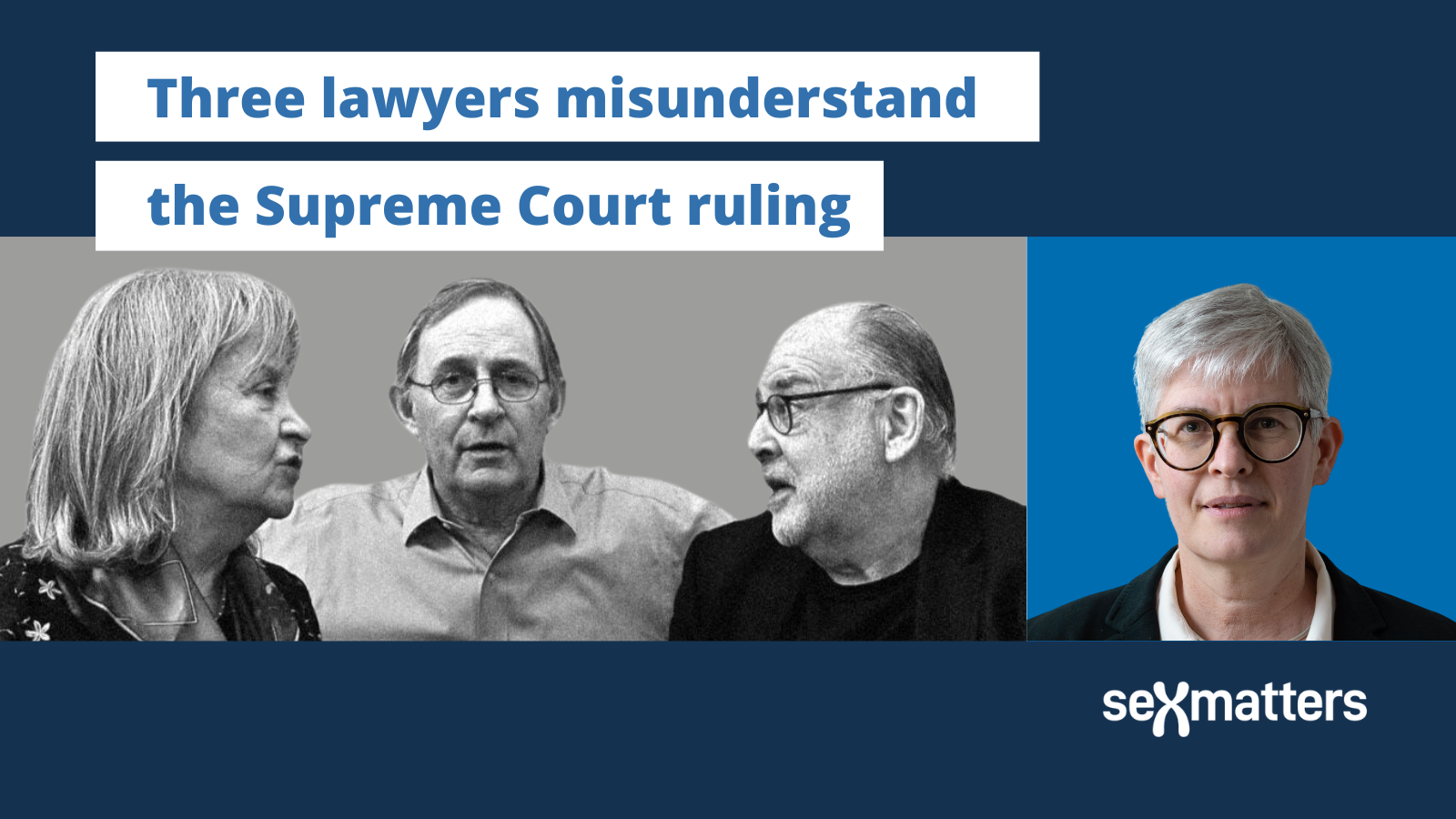
Three legal luminaries discussed the For Women Scotland judgment on their Law & Disorder podcast, writes Sex Matters chair Naomi Cunningham. They were Lord (Charlie) Falconer, former Lord Chancellor; Sir Nicholas Mostyn, retired High Court judge; and Helena Kennedy KC, Baroness Kennedy of the Shaws. You might reasonably expect that this would be a learned and sophisticated conversation among three people who had read the judgment and engaged with the detail of the arguments before the court. Mostyn followed up with a note on his Law & Disorder website.
Baroness Kennedy kicks off by expressing surprise that the Supreme Court hasn’t grappled with the problem of discrimination by perception:
“What about the perception of someone’s sex? If someone has transitioned very successfully and everyone assumes that person is a woman and she’s discriminated against in the way that women are in employment, for example, do we not see that as being discrimination?”
Kennedy returns to this question twice more in the podcast. On the third occasion, when she says “Perception matters in all of this. And I think that the court didn’t consider that, did they?” Falconer sets her straight, and explains how discrimination by perception works: a matter dealt with fully and lucidly in the judgment at paragraphs 249–250.
Mostyn says early on that it is important that listeners should understand that “the actual decision affects only a very small number of people,” and points out that only about 8,000 individuals hold a certificate.
This misses the point. People who assert a “trans” identity may only be around 0.4% of the population as a whole; but even if that is double the true percentage, one in 500 is not outlandishly rare. If accurate, that means that it will not be surprising to find a couple of dozen such people employed in the average NHS trust, three or four housed in the average prison or a couple of hundred participating in the London Marathon. And as should be obvious to anyone (but especially a former judge), the rights and claims of one group often come into conflict with those of another. If one trans-identifying man is allowed to participate in the London Marathon “as a woman” that will bump every single woman participating whose time is slower than his one place down the ranking. If one trans-identifying male employee in a workforce of a few hundred is permitted to use female facilities, those facilities are not single-sex any more, but mixed, and that has an effect on all the trans-identifying man’s female colleagues.
Mostyn returns to this theme later on in the podcast, speculating that the judgment might have been different if more gender-recognition certificates (GRCs) had been granted, and that the reason numbers are so low is that the procedural requirements placed on those who seek a GRC are “formidable”.
Mostyn is wrong on both counts. There is nothing in the judgment of the Supreme Court to suggest that the small number of GRCs in circulation played any part in the court’s reasoning, and indeed the practical consequences of the various difficulties that would be caused by a “certificated sex” interpretation, and which the court found persuasive, would self-evidently be proportionately greater if more certificates had been granted. He is also wrong to suggest that there is anything difficult or daunting about the process, or any requirement to explain a decision not to undergo surgery, as a cursory glance at the Gender Recognition Act 2004 (a short Act running to only 28 sections) would have told him.
On the same subject, near the end of the podcast there is this rather fascinating exchange:
HK “But there are also women who just don’t fancy the idea of people being trans and where there’s a hostility to it. I just feel that we’re opening a door. There’s a tiny number.”
NM “Tiny number. Tiny number.”
HK “Tiny number. And when they raise the business about refuges or when they talk about the business of prisons, honestly, they’re exaggerated out of all proportion. Yes, horrible things have happened, but they’re so rare.”
The insistence that trans people are a tiny number – repeated almost liturgically here – is one of the most familiar refrains of trans activism. “What are you getting in such a fuss about, it’s only a tiny number?”
The truth, of course, is that as shown above, the numbers don’t greatly matter: it only takes one man in a supposedly women-only space to render it mixed-sex. And it only takes the theoretical possibility that men may be present in certain single-sex spaces to cause many women simply to self-exclude.
Turning to the single-sex and separate-sex provisions of schedule 3 to the Equality Act 2010, Mostyn conjures up two imaginary individuals, Alan and Jane, both aged 60. Alan is a trans-identifying woman (or “trans man”), and Jane is a trans-identifying man (or “trans woman”). Both Jane and Alan underwent substantial medical treatment some thirty years ago, and both “pass” successfully as the opposite sex. Mostyn asks whether on being admitted to hospital after a car crash, Jane and Alan should be placed in a women’s ward or a men’s ward.
It is a small but perhaps telling detail of this scenario that none of the three contributors notices that A&E departments are not sex-segregated: neither Jane nor Alan will be placed on a ward at all until after the immediate crisis has passed. But leaving that aside, and assuming that we are considering what the hospital is to do next, once Alan and Jane are stabilised sufficiently to be moved to a ward, it is true that, as described, they present the hospital with a real problem. They will look and no doubt feel out of place on a single-sex ward for their own sex; but placing them on opposite-sex wards will violate the privacy of the other patients on those wards. It is all very well for Kennedy to say airily that the woman in the next bed would much prefer to wake up next to Jane than Alan. That may be so if Jane passes so well that no-one would ever suspect that he is really male. But suppose the woman in the next bed is a rape or sexual abuse survivor who is hyper-vigilant to the possibility that the female-presenting person in the next bed is in fact male? Or an adherent of a faith that requires her not to share intimate spaces with men? What if the woman in the next bed is much better, for whatever reason, at spotting a biological male than Kennedy is? What if, unknown to the hospital, Jane is a vocal trans activist with a public profile, and the woman in the next bed knows for a fact that he is male – or has even crossed swords with him in the past on the subject of single-sex spaces?
Even leaving aside the possibility that the hospital’s snap judgment that Jane “passes” as female sufficiently to be placed on the women’s ward is simply wrong, and even assuming that no female patient on that ward notices that Jane is male, how is it acceptable to trick those female patients into sharing an intimate space that is expressly designated as single-sex with a person of the opposite sex? And how is it acceptable to convey to all potential female patients the message that they can never be sure that the women’s ward is what it purports to be?
The other objection to Alan and Jane is that they are figments of Mostyn’s imagination: in reality, although women who have taken testosterone can often pass well as men, it is very difficult indeed for a man who has gone through male puberty to pass as female, whatever surgical and hormonal treatment he may have had. And the problem is much more acute in relation to men in women’s spaces: for good reason, women tend to feel modesty taboos much more strongly than men do. So if Jane really does “pass” for female, Jane will be a vanishingly rare case: the much more plausible example is Cynthia, who wears women’s clothes and may even have developed breasts under the influence of artificial hormones, but is unmistakably male to all; see for example the protester interviewed in this clip.
Falconer says of the imaginary Jane: “Nobody’s going to start questioning what her sex is in the aftermath of a car crash.” This is a surprising claim, bearing in mind that many conditions affect men and women differently, and many drugs act differently on male and female patients.
Kennedy then raises the usual objection of the masculine-presenting lesbian: “But supposing, for example, somebody comes in to the surgical unit, who is a very male-looking lesbian, are we going to start quizzing people about…” and Mostyn chips in: “This is the point that everybody seems to have missed and you put it absolutely perfectly.” He then starts talking for no obvious reason about a trans-identifying woman who had lectured him at the Judicial College when he was a judge, who he thought “looked like a man in every respect”.
This is exasperating stuff. First, the masculine-presenting lesbian who faces being quizzed about whether she is really a woman is very far indeed from being a point that everyone seems to have missed: it is one of the most well-rehearsed zombie arguments of trans activists. It is also profoundly silly. Being sexually oriented towards other women does not cause women to look like men. It does not give them bigger muscles, a taller frame, bigger hands and feet, a lower voice, a beard, an Adam’s apple, a man’s gait, or any of the other visible or audible signs by which we discern sex. A woman in trousers and no make-up with short hair and comfortable shoes does not look like a man; she just looks like a woman in trousers and no make-up with short hair and comfortable shoes. Indeed, in truly shocking news, I can reveal that a woman in trousers and no make-up with short hair and comfortable shoes is not even necessarily a lesbian.
The woman who lectured Mostyn at the Judicial College may indeed have looked and sounded very like a man. Quite what he imagines this fact has to do with the risk that lesbians will be quizzed about whether they are really female because of a gender non-conforming dress sense is not revealed.
All three speakers on this podcast appear unable to imagine how on earth clear rules about single-sex spaces could work, trotting out the usual objections about how such things are to be policed. This is an imaginary difficulty. At present, there is a widespread assumption that people with a trans identity must be allowed to use whatever facilities they please. That means that a man in a supposedly women-only space is not a surprising or anomalous or obviously transgressive phenomenon, because for all we know, he may be a “transwoman”. We can almost always tell whether another person is male or female, because we are evolved animals and that is a question of fundamental importance to us (and in any medical setting, it is essential that it should not be concealed from healthcare professionals). But we have no way at all of telling whether another person has a male or female “gender identity” unless they tell us, because “gender identity” is not an objective thing at all. We can no more discern someone’s gender identity by looking at them than we can identify their spirit animal or their favourite colour.
But if we can get back to a situation in which there are clear, unambiguous rules requiring men (however they identify) to stay out of women-only spaces and women (however they identify) to stay out of men-only spaces, rule-breaking will become obvious again. Most people will mostly comply. If we see a man in the ladies’, we don’t have to grapple with whether he is a man pretending to be a woman, or a man who identifies as a woman, or a man who is pretending to identify as a woman, or what the difference between those three things might be anyway. We can just identify him on sight as a rule-breaker, and expect HR or security or the bouncers or whoever to back us up when we complain.
No doubt once in a while there will be a rule-breaker who “passes” well enough to get away with it. That doesn’t mean the rule is impossible to police, or require us to conduct the “genital inspections” that feature in so much hyperventilating commentary from trans activists and allies. It’s nothing more than an observation that perfection in human affairs is rare to vanishing: we don’t abandon speed limits or taxes or the law against theft just because people sometimes break speed limits, evade taxes and steal things without being detected and punished. It is really quite surprising to have to point this out to three eminent lawyers.
Falconer thinks that hospitals (and by extension presumably other service providers) ought to be able to make a “reasonable judgement” between a man, even with a GRC, who has undergone no medical treatment and “is in every single respect a biological man”, and Mostyn’s imaginary Jane. It seems that he thinks that what should make the difference is how well a particular individual “passes”. A moment’s concrete thought about how a hospital or anyone else would make such judgements should have revealed the difficulty. Who is to make this judgement, and how? Are they to inspect trans people clothed or unclothed? Are they to ask them to speak, and take a turn about the room? Will it not be more upsetting to Cynthia or Jane to be told “you can’t be on a women’s ward because you don’t pass” than simply to be told “you can’t be on a women’s ward because you are male, and no males are allowed there?” The three participants in this podcast show in most respects a tender regard for the feelings of trans-identifying men (in particular) not matched by any real empathy for women, especially traumatised or vulnerable women. But at this point Falconer appears to be proposing to put trans people through a profoundly humiliating parade.
If some men who identify as women are allowed through, then the tendency in practice, in a world that feels the needs of trans people more keenly than the needs of women, will be to let most trans-identifying males through, to avoid causing the offence that will inevitably flow from telling them that they don’t pass, or to avoid being on the receiving end of a complaint. And in that case women’s right to be on a women’s ward will be a right that they enjoy on paper only. The only way to secure a women-only ward (or any other women-only space) for women is to exclude all men regardless of whether they pass or not. As I have remarked before, it’s like peanut-free meals: you have to leave the peanuts out. All of them.
Kennedy then conjures up another scenario as an answer to Baroness Kishwer Falkner’s insistence that transwomen must not use facilities provided for women:
“So, I mean, so you have some poor trans woman, there she is, in her suit, she goes to work and she’s on the way home and she’s at Waterloo Station and she thinks, oh my God, I have to get to the loo and she wants you to run around looking for a disabled toilet. I mean, I think that is appalling…”
I find the suit quite a telling detail. I think there is both social class and disability stigma in this story. Kennedy is unselfconsciously framing her imaginary transwoman as a professional, and that is feeding into her outraged empathy at the idea that this person should be expected to “run around looking for a disabled toilet”.
What, exactly, is so appalling about a professional on the way home from work having to find a disabled toilet? Can Kennedy not imagine a disabled professional person in a suit equally being caught short at Waterloo Station? If a trans-identifying man (even in a suit) is uncomfortable using the gents’, why does it follow that he should be permitted to violate the privacy of women in the ladies’? I know that many people with disabilities will object to him using the disabled loo, but in truth this is simply a numbers and footfall issue: we need to have enough single-occupancy accessible toilets both for the use of people with disabilities, and for the use of people who are uncomfortable using single-sex facilities for their own sex.
Mostyn then asks a good question:
“If you’re going to make an exception, which is, in fact, the female changing room is going to be mixed, because we’re going to allow people who are not biological women in, they’re going to be biological men, but they’ve transitioned to becoming women, then what happens about somebody who is very obviously masculine? How do you draw up the rules about who can come into this changing room?”
So far as I can discern any attempt to answer that question, it is in Falconer’s “Why can’t you just have a situation where common sense applies?” and Kennedy’s “I personally have no problem, no problem at all with a transwoman using the same lavatories as me. I really don’t mind”.
I struggle to know how to comment on these contributions without being rude, so I shall pass on. The next matter of significance is Kennedy’s claim that what drove lesbian objections to a “certificated sex” reading of the Equality Act was the fear that they might find themselves having relationships with “a male-bodied person who had presented to them as a woman”.
This is missing the point. I am not aware that there has ever been a criminal case of sex by deception in which a lesbian was tricked into sex with a man she thought was a woman. The problem that lesbians face is far less the risk of failing to notice that a man who says he is a woman is in fact male than intense pressure from heterosexual men on lesbian-only spaces, events, organisations, dating sites and so on. Lesbians using online dating apps supposedly designed for lesbians find that half of the “women” on there are obviously male, and they are not allowed to screen what they see to limit potential matches to biological women. I personally know at least one lesbian who was thrown off a purportedly lesbian dating app for expressing such a preference.
In the context of prisons, Mostyn says:
“The examples demonstrate that I don’t think people have thought through the consequences. Lord Newburger once said: ‘We only have one iron law in this country, just one. And that’s the law of unintended consequences.’ And I’m thinking that this decision is going to lead to unintended consequences.”
I am chair of an organisation, Sex Matters, that since its inception in 2020 has been intensively thinking through the consequences of different possible interpretations of the Equality Act; and I have been a member of the Legal Feminist collective, also thinking intensively about these issues, since at least two years before that. I have come late to this issue: many feminists had been grappling with these problems for a decade or more before it blipped my radar. People have thought through the issues.
Mostyn expands on the prisons question in his blog post that accompanies the podcast, in a passage worth quoting at length:
“Why are the trans women with birth genitalia or who have committed sexual or violent offences excluded from women’s prisons?
Presumably if they are in the former category (possessing birth genitalia) it is because their presence would cause the biological female prisoners to feel uncomfortable.
If they are in the second category (having committed a sexual or violent offence) presumably (and rightly) because they are considered to be a risk of committing a comparable offence on a biological woman prisoner.
I consider that in formulating this policy there is a danger of insufficient regard being given to the human rights of the trans-woman prisoner. A trans woman prisoner who is placed in an all-male prison is surely at very considerable risk of victimisation, abuse and assault.
If the reason is birth genitalia, why do the feelings of discomfort of the biological women prisoners trump the rights of the trans-woman prisoner not to be victimised, abused and assaulted?
As to sexual or violent offences, why is it necessarily assumed that a trans woman prisoner who has committed such an offence is more likely than a biological woman prisoner to commit a comparable offence on another biological woman prisoner?”
Mostyn contrasts the “feelings of discomfort” of female prisoners with “the rights of the trans-woman prisoner not to be victimised and assaulted”. It does not appear to have crossed his mind that the rights of female prisoners not to be victimised and assaulted might be engaged. No-one who has been paying attention to these questions over recent years should be unaware of the case of Karen White.
When Mostyn asks rhetorically why it is assumed that a transwoman is more likely than an actual woman to commit a sexual offence on a female prisoner, one has to wonder what planet he has just dropped in from. Around 98% of all sexual crimes are committed by men. And – to state what should be obvious – transwomen are a subcategory of men. There is no plausible mechanism by which claiming to have a female gender identity should be expected to effect a radical change in a man’s risk of sexual offending.
As for the supposed vulnerability of trans-identifying men in men’s prisons, no doubt they are vulnerable. Men who don’t say they are women are quite frequently raped in prison, too. It is the job of the prison service to keep prisoners safe, but no-one suggests that younger, smaller, or otherwise more vulnerable male prisoners should be moved to the female estate to serve their sentences. It is unclear why Mostyn thinks that the vulnerable female prison population should be used as a human shield against male violence for a special subcategory of men.
Mostyn and Kennedy confidently agree that “Jane”, if employed in a hospital, should be allowed to use a women’s changing room. Kennedy contributes this:
“Absolutely, because I don’t know about other people. But when we’re talking about changing, are we talking about people going straight to the buff? I mean, most people just go down to their bra and knickers, and then put on their outdoor clothes, leaving their nursing uniform behind or putting it into the laundry or whatever it is that they do.
“And I mean, I don’t see it as a terrible infringement of my personal security or anything, that somebody who’s trans is there sharing those facilities.”
It is hard not to hear Kennedy’s privilege in this. She may not be able to imagine feeling intimidated by the presence of a male colleague (or stranger) when she is undressed to her bra and knickers. It must be nice to feel so invulnerable. But it does not follow that other women – some with a background of sexual assault or rape, some with religious beliefs that prohibit them from being in a state of even partial undress in the presence of a man other than their husband, some simply self-conscious about their bodies – are not entitled to bodily privacy from men. Kennedy can consent to this for herself, but she cannot consent for other women. It is dismaying that she sees fit to make so free with other women’s rights.
Perhaps it is not so much For Women Scotland, Sex Matters, the lesbian interveners or the Supreme Court who have failed to think through the consequences of a literal understanding of “sex” in the Equality Act, but Sir Nicholas Mostyn, Baroness Kennedy and Lord Falconer.