
This is part of our Sex in the Supreme Court and The law is clear – so get on with it! campaigns |
Duty bearers under the Equality Act must act now
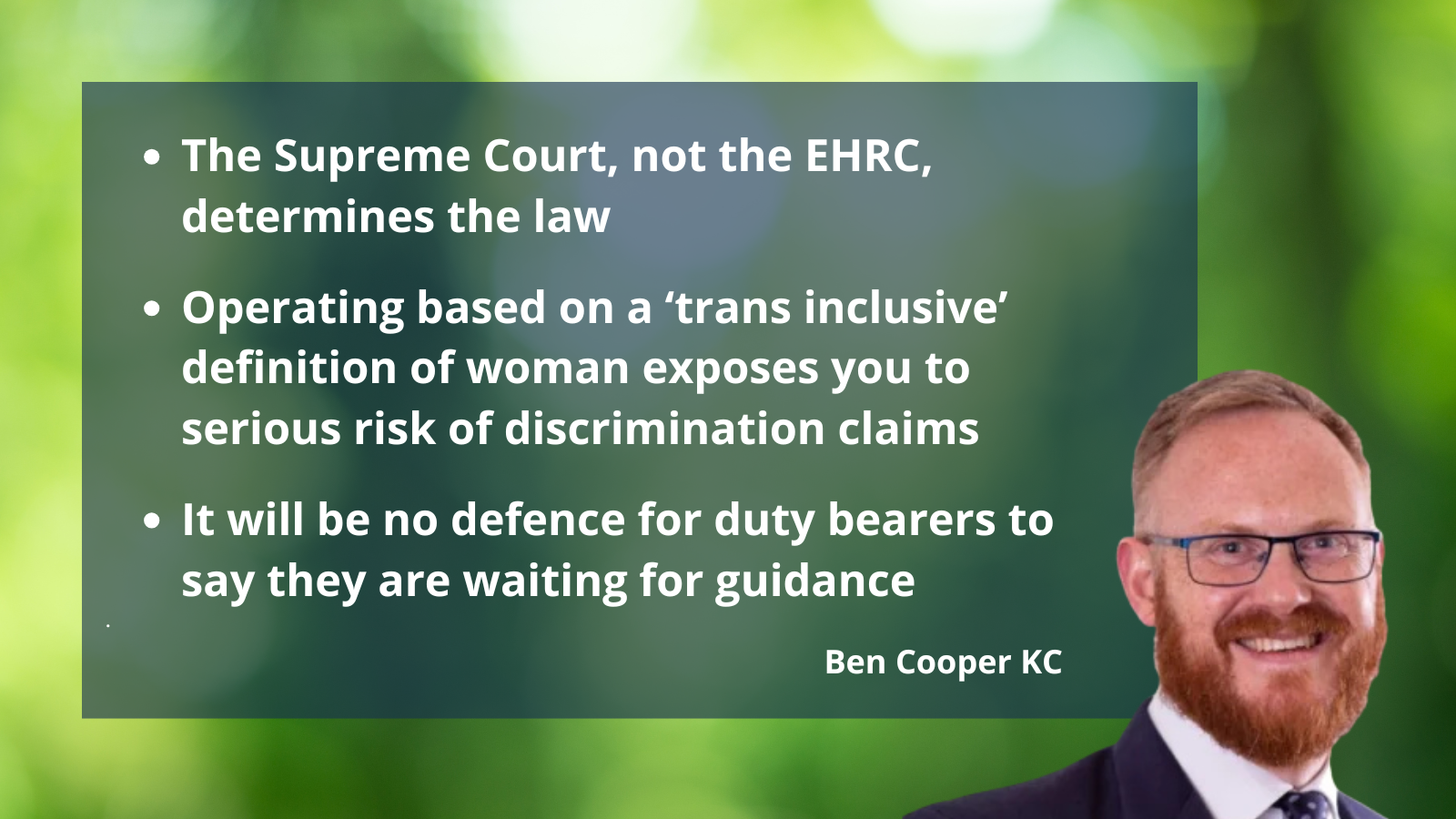
Ben Cooper KC of Old Square Chambers (who represented Sex Matters in our intervention in For Women Scotland) has written a comprehensive analysis of the practical, legal and human-rights implications of the Supreme Court’s judgment in For Women Scotland v The Scottish Ministers.
The legal analysis supports a simple, clear approach to operating single-sex and separate-sex services:
“The practical effect of the balance struck by the EA 2010, in light of the decision of the Supreme Court in FWS, is to apply a general rule that, where there are sufficiently weighty needs of one or both sexes to justify the provision of single sex or sex-segregated services, service providers should provide those services on the basis of biological sex and trans people should be excluded from the services provided for members of the sex with which they identify, but that alternative provision should be made so far as (reasonably) possible.”
The article is carefully argued, drawing on legal principles and relevant case law. It makes clear that the Equality Act protects everyone’s rights by recognising women and men as separate groups. It does not destroy trans people’s human rights, but there is a genuine and inescapable conflict of rights between women and “trans women”.
“There is no solution which will fully satisfy everyone’s interests. If some men were to be admitted to women’s services because they identify as women, that would undoubtedly interfere with the rights of some women who would (reasonably) object on grounds such as safety, dignity, privacy and/or religion. and would consequently self-exclude from potentially important services. It is nothing to the point that other women might not object: there would still be an interference with the rights of those women who do.”
Cooper says that it should be obvious to any lawyer that duty bearers who are acting outside of the law by using a “trans inclusive” definition of woman and man must act now to bring their policies into line with the law, not wait for the Equality and Human Rights Commission.
This will be a useful resource for policy-makers, regulators, standard-setters, general counsels, HR departments and others seeking a robust understanding of how the Equality Act works.
The legal analysis is clear: it is the Supreme Court, and not the Equality and Human Rights Commission, that authoritatively determines the law. If a duty bearer has current policies or practices that are unlawful, it will be no defence to any claim against them to say that they are awaiting guidance from the EHRC.
“Duty bearers would be ill-advised to [follow encouragement to wait]. All duty bearers should understand the following points (which really ought not to need stating, and certainly ought to be obvious to any lawyer):
The Supreme Court’s decision in FWS as to the meaning of ‘sex’ in the EA 2010 determines what the law is, and always has been.It is the Supreme Court, and not the EHRC, that authoritatively determines the law. The EHRC’s role is to provide guidance to assist people to understand and comply with their rights and obligations under the EA 2010; its role is not to determine the law or to interpret the EA 2010.
Therefore, if a service provider, employer or other duty bearer is currently following policies or practices that, in consequence of the Supreme Court’s decision in FWS, are unlawful under the EA 2010, it will be no defence to any claim against them to say that they are awaiting guidance from the EHRC.
So, for example, if a service provider is currently operating a service or facility for women based on a ‘trans inclusive’ definition of ‘woman’, they will be exposing themselves to a serious risk of (i) claims for direct sex discrimination by men who are excluded from that service; and/or (ii) claims for indirect sex discrimination by women who are put at a particular disadvantage by the undermining of their sex-based protections that the admission of men who identify as women into the service is likely to represent.”
Five key insights
1. There was never a question that “sex” in the Equality Act could refer to self-identified gender
The For Women Scotland case concerned the definition of “sex” in section 11 of the Equality Act. The Supreme Court was not choosing between a biological meaning and a general “trans inclusive” definition of woman and man. The position at common law was already settled that sex is binary, biological and fixed at birth. This had already been confirmed in cases including Chief Constable of West Yorkshire Police v A [2005] and Forstater v CGD Europe [2022].
The only possible meanings of woman and man in the EA 2010 were either this ordinary, common-law meaning or the ordinary meaning except for people who have obtained a GRC.
“The only possible meanings of ‘sex’ in the EA 2010 were either (i) biological sex, or (ii) biological sex, except for people who have obtained a GRC. There was never any question of ‘sex’ in the EA 2010 referring to a person’s self-identified gender, or to how they dress or present themselves, or to any other possible variation on a broadly ‘trans inclusive’ definition of sex.”
Read >> The potential interpretations of ‘sex’ available to the Supreme Court
2. The case was about protecting everyone’s sex-based rights
The fundamental purpose of the definition of sex in the Equality Act is to provide the foundation for sex-based rights and protections. Clarity of the definition is necessary:
“…to provide a coherent foundation for the protection of sex-based rights and protections, including in particular protection against disadvantages arising from the shared experiences or needs of women as a group, or men as a group. The critical question for the Supreme Court was which of the available alternative interpretations would enable the coherent application and operation, in practice, of those sex-based rights and protections.
“….A modified meaning of ‘sex’ in the EA 2010 would have meant that, despite their obvious shared characteristics, needs and experiences, the biological classes of men and women would not have been protected as such under the EA 2010.”
The Supreme Court determined that the definition of sex that enables sex-based rights and protections to be applied coherently and effectively is the ordinary meaning that relates to biology.
Read >> The core functions of the definition of ‘sex’ in the EA 2010
3. Trans people have not lost any rights
Trans people with or without a GRC remain fully protected from unlawful discrimination or harassment because of any conceivable aspect of their sex or being transgender on the basis of:
- having the protected characteristic of gender reassignment (as defined in Section 7 of the Act – this is separate from the protected characteristic of sex)
- their biological sex
- being perceived to be a particular sex or associated with that sex.
Trans people are also protected in relation to absences from work in relation to transition-related treatment.
But it was always a misunderstanding of the law that single-sex services could lawfully be provided on the basis of gender identity. Even before the Supreme Court judgment there was no legal basis for a policy of permitting trans people to use single-sex or separate-sex services based on self-identification.
“Whilst there was a widespread practice of adopting broadly ‘trans inclusive’ policies for single sex services and facilities, that was never based on a settled understanding of the law under the EA 2010, and there was certainly no legal consensus in support of such policies.
“Consequently, anyone who suggests that the effect of the Supreme Court’s decision in FWS is to ‘remove’ any settled or established ‘rights’ of trans people generally to be treated as the sex with which they identify for the purposes of the EA 2010 – including as regards the statutory exceptions for single sex or segregated services or facilities – is simply wrong.”
The article picks up a point that the Supreme Court got wrong. On the basis of an analysis presented by the Equality and Human Rights Commission, the court was under the impression that a trans person would now be excluded from equal-pay protection. The argument explaining why this does not follow from the definition is somewhat technical, but in short Cooper concludes:
“Contrary to the understanding of the Supreme Court in FWS, trans people are able to claim for both direct discrimination by perception and indirect discrimination by association in relation to pay or other terms of employment, in the same way as in relation to other types of treatment.”
Read >> What FWS means for the rights and protections of trans people
4. Protecting sex-based rights requires clear sex-based rules
The starting point for provision of single-sex or separate-sex services or facilities (and other single-sex situations such as charities, positive action and single-characteristic associations, and sport) is that they involve direct sex discrimination, which is in general unlawful. Therefore duty bearers need to rely on an exception in the act, which depends on consideration of sex-based interests:
“The EA 2010 only provides for limited exceptions to the general prohibition on direct sex discrimination where there are sufficiently important overriding rights or interests at stake. In short, this is an area where sex matters, and matters strongly.”
Since ‘sex’ means biological sex, it follows that those exceptions only permit those exceptions to operate in relation to this category.
“The effect of the Supreme Court’s decision in FWS is that, in order lawfully to operate single sex or sex-segregated services, a service provider must do so by reference to biological sex – otherwise, they cannot rely on the exceptions and must allow anyone of either sex to use the service.”
The reason for the single-sex provision must, by definition, justify the adoption of a general rule excluding all members of the opposite sex.
“It is well-recognised that a general rule may be justified where the legitimate aims in question can only be achieved by the application of such a rule, as opposed to case-by-case consideration of individual circumstances (see e.g. Seldon v Clarkson Wright & Jakes).”
The Supreme Court recognised that the kinds of legitimate aim relevant to the provision of single-sex or separate-sex services will inherently justify such general rules or policies because it would be difficult, if not impossible, to meet their objectives if some members of the opposite sex were admitted.
“The Court further explained that such aims would be intrinsically undermined if some members of the opposite sex were admitted. For example, where separate toilet or changing facilities are maintained to protect the rights of women who, for religious reasons or reasons of privacy and/or dignity, reasonably object to sharing such facilities with men, then that aim simply cannot be met if some men are admitted.”
Cooper also notes that on the face of the act the exceptions are merely permissive – in the sense that they allow, but do not require, a service provider to operate single-sex or sex-segregated services – but in practice, where the circumstances are such that the criteria are met, it is highly likely that failing to provide a single-sex or sex-segregated service would put members of one or both sexes at a particular disadvantage.
“In those circumstances, therefore, a failure to make use of the available exception in order to provide a single sex or sex-segregated service would constitute unlawful indirect sex discrimination contrary to section 19 of the EA 2010, unless justified in turn by some countervailing legitimate aim.”
Read >> Practical implications of the decision in FWS for single sex and sex-segregated services
5. There is no breach of the ECHR rights of trans people
It is clear from the judgment that the exclusion of trans people from services or facilities provided for the sex with which they identify will not constitute direct gender reassignment discrimination because they are not being treated differently to another person of the same sex who does not have a trans identity.
But it could result in indirect gender-reassignment discrimination. Measures adopted must be proportionate overall. If the disadvantage to trans people of providing sex-separated services can be reduced by providing alternative provision without compromising the legitimate aim of the overall service then it should be.
“So, for example, in relation to toilet facilities, the provision of unisex facilities alongside single sex provision for men and women would reduce the disadvantage to trans people who do not feel comfortable using the facilities provided for their (biological) sex.”
This minimal, sensible approach is not what many trans people want, but it does not undermine their human rights.
“To state the obvious, such services are not provided as a vehicle for people to express their gender identity. They are provided because there are important reasons for doing so, related to (biological) sex, which are sufficiently weighty to override the normal prohibition against direct sex discrimination.”
The right to respect for private and family life (Article 8 ECHR) which encompasses a right to gender identity and personal development is a qualified right, which can be subject to constraints when one person’s interests conflict with another set of legitimate interests. Cooper concludes:
“It is clear, in my view, that the balance that is struck by the EA 2010… does not entail any breach of the rights of trans people under the European Convention on Human Rights (‘ECHR’).”