
Good Law Project’s failed legal challenge against the Equality and Human Rights Commission
Court: High Court, King’s Bench Division (Administrative Court)
Judge: Mr Justice Swift
Date: 13th February 2026
Background
On 16th April 2025, the Supreme Court handed down a landmark ruling in For Women Scotland v The Scottish Ministers [2025]. It held that “woman” and “man” in the Equality Act 2010 refer to biological sex only, and that a gender-recognition certificate (GRC) does not change a person’s sex for the purposes of the act.
Following this, on 25th April 2025, the Equality and Human Rights Commission (EHRC) published an interim update on the practical implications of the UK Supreme Court judgment. This was to update its 2011 code of practice for service providers, which had not followed the law.
This update set out practical guidance on the implications of the Supreme Court ruling, in particular the use of single-sex toilets, washing, and changing facilities in workplaces and public services. It stated that “trans women” (biological men) should not be permitted to use women’s facilities.
The EHRC removed the interim update from its website in October 2025 in expectation that the updated services code of practice, which is statutory guidance on the Equality Act, would shortly be laid before Parliament. It was submitted to the Minister for Women and Equalities for approval on 4th September 2025 but not published until May 2026.
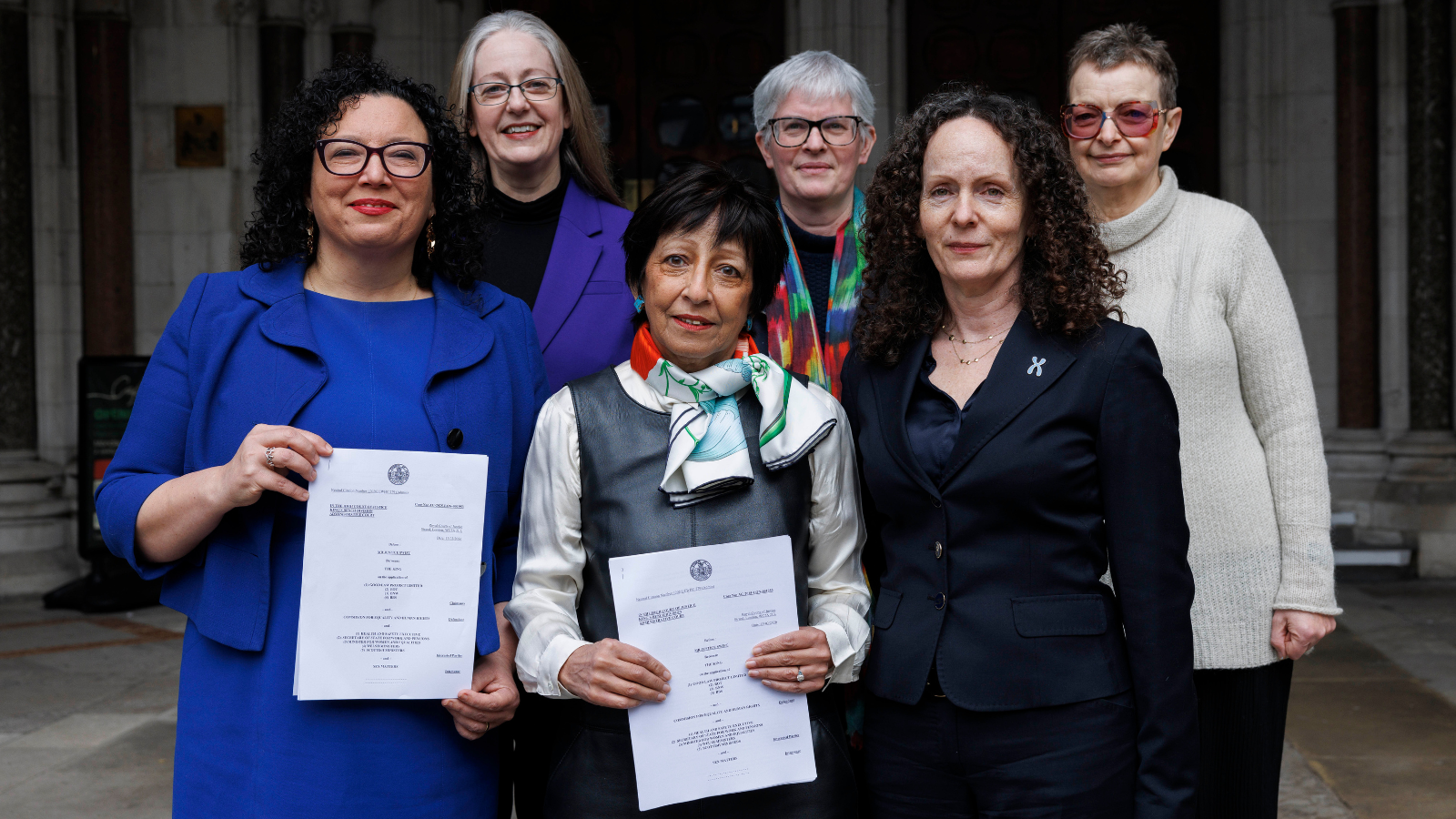
Good Law Project (GLP) and three anonymised individuals requested permission from the High Court to apply for judicial review to challenge the update. They argued that it contained legal errors and had been published in breach of the EHRC’s statutory duties. All three individual claimants said they had been instructed by their employers to stop using facilities provided for the opposite sex, directly in reliance on the update.
Following a hearing and written submissions, Judge Swift gave judgment.
Claimants
First claimant: Good Law Project Limited, a campaigning organisation.
Second claimant: BOT, a female person with a disorder of sexual development (self-described as intersex).
Third claimant: BNW, a trans-identifying male person with a GRC.
Fourth claimant: BBS, a trans-identifying female person who had applied for a GRC.
Standing
In order to pursue a judicial review claim, an applicant must have “standing”, by demonstrating that it has “sufficient interest” in a public body’s decision to challenge its legality in court (s.31(3) of the Senior Courts Act 1981). In this case the individual claimants had standing, but the judge ruled that GLP did not, because it was not directly or personally affected by the EHRC’s interim guidance.
Whether the case was academic
Before proceeding to consider the substance of the legal challenge, the judge also had to decide whether the fact that the EHRC had already removed the guidance from its website meant that the case was “academic”: that is, whether it had ceased to have any practical importance but was now merely theoretical. The judge ruled it was not, because some employers had relied on it for guidance and changed their arrangements accordingly, and those new arrangements were still in force.
The application for judicial review by the individual claimants was therefore allowed to proceed.
The Secretary of State for Women and Equalities was an interested party. Sex Matters applied to intervene and was granted permission.
The grounds
The claimants argued that:
- the guidance in the interim update was wrong in law and the EHRC acted unlawfully by publishing it
- publishing the guidance part of the interim update was in breach of the EHRC’s obligations under sections 3, 8 and 9 of the Equality Act 2006
- if, contrary to the first submission, the guidance in the interim update correctly stated requirements contained in the Equality Act 2010, those requirements are incompatible with the European Convention on Human Rights (the convention).
The decision
The High Court dismissed all three grounds of challenge, ruling that:
- the interim update accurately reflected the legal implications of the Supreme Court ruling
- the EHRC acted within its statutory powers and duties when issuing the update
- the guidance did not breach the claimants’ rights under the convention.
The court ruled that the interim update had simply explained the legal framework for single-sex services, and had correctly stated that any single-sex or separate-sex provision must be a “proportionate means of achieving a legitimate aim” under the Equality Act.
The court rejected the claim that the guidance required blanket exclusion of trans people from services in general. Employers and service providers must have regard to the dignity and rights of all people, and this may involve providing trans people access to alternatives to separate-sex services. The judge pointed out that the update was not intended to be comprehensive but merely to cover the gap until the updated code of practice was available. It was an accurate summary of the key points and could not be expected to cover every single possible scenario.
FAQs
Did GLP win?
No.
GLP failed at the first legal hurdle as it did not have the legal standing (the right) to bring a challenge.
However, even if GLP had been found to have standing, its challenge would have failed because its proposed legal arguments were the same as those made by the individual claimants whose claims were heard and rejected.
Did the individual claimants win?
No. Their case failed on all three legal grounds. The High Court ruled that the EHRCs interim update provided legally correct advice and that the EHRC acted lawfully when issuing it.
Have the claimants appealed?
On 23rd February 2026, GLP announced on its website that the three individual claimants have applied for permission to appeal. The GLP is also seeking to appeal the decision that it does not have standing.
How does the judgment define woman, man, male and female?
It states that, in line with the Supreme Court ruling, these terms refer to biological sex, that is, to the sex someone is born. This is regardless of how any individual or organisation defines “gender” and any distinction they may make between that gender and sex.
Therefore, a “trans woman” is a man and a “trans man” is a woman.
Does the judgment define gender?
No. No legislation defines “gender” as either a concept or a personal attribute. Therefore, in order to comply with the law, when employers and service providers set policies that exclude people from certain services and facilities, they must recognise that for the purposes of the Equality Act, terms such as man, woman, boy, girl, male and female take their ordinary, biological meaning. Employees and service users should therefore interpret those terms as referring to their sex, regardless of whether they possess a GRC or regard themselves as having a “gender identity”.
Must employers have single-sex facilities?
By law, all workplaces must provide “suitable and sufficient” single-sex toilets (and changing rooms and washing facilities if required) for both men and women – unless each toilet or changing cubicle or shower is an individual lockable room.
This is a statutory provision in the Workplace (Health, Safety and Welfare) Regulations 1992. It is therefore a health and safety requirement, not one under the Equality Act.
Must service providers have single-sex facilities?
Unlike employers who have strict obligations under the Workplace (Health, Safety and Welfare) Regulations 1992 to provide toilets to their employees, there is no universal statutory obligation for service providers in the UK to provide toilets to the general public, whether single sex or not. However, specific rules may apply depending on the nature of the business and its relevant local council. Restaurants with 10 or more seats must provide toilets for customers under the 1976 Local Government (Miscellaneous Provisions) Act.
What the Equality Act 2010 and EHRC’s Code does cover when it comes to service providers and toilets – along with changing facilities – is a legal obligation on service providers to not discriminate. In some circumstances it will be appropriate, for the dignity, privacy and safety of certain users to provide separate-sex facilities (and it may in some circumstances be indirectly discriminatory not to do so).
This means that where a service indicates in whatever form, including through signage, that is it for female service users, then that service is only for girls and women. It is not for anyone male to use, even if they have a GRC or identify as a girl or a woman.Service users – as well as employees – should obey this signage and stipulations. Similarly, facilities labelled as being for boys and men are not open to girls and women, and girls and women should not attempt to enter or engage with them.
Is there a contradiction in the judgment?
GLP has stated: “The High Court said that services can be trans inclusive, yet somehow decided that the EHRC’s interim guidance was lawful.” Is GLP right that this is a contradiction in the judgment?
There is no contradiction between the judgment stating that services can be trans inclusive (that is, mixed sex) and its conclusion that the interim update was lawful. When the judgment states that services can be trans inclusive, it means in a generic sense – the entire range of services on offer – and not specifically in reference to single-sex services.
Trans-identifying people can in general use the single-sex service that corresponds to their sex, but it is understood that they may feel uncomfortable doing so, and would therefore not regard single-sex facilities as being “trans inclusive”.
However, many service providers already provide mixed-sex facilities, either as well as or instead of single-sex ones, and are therefore “trans-inclusive”. Services that are not designated for one sex only are automatically “trans inclusive” as they are for everyone. Common examples are single-user unisex toilets.
Therefore, a service as a whole can be trans-inclusive even if single-sex elements are not.
Does the judgment allow service providers to provide “trans inclusive women’s toilets”?
GLP states that it is “lawful for service providers to allow, for example, trans women to use women’s toilets and changing rooms (and vice versa for trans men.”
This is not correct. As GLP notes, the High Court ruled that: “The [interim update] concerned when it would be permissible for a service provider to make a single-sex provision. It does not exclude or prohibit other provision.”
However, this does not mean that it would be lawful (or practical) to provide facilities labelled as being for male and female users but which also allow members of the opposite sex to use them based on their gender identity.
Dealing with the question of whether it is direct sex discrimination to exclude men from women’s toilets and vice versa, the judge said:
“I consider there would, in principle, be scope for a strong argument that a rule or practice that permitted trans women to use the “female” lavatory but required other biological men to use the male lavatory would comprise different but not less favourable treatment on grounds of sex [towards the excluded men]. However, the circumstances of the case would be decisive. (For the purposes of the EA 2010 the lavatory would be mixed-sex, but for the purposes of the Claimants’ submission in this case it would still be labelled “women”.)”
The judge was not answering here the question of whether it could also be indirect or direct discrimination and harassment towards women to provide facilities labelled “female” and then allow men (who identify as trans or non-binary) into them.
What is clear is that it is lawful to provide men’s facilities, women’s facilities and unisex (solo-use) facilities, and that with these three options everyone is provided for.
The Good Law Project suggests that: “an employer could provide single-sex women’s toilets alongside women’s toilets which both cis and trans employees were permitted to use”. This seems impractical and likely to lead to confusion and potential unlawful conduct since it requires labelling one set of toilets as “mixed-sex” but also “women’s”.
Did the judgment state that excluding trans-identifying people from using toilets of the opposite sex may amount to gender-reassignment discrimination?
No, it did not. This is one of the grounds on which the claimants are appealing the judgment. The claimants believe that the interim update should have warned that excluding trans-identifying people from the toilets and changing rooms of their chosen ‘gender’ could amount to gender-reassignment discrimination. The Court, however, ruled that regardless, the update was lawful.
Did the judgment say that provision of toilets for trans-identifying people should be considered?
Yes. It pointed out that an employer or service provider has a duty to consider the dignity and privacy of all workers and service users. Both sex and gender reassignment are protected characteristics. Employers and service providers should provide services that everyone can use. In most situations this will mean providing or sign-posting solo occupancy facilities or mixed-sex facilities.
How can employers and service users best meet their obligations regarding toilet and changing facilities?
Employers and service providers should take any steps necessary as soon as possible to ensure they are legally compliant. In practice this means providing, to the best means possible:
- either fully solo occupancy toilets and changing facilities
- or both single-sex toilets or changing facilities and also mixed-sex or solo-occupancy facilities: for example, providing women’s toilets, men’s toilets and a unisex accessible toilet.
What an employer and service provider can reasonably provide will depend on many factors including physical space and the number of employees and service users.
The judgment notes that there are potentially scenarios involving conflicting protected characteristics that have not yet been addressed by either statute or case law. It is therefore impossible for any guidance or statutory code of practice to cover all of them.
The judgment also notes that there are situations where it may not be possible to follow these legal obligations to the letter. For example, it is acceptable in an emergency when some facilities aren’t operating properly for a service provider to turn a men’s or women’s toilet temporarily into a mixed-sex one.
The judgment notes that a male cleaner going into the women’s toilet to clean it (ideally of course with notice) does not stop the women’s toilet from being single sex. Nor does a woman bringing her young son into the female toilet, or a man taking his young daughter into the men’s. These are all commonplace scenarios which reasonable people understand are necessary in the course of normal cleaning and caring responsibilities.