
Keeping children safe in education: better than before
The government has published the final version of the statutory safeguarding guidance for schools in England, Keeping children safe in education (KCSIE), which will come into force in September 2026. There were very few changes from the version published for consultation in February.
It includes sections on single-sex spaces (paragraphs 105–116) and single-sex sports (paragraphs 95–98), as well as a long section on “children questioning their gender” (paragraphs 252–282).
In December 2023, under the previous government, the Department for Education published draft guidance on “gender questioning” children, to which we gave a score of 76 percent based on our published scoring framework.
We said it should:
- Support schools in line with the law
- Provide coherent, consistent guidance across the education system
- Direct schools to collect sex-based data
- Uphold the Admissions Code
- Uphold single-sex spaces
- Uphold single-sex sports
- Avoid undermining safeguarding
- Rule out full social transition in school
- Uphold freedom of belief and speech
- Support clear sex-based rules and consideration for gender non-conforming children.
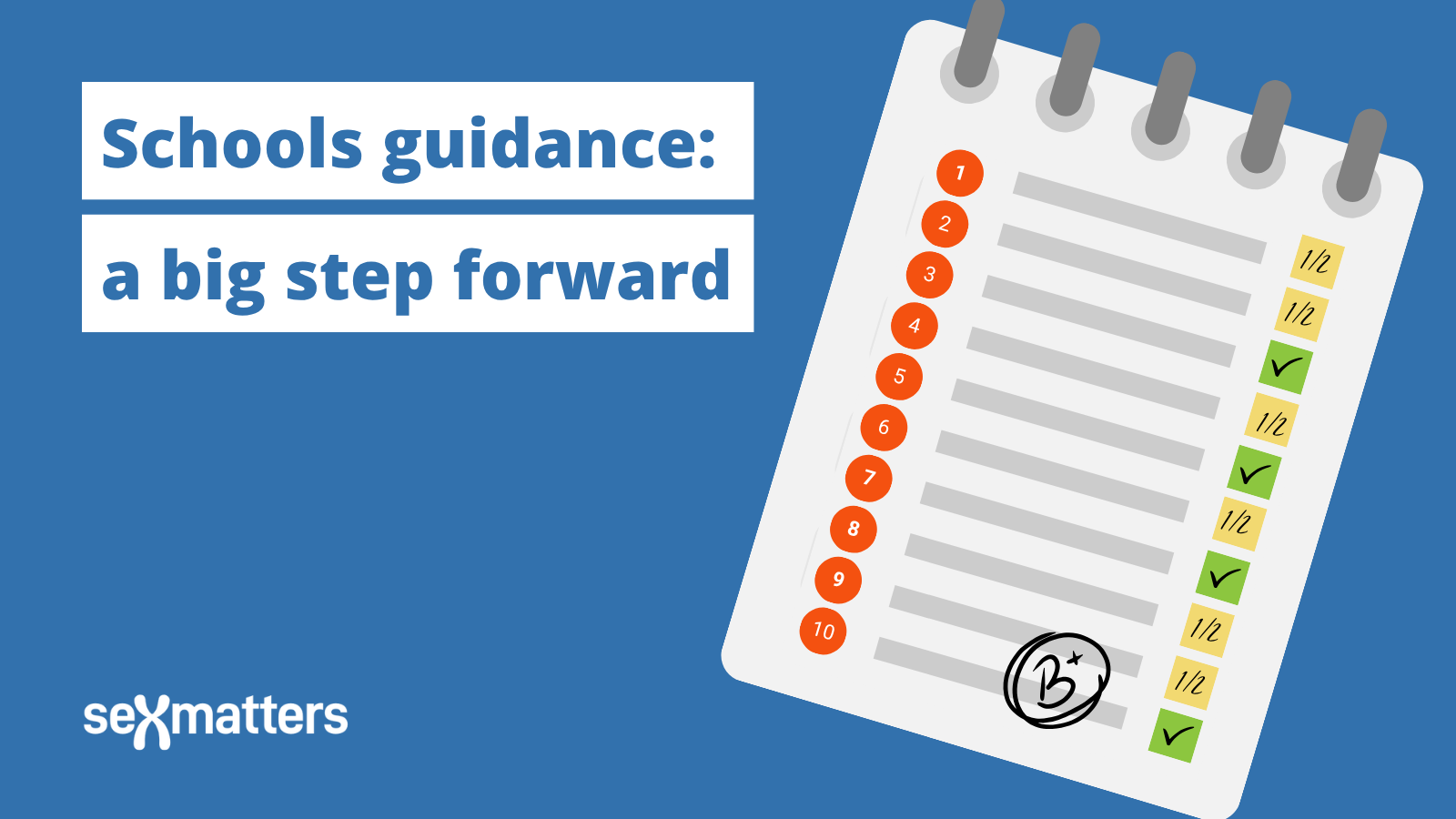
We have applied the same scoring framework to the new guidance and it comes in at 79 percent, with the improvement largely due to it being brought into the statutory safeguarding framework and having been made shorter and clearer.
There are, however, still some concerning aspects. Although the guidance is in line with the Equality Act in making clear that separate-sex facilities are not negotiable – no child may be permitted to use spaces designated for the opposite sex, no matter how that child identifies – it tries to reconcile this firm principle with the idea of “social transition” at school.
It defines this as facilitating “the child presenting as the opposite biological sex”, despite ruling out steps such as using opposite-sex facilities or being recorded as being the opposite sex. But by raising the possibility of “social transition” in school, it opens the door to negotiation and pressure, even though any school that works through the guidance accurately will inevitably conclude that the only fair and safe way to set policies that differentiate between girls and boys is to be clear who the girls are and who the boys are.
Helpfully, KCSIE says that schools should not initiate social transition, which should stop activist teachers promoting it. But it still leaves schools having to negotiate with activist parents who want their child to “socially transition” at school, and who may be highly motivated.
1. Support schools in line with the law
7/10 – The guidance has been put on a statutory footing and ties into existing sex-based laws and regulations, including the Equality Act and regulations concerning school premises. It says that school governing bodies and proprietors:
“must have regard to this guidance, ensuring policies, procedures and training in their schools or colleges are effective and comply with the law at all times.”
By putting the advice about use of single-sex facilities within KCSIE, the government has placed compliance within the remit of school inspections. The result will help clamp down on activist teachers promoting transition.
The new gender-related material within KCSIE is shorter and clearer than the previous draft guidance, but it suggests that children may in rare instances be able to undertake “social transition” in school, which it defines as facilitating “the child presenting as the opposite biological sex”.
2. Provide coherent, consistent guidance across the education system
7/10 –The guidance is clear that schools cannot allow children of any age to use opposite-sex toilets and changing facilities, or (in most situations) to play sports designated for the opposite sex. It applies to all schools, both state and independent, and will be covered by the inspection regime.
It also makes clear where the Equality Act and regulations concerning school premises apply differently to 16–19 academies that are outside the “further education” sector. It says that these colleges may be covered by part 3 or 5 of the Equality Act 2010 and still need to comply with the law.
The guidance will form part of the inspection of safeguarding, where leaders are expected to “take an effective, whole-school approach”. However, while in practice it rules out many aspects of “social transition”, it still suggests that children may (rarely) transition at school, including what it calls “full social transition” at primary school. It does not explain how this can be consistent with the rest of the guidance.
3. Direct schools to collect sex-based data
10/10 – The guidance is clear that no child can change their sex at school, and under the section on “correct information” it states that:
“schools and colleges are legally required to record a child’s biological sex accurately wherever it is recorded.”
4. Uphold the school admissions code
7/10 – The guidance does not mention admission to single-sex schools (the previous version made clear that schools are not required to admit a girl “as a boy” to a boys’ school or a boy “as a girl” to a girls’ school). It should be obvious that it is not possible to safeguard a girl in a boys’ school or a boy in a girls’ school while pretending that child is the opposite sex.
The guidance does address the question of children already “in stealth” at school. It says:
“Schools and colleges should be particularly conscious of the vulnerabilities of children who have fully socially transitioned from an early age and may be living in stealth (that is, school or college friends/staff may be unaware of their biological sex). The Cass Review emphasised that these children are likely to approach puberty in a fearful and anxious state. Schools and colleges should involve the designated safeguarding lead in these cases.”
The idea that a child can be admitted to school “in stealth” as the opposite sex is not consistent with the legal requirement that all children’s sex must be correctly recorded wherever sex is recorded (such as in the admissions register and school information system).
5. Uphold single-sex spaces
10/10 – The guidance has a clear, dedicated section on the law on school premises in relation to toilets, changing rooms and residential accommodation, which it ties into the safeguarding inspection framework:
“In line with the responsibilities of schools and colleges to adhere to the highest standards of safeguarding for the children and young people in their care, alongside obligations under the School Premises (England) Regulations 2012 and the Education (Independent School Standards) Regulations 2014, schools must not allow pupils into toilets, changing rooms, or boarding or residential accommodation designated for the opposite sex, with no exceptions. Colleges to which part 6 of the Equality Act 2010 applies should follow the same principles.”
6. Uphold single-sex sports
7/10 – The guidance correctly says:
“Where schools have implemented single-sex sports as being necessary for safety reasons, there should be no exceptions and pupils must not be allowed to participate in sports designated for the opposite sex. Colleges should follow the same principles.”
However it also says:
“Where there are no safety concerns and a child makes a request relating to how they participate, schools and colleges will need to consider the request in light of the advice on ‘considering requests for support with social transition’. This means that the school or college would need to take into account all the relevant factors, including whether supporting social transition is overall in the best interests of the child, as well as considering the impact on other children and the aim of creating safe and fair environments for children to participate in PE.”
We don’t think there is any basis for this. Whether for fairness, safety or the encouragement of girls in sport, single-sex sports should be single sex. Gender non-conforming children should not be discriminated against or harassed in participating in sport with their own sex.
While there is a general principle that decisions about children should be made with the child’s best interests paramount, this part of the guidance appears to consider making complex clinical decisions in the context of deciding which PE team a child can play on.
The guidance does recognise (at paragraph 275) that both fairness and safety are legitimate aims for separate-sex sports.
7. Avoid undermining safeguarding
8/10 – Putting the guidance into the statutory safeguarding framework is a big step forward. However, including the possibility of “social transition” and the concept of “gender” is inconsistent with the parts of the guidance that are clear about sex. It will provide opportunities for organisations to continue to undermine safeguarding by encouraging children and their families to think that children may be able to “present as the opposite sex” during their school career.
The guidance also misses the opportunity to underline that gender identity should not undermine sex-based rules and behaviour codes in other parts of the guidance, such as harmful sexual behaviour – harassment, coercion or sex by deception – by trans-identifying pupils, and those children’s vulnerability to online harms and radicalisation. Any child disclosing that they are considering adopting or have adopted a cross-sex identity is disclosing a safeguarding risk.
It does not mention other safeguarding risks such as children breast-binding and taking off-label banned drugs or “DIY” cross-sex hormones.
8. Rule out full social transition in school
7/10 – The guidance rules out large parts of what is commonly included under that label, such as recording a child as the opposite sex, allowing them to use opposite-sex facilities and letting them participate in most sports with children of the opposite sex.
But it uses the term “social transition” 31 times, and leaves the door open for other, undefined, aspects of social transition to be negotiated. This presumably means pronouns and uniform, although they are not covered in any detail.
Paragraph 275 explains that schools and colleges should consider how their policies affect children with the protected characteristic of gender reassignment, both when developing policies and when considering requests to be exempted from following them. When a rule or policy places a gender-questioning child (and other gender-questioning children) at a disadvantage compared with those who are not gender-questioning, the school or college should consider:
(1) Does the policy have a legitimate aim, for example, safeguarding or fairness in sport?
(2) Is the policy a proportionate means of achieving that legitimate aim? This will involve considering:
- whether there is another way of achieving the same aim. Might a policy be adopted or an exception made that still achieves that aim?
- the impact of the rule, or of making (or not making) an exception on the child themselves and anyone else affected. The school or college should balance the impact of agreeing to the child’s request against the impact of refusing their request, taking into account all the relevant factors. This will include taking into account the school or college’s judgment about whether supporting social transition is in the child’s best interests and the best interests of other children.
In practice, if schools refer to children by words used for the other sex or allow them to wear the opposite sex’s uniform it will be difficult to maintain clear expectations and rules.
9. Uphold freedom of belief and speech
7/10 – The guidance says:
“The school or college should also make sure that children and their families are aware that while the school or college will appropriately sanction any cases of bullying or harassment, and take a strong stand against bullying, the school or college must also be conscious of the rights of pupils and staff in relation to their religion or belief. However, schools and colleges supporting social transition might consider discussing options with pupils and staff such as using names instead of pronouns.”
This is the only mention of pronouns in the guidance.
10. Support clear sex-based rules and consideration for gender non-conforming children
9/10 – The guidance says that:
“schools and colleges should consider adopting policies across school and college life that maintain flexibility and avoid rigid rules based on gender stereotypes.”
Avoiding gender stereotypes is a good principle. But encouraging “flexibility” while suggesting that children may be able to undertake social transition creates ambiguity and room to negotiate.
Total 79%